Tuesday, June 21, 2005

Diaoyu is our land!

So it's not just the Koreans who have maritime territorial disputes with Japan. A Taiwanese warship has been sent to the fishing grounds around the disputed Diaoyu Islands (called the Senkaku Islands by the Japanese) in an apparent show of strength after complaints of harassment by Japanese patrol boats.


Location of Diaoyu Islands.

China also claims these islands (not to mention, all of Taiwan, which in turn claims all of China, so there).

Tokto/Takeshima redux? Listen to Parliament speaker Wang Jin-pyng and decide for yourself:
This area belongs to us historically, geographically, and legally. We must defend our sovereignty and protect our fishing rights.
Or how about this from a Taiwanese fisherman:
It's good to see it's finally our turn to scare the Japanese. They have always bullied us and make us feel we are thieves at sea.
And from opposition parliamentarian May Chin:
The entire nation is waiting for the government to show its guts and stand up to Japan.
According to the BBC, Taiwanese fishermen have been protesting against being frequently driven out of the waters by Japanese patrol boats. This is all a bit odd considering how so many critics of China and the Koreas have cited the Taiwanese people's love of Japan as a sign that at least one former colony didn't really mind former colonizer Japan's increasing militarism.


Wang Jin-pyng points at disputed Diaoyu Islands.

And just as Japan's Tokto declarations have led some Koreans to think they'll have a better ally in Beijing, some Taiwanese fishermen have reportedly called for protection from China, Taiwan's historical arch-rival.

While it would be tempting to gloat a little that Japan is having almost the same problem with another "ally," I really wish Tokyo (and Seoul, and now Taipei) would get their act together and see that they have far, far more in common than they realize, and they make better friends than adversaries. Just as important, they all need to stand together in the face of a rising China.

Monday, June 20, 2005

Engineering animosity toward Japan


Reason is nectar.
Emotion is wine.
Anger is vinegar.
Hatred is acid.

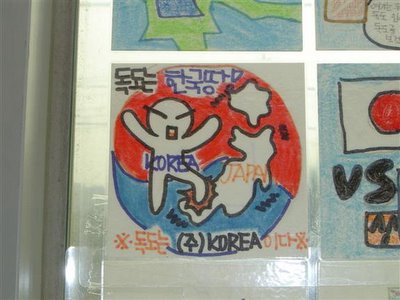
The teachers and subway employees who are behind the creation and display (at Kyulhyŏn Station [귤현역; NAKL: Gyulhyeon] in Inchon) of these children's works about Tokto should be ashamed of themselves for trying to instill such animosity in young children.

People who would actively try to promote such hatred in impressionable young minds are simply not fit to be teachers.

ADDENDUM TO POST:
This update comes many months later, after the first five comments left below. Anyway, when I first heard about this, I made plans to go to Kyulhŏn Station to see the whole thing for myself, and perhaps lodge a complaint. But then came news that the display had been taken down a few weeks earlier than its scheduled "closing date." I called and asked, and I was told that there had been local complaints (i.e., people from the area had complained directly). I asked if foreigners had come to see the display, and I was told yes. There was no mention of the foreigners specifically being the ones to complain. It was more of a generic "people in the neighborhood," which one would assume to be primarily Koreans. Had it been primarily "foreigners" who had complained, I think that would have been stated.

At any rate, after looking into this some more and discussing it with a few people, I am almost certain that teachers of the far-leftist, neo-Marxist, pro-Pyongyang Korea Teachers Union, also known by their former Korean acronym Chonkyojo, were behind this. If you want to know who is teaching animosity in schools—not just against Japan but also against the United States, the Korean government, anyone perceived to be "too rich," free-market capitalism, etc.—this is your main culprit.

As a main part of the chinbo (literally "progressive," but some of the groups in this umbrella clearly distort that word's positive intent) movement, they are responsible for inculcating Korean children with pro-Pyongyang, anti-Seoul, class-conscious, anti-capitalist, anti-Western views. In schools where their leftist textbooks have not been authorized, the Chonkyojo teachers use Chonkyojo-approved "teachers guides" to supply the Cumings-esque viewpoint (after Bruce Cumings, the University of Chicago historian whose Pyongyang apologist pap is a staple of Korea's radical far left "thought").

Until just a few years ago, in fact, this radical labor union was outlawed in Korea (former President Kim Daejung legalized them as a way of breaking away from Korea's hard-line past), and mainstream educators distrust members for their far-leftist views.

Current President Roh Moohyun, who has stocked his cabinet with government ministers who are so far left you can't see them because of the curvature of the Earth, is trying to force private schools (40% of all schools) to accept local advisors on the school boards. This is nothing more than an invitation for Chonkyojo teachers to make their way onto the boards of even private, supposedly independent schools. Needless to say, the private schools haven't been taking this lying down.

One final note. The original poster who presented this display was very liberal in using the phrase "Fuck Japan!" in his explanations of what was being said in the various pictures. For those who don't read Korean, this might lead to an inaccurate impression of what the Korean words were saying in some cases. Often, the words accompanying the pictures were far milder than that bit of profanity would suggest.
... 

Sunday, June 12, 2005

Tragic story below the radar

On Friday night I had drinks with some people associated with US interests here in Seoul. They recounted the very stressful afternoon they had in the wake of news that a 51-year-old Korean woman had been killed by a vehicle driven by a USFK truck at 2 p.m. that day in Tongduch'ŏn. With reports that there were already to be vigils marking the third anniversary of the two junior high school girls tragically killed by a USFK military vehicle in 2002, which sparked a major wave of anti-Americanism that year, there was a great deal of concern that a new round of angry protests would be coming.

I went to bed on Friday night without looking at any news sites, fearing it would make me too upset about the ensuing chaos. The next morning, I was surprised at what I found -- or didn't find.

The Korea Times carried the above linked story that US President George W. Bush, meeting with South Korea President Roh Moohyun, had expressed condolences to the family of the accident victim. His words at the beginning of their joint appearance:
I first want to express my country’s deepest condolences for the accident that took place, where a U.S. military vehicle killed a Korean woman. And we send our deepest sympathies to the woman’s families. And Mr. President [Roh], I just want you to know our hearts are sad as a result of this incident.
This was done with amazing swiftness and tact, no doubt helped along by the focus on the two leaders' potentially tense meeting. But I believe it was also reflective of the US embassy in Seoul and USFK learning that they need to handle Korean grievances more swiftly and with more care. I have long asserted that most South Koreans want the US military presence in Korea to remain (some enthusiastically, some grudgingly), but they want the US military to remain as small a footprint as possible.

Among a variety of things, that "small footprint" means (for some) few or no foreign troops in the capital (something based on historical reasons), bases that don't occupy huge tracts of prime real estate, and a US military population that is perceived as playing by the rules and behaving themselves.

To be fair, the USFK's reputation for crime may be somewhat exaggerated, with anti-Americanism pushed along by agenda-driven segments of the press that promote anti-USFK, anti-American, anti-Japanese, anti-business, anti-this, or anti-that sentiment. I have also frequently asserted that if even half of what the average Korean finds in the media were true, that would be reason to be very, very upset.

So I was fully expecting at least some parts of the press to be making a big deal out of this tragic story. But there it wasn't. Some news sources carried no stories in English at all, and few in Korean.

Was it Bush's nearly instantaneous apology (matched by an as-swift USFK apology), the type of treatment Koreans have long complained Washington gave to Tokyo but not Seoul? Was it careful treatment by the Korean media, which has learned the painful lesson that constant bashing of the US really can damage the US-ROK alliance and make some Americans consider leaving? Was it the lack of outrage on the part of the Korean viewers/readers, who can distinguish between negligence and an unavoidable accident?

Japan's bereaved families speak out against Yasukuni visits

A lot of Japan apologists who make excuses for Japanese Prime Minister Junichiro Koizumi's visits to Yasukuni Shrine, where Class-A war criminals whose actions and decisions terrorized and brutalized much of East Asia, make excuses ranging from, "You don't understand the peaceful meaning of the visits," to a more in-your-face, "It's not your country, so butt the hell out!"

Lots of Japanese are aware that the Yasukuni Shrine visits by Koizumi do cause seriously strained relationships with Japan's continental neighbors, especially China (where violent protestors made Koreans look like the sane ones). It's actually not too hard to find people opposed to the visits.

But the right-wingers in Japan continue to visit, claiming that to not do so would be an insult to the war dead. So it is interesting to see in today's Kyodo that Nippon Izokukai (the Japan War-Beareaved Association), headed by former LDP Secretary General Makoto Koga and a major supporter of that party, has issued a statement on the PM visits.
[Having prime ministers paying homage at the shrine] has been an ardent wish of the association and we appreciate it very much but, at the same time it is most important that the spirits of the war dead rest in peace. It is necessary to give consideration to neighboring countries and obtain their understanding.
One major policy of the association is to have regular Yasukuni visits by Japanese prime ministers, but the statement urged Koizumi, in an unusual move, to consider the criticisms of neighboring countries such as China and South Korea.

Kyodo reports that the statement also said politics should not be brought into the argument about whether Class-A war criminals should be separately enshrined from the war dead.

The association, however, expressed their opposition to the building of a separate shrine, an act which some have said would resolve the issue. The association considers Yasukuni Shrine as "the only memorial facility for the spirits of the war dead" and thus opposes establishment of any new facilities for the war dead in the future. They also oppose separate enshrinement of the Class-A war criminals.

Still, it's important to hear that even many on the right in Japan recognize that it's not in Japan's best interest to go pissing off the neighbors.

Saturday, June 4, 2005

Inch'ŏn and the Ryugyŏng Hotel

Note: This post is also known as "the China Rant."

Here's an odd bit of peninsula news from yesterday. We all knew that Inch'ŏn has been trying to jointly hold the 2014 Asian Games with P'yŏng'yang, but the new twist is that the mayor of Inchon said his city will invest the equipment and money needed --about half a billion dollars (or more) -- to fix up and finish Pyongyang's 105-story Ryugyŏng Hotel, the 300-meter-high unfinished phallic shell that dominates the Pyongyang skyline like the water tower in a Minnesota town. (Marmot's Hole has a good intro on this).


The Ryugyong Hotel is the pointy thing in the background.

What does it mean if they fix up the hotel? Yes, it means SK money and equipment pumped into NK, but it also means that Pyongyang will end up allowing a whole bunch of South Koreans (and others?) up into North Korea. Not just in controlled areas like Kaesŏng and Kŭmgangsan or even Najin, but in the heart of the country: the capital.

And I think this is part of the point of the gradualist approach to reunification: aiming not toward collapse of the system, but of a creeping in of southern/Western values for two purposes. First, this gradual influx of capital, infrastructure, and know-how will make things a hell of a lot easier when reunification does come. And second, the more and deeper these connections are, the harder it is for the regime to control thoughts and ideas, which helps build up a critical mass of perception of both the outside world and the inside world, which may become very crucial at some future crisis point in the regime's existence, leading to an East German-style throwing-in-of-the-towel rather than a going-down-with-both-guns-blazing scenario from the military or some other "leadership."

Of course, there is the problem with all the refugees and the starvation, which this seems to fail to address. But are the two mutually exclusive? Can't these ties be fostered while also providing food aid? Of course they can.

But then there's the ugly idea that these ties are actually propping up the Pyongyang regime, forestalling the collapse of the Kim Jong-il regime, thus prolonging the torture and death of many more.

But is this really true? Is South Korea's "Sunshine Policy" really forestalling their collapse while a hard-line approach would hasten their demise? I don't think the evidence is there, considering that nearly fifty years of the latter did NOTHING to lead to Pyongyang's collapse, and perhaps the greatest number of famine-related deaths occurred as a result of policies and actions took during that time.

In other words, decades of a hard-line approach did NOT lead to the collapse of the northern regime and it did not prevent the deaths of hundreds of thousands or millions. Thus, calling the so-called "Sunshine Policy" of engagement morally bankrupt because it props up Pyongyang is a bit specious.

And it also ignores a very, very important point, that there is another elephant in the room we choose to ignore: China.

It is China that props up Pyongyang. China. That's right: China. China props up Pyongyang. It is not Seoul, it is China.

South Korea could double, triple, quadruple, halve, or eliminate (zeruple?) its investment in North Korea and it would make little or not difference on when and if Pyongyang collapses. China controls that switch.

I think this is why it bothers me so that conservatives are so quick to bash Seoul for its political and economic engagement with the North while virtually ignoring Beijing's role. Seoul is playing the piss-poor hand it was dealt, but it is China that set up the table and the rules.

Bash Beijing if you're going to criticize Seoul.

But who is doing that? Virtually no one. China is a major economic cow to be milked, so we don't criticize China. We don't criticize China for torturing its own citizens, much less actively rounding up North Korean refugees and sending them back to North Korea where they will likely be tortured and imprisoned, likely forced to do hard labor, and possibly killed.

We don't criticize China for keeping Pyongyang propped up even though they know that North Korea is a human rights nightmare that makes China look like a kindergarten by comparison.

No. We send them billions up billions of dollars in investment instead.

But we criticize every step South Korean government or business takes as part of the Sunshine Policy.

Not only is this hypocritical, but it may also be counterproductive. At least the Sunshine Policy has a shared goal (eventually) with the hardliners: eventual elimination of the North Korean regime and absorption of North Korea into South Korea. The difference is in tack: Sunshine Policy seeks to kill with kindness while the "Moonshine Policy" (Dr. Lee Jungmin of Yonsei) seeks to isolate it and let it die a quicker death.

But China has no such goal in mind. It wants its buffer state against Japan and the US (and perhaps Korea and democracy in general). It wants to keep propping up Pyongyang. It does not share the goals of Sunshine Policy. China is the culprit. China is country responsible (beyond North Korea itself) for keeping Pyongyang afloat.

China.

The People's Republic of China, whose government still shares, nominally at least, a communist ideology with the Democratic People's Republic of Korea.

China in which we invest tens of billions of dollars and then tens of billions of dollars more. China which gives us cheap electronics to buy at Walmart. China.

So what am I advocating? Am I saying we should slap sanctions on China until they come around on North Korea? That may not be practical, given how deeply enmeshed we are, economically, with the People's Republic of China.

But it does mean two things: we need to recognize that China is the one that needs to be pressured. We need to make China feel comfortable -- or less uneasy -- with the prospect of a democratic and capitalist and unified Korea at its doorstep and allied with the US and Japan. We need to plant the idea in Beijing's head that they can and should flip the switch on Kim Jong-il. Whatever that entails.

And second, stop beating up on South Korea for the Sunshine Policy. It's not anti-US. It's not even pro-North. It's an attempt to try something when the hardline way failed to work after half a century. It will take time, if it works at all.

Now, having said that, I do think there are some things that are deserving of criticism. The Roh administration and much of the press seem to go overboard not to offend Pyongyang or Beijing, almost to the point of kowtowing to them.

In particular, I think that Roh's policy of preventing the refugees from coming here to South Korea crosses the line: it is not necessary to do so from a Sunshine Policy perspective, and it borders on moral repugnance. But again, the true culpability falls on Beijing, which is rounding up these North Koreans and sending them back. South Korea is merely slowing its process of accepting them, at a time when few other countries -- including the United States -- are willing to accept any North Koreans except those who make it to that country's shores on their own.

South Korea is given the Hobson's choice between continuing Sunshine Policy unabated but turning down the volume on the refugee issue or endangering Sunshine Policy progress, which (its proponents believe) could end up causing more good in the long run. Both choices may lead to considerable losses.

But Beijing is the one with the real choice: actively maintain its agreement with Pyongyang to round up and send refugees back to North Korea, knowing that they will likely be tortured and possibly killed, or tone down or even end the round-ups and let the North Koreans stay in China or quietly go to South Korea or some other country.

Ultimately, it is China's choice, not South Korea's. China, our economic partner.

Finally, and this is perhaps an entirely different issue, is the idea of Inch'ŏn taxpayers subsidizing a P'yŏng'yang hotel. I'm a Seoul taxpayer, but if I were an Inch'ŏn taxpayer, I might be livid.

But people will do strange things for civic pride, like building stadiums for sports franchises or for Olympic bragging rights. The 2014 Asiad that Inchon and Pyongyang are trying to jointly hold could lead to a 2020 Olympic bid for one or both of them (though I think the only way Pyongyang will get the Olympics anytime soon is as a nod to a newly reunified Korea).

But this does bring an odd twist: would, say, Detroit build subsidize a new stadium in Windsor, Ontario, just to get a sports franchise in the area? Would Seattle do this even for Vancouver, Washington, much less Vancouver, British Columbia? I couldn't even see Los Angeles County doing this for Orange County (not that we need it, because we have Disney dollars).

Thursday, June 2, 2005

Bill for World President

In late February, when former President Bill Clinton came to Seoul for a booksigning, I had a chance to meet him at the Kyobo Bookstore in Kangnam. Either he is really tall, or I am really short, since he towered over me.

He was gaunt — a result of his bypass surgery — but he powerfully shook my hand and spoke to me in his charmingly gravelly voice. I carried on a very brief conversation with the man while he signed my copy of his book, My Life.

"It's an honor to meet you, Sir. I voted for you twice."
"Well, thank you. So what do you do here in Seoul?"
"I blog*."
"That's just great."

Anyway, there has long been talk about Bill lobbying to become the next UN Secretary-General, a position for which he is eminently qualified. And if that really happens, it would be a needed balance to the image of Bush's America that does whatever the hell it wants to for whatever reasons it wants to.

This talk apparently isn't just talk, according to this article in the Washington Post.

*Actually, I told him something else, but I'd rather not say here.

Wednesday, May 25, 2005

Dismantling stereotypes about overseas adoptees

Overseas adoption has long been somewhat common in the United States, Canada, and Europe, and there have long been stereotypes and biases regarding children adopted from Korea, China, Colombia, Romania, Mexico, Russia, etc.

An article in JAMA (Journal of the American Medical Association), however, says that many of the stereotypes of overseas adoptees as "problem kids" are simply not true: international adoptees have fewer behavior problems than domestic adoptees.

The money quote:
Most international children who are adopted are well-adjusted and have fewer behavioral problems than children who are adopted domestically, according to an article in the May 25 issue of JAMA.
This is a big issue, with 40,000 children per year moving between more than 100 countries, according to the JAMA study's authors, Femmie Juffer, Ph.D., and Marinus H. van Ijzendoorn, Ph.D., both from Leiden University in the Netherlands. They used medical literature from 1950 to January 2005 to estimate the effects of international adoption on behavioral problems and mental health referrals.

The authors acknowledge that prior to adoption, "international adoptees often experience insufficient medical care, malnutrition, maternal separation, and neglect and abuse in orphanages." But this doesn't translate into long-term problems, as their analysis "showed that the majority of international adoptees are well-adjusted."

They do acknowledge that international adoptees do have slightly more of such problems than non-adoptees (the control group in the research), but that "the effect sizes were small."

Surprisingly, age at adoption was "not important for the development of behavioral problems." But the authors warn that "clinicians should be aware of higher risks for problem behaviors in domestic adoptees and in international adoptees who experienced neglect or maltreatment in the preadoptive period." This, of course, would be true even for children raised by their biological parents.

In Korea overseas adoption is a big issue. Prior to the Olympics it was considered natural that children of mixed ancestry, or children whose parents had died or couldn't care for them, would live better lives if adopted by loving parents in North America or Europe.

But the American media—particularly NBC—cast a negative light on the situation, depicting Korea as a nation of "baby exporters." Domestically, the embarrassment from this unfavorable press resulted in a very strong movement to end overseas adoption. Overseas adoptions were to end in 1996, with exceptions made for "mixed" children (honhyŏra, 혼혈아; or honyŏrin 혼혈인) or children with physical or mental disabilities. This caused an outcry of a different kind: Korea was now seen as a cruel country just trying to get rid of its "undesirables."

The problem was that the overseas adoption debate in Korea was being driven by concerns about the rising economic star's public image, not by the best interests of the children involved. There were many Koreans who supported the continuation of overseas adoption for the sake of the children. These proponents pointed out that there were too few people willing to adopt a child in this increasingly prosperous country, primarily because of the strong emphasis on blood ties within a family structure.

But opposition to overseas adoption remained high, with the public exposed to media designed to mold their opinion. The 1991 movie "Susan Brink's Arirang" stood out among the anti-overseas adoption fare. This well-acted movie, starring Choi Jinshil [최진실], depicted the life of real-life Susan Brink as told through her autobiography. With an emotionally abusive adoptive mother, her life in Sweden was quite difficult, and it made her miserable enough to attempt suicide.

Many Koreans were touched by the film, which also showed interviews of actual European adoptees from Korea telling how much they hated Korea and the biological parents who gave them up. With so little evidence to the contrary, many Koreans were convinced that overseas adoption was cruel and must be stopped.

The necessity of finding homes for thousands of children without homes ended up being the deciding factor, and the 1996 deadline came and went. But the issue does occasionally rear its ugly head. I say the "issue" has an ugly head, because overseas adoptees, like children of mixed ancestry, are enjoying something of a renaissance. At the very least, it is much less common for them to be viewed as freaks or undesirables. Many are greeted "back" with special programs and outreached arms.

And in this respect, the report in JAMA can only help things. People in Korea can feel good that—despite the propaganda to the contrary—overseas adoptees are generally leading happy and healthy lives.

Friday, May 20, 2005

Send in the clones!

I'm still reeling from a grueling chemistry final and my mind is in a science-oriented mode. And just in time for that, today's issue of the prestigious journal Science reports that South Korean scientists have created the world's first human embryonic stem cells that are customized to injured or sick patients. This is considered a crucially important step toward growing patients' own replacement tissue to treat diseases, which is one goal of proponents of cloning research.

These are the same scientists who are headed by Dr. Hwang Woo-suk of Seoul National University, who created a lot of buzz for Korea's cloning industry (which they completely copied from the Japanese and the Americans!) last year when they became the first to clone a human embryo.

The clonings last year were a genetic match to a healthy woman, not a sick person. But now the Korean scientists have cloned patient-specific stem cells, which is important to prevent rejection by the body's immune system.

The "subjects" were males and females from two to fifty-six, all suffering either spinal cord injuries, diabetes or a genetic immune disease. But, they warn, therapy is still years away from being tested.

The same lab also found ways to more quickly and more safely cull stem cells with far fewer donated eggs. It only takes twenty per try.

Not that Korean women are really using their eggs that much, evidenced by Korea's all-time low fertility rate of 1.15 births per woman. Maybe the government could utilize cloning to create more babies, which could be raised by the beneficent state in special centers to turn them into productive members of society (hat tip: Aldous Huxley).

UPDATE (December 15, 2005):
Ah, crap.

Saturday, May 14, 2005

Korea versus Corea

NOTE TO VISITORS FROM GORD SELLAR'S ARTICLE ON ANTI-JAPANESE DRAWINGS BY KIDS IN THE SUBWAY: That is one old post at Gord's, but I still get lots of hits from there. Although I think Gord's post is important, it is also misleading. Please take a look at the addendum in this post, particularly the first and last paragraphs, for a bit of perspective on the issue and on Gord's somewhat distorted presentation. (2009.01)

REVISED NOTE: This three-year-old post, easily the most widely popular I've written, is pretty much okay as is, just a little rough around the edges toward the bottom. Some day, when I don't have work and school and serious family issues, I may try to polish it up, but for now it's good to go. (2008.05)

ORIGINAL NOTE: This post is still a work in progress (I had asked people not to link to it, but nobody paid any attention, so I'm officially withdrawing that request), but I'm going to keep it up here as I go along. I'll remove this paragraph when it's ready for prime time. Hopefully I'll have time to polish it up after finals (2005.11). In the meantime, all the information presented is accurate to the best of my knowledge.

ORIGINAL POST (2005.05):
Back in 2002, during the FIFA World Cup, Korean stadiums were awash in a sea of red-shirted spectators. There was a giddy month-long national celebration as Korea's home team shattered all expectations and made it to the semi-finals of world soccer.

Amidst all this, considerable irony abounded, with partying fans wearing the Konglishy "Be the Reds!" t-shirts (irony because this nation-loving display had an inadvertent pro-communist message), and, after making a big deal about Korea's name going first in the 2002 Korea/Japan World Cup name, so many people were displaying banners, signs, etc., with Korea spelled with a C: hence the signs rooting for Corea.

Indeed, this Korea-versus-Corea spelling issue is something that bubbles up from time to time. Most recently (as of this writing), a member of the National Assembly even put forward a bill in 2003 to change the official spelling of the country's name to Corea. (The linked article refers to the "allegation that Korea is a vestige of Japanese colonial rule over the nation.")

The K-v-C issue is not new. In fact, it has become a symbol of pride for uber-patriotic Koreans to label themselves Corean and their homeland Corea. Google yields 6.08 million hits for Corea, 220,000 hits for Corean, and 12,500 hits for Corean-American in quotations (though google did ask, "Did you mean, 'Korean-American'?"). Corea is a badge of honor to wear in the fight against imperialistic and racist forces, both real and imaginary.

But I am getting ahead of myself. I am introducing a value judgment about the K-v-C issue without having first explained how I came to the realization/conclusion that this entire issue is hogwash. A red herring designed to whip up anti-Japanese sentiment.

The argument goes that Japanese authorities conspired to use their nation's power in order to change Korea's traditional spelling of Corea to Korea so that Japan would come before Korea in any international forum.

Indeed, it is an irrefutable fact that Korea was at one time spelled as Corea, largely because of French influence in the 19th century. The usage of Corea is an indisputable part of the historic record, with numerous official items showing the official and unofficial spelling of Corea. Sometime in the late 19th century and early 20th century, however, both official Korean usage and unofficial usage clearly came to favor Korea.

That Japan was behind the spelling change in order to come out ahead of Korea is an interesting hypothesis, but it is full of holes in the form of logic and fact. The story is verifiably false for the following reasons:

1. No one has ever been able to come up with hard, conclusive evidence that such conscious decisions were ever made.
When the Japanese government denied official involvement in the mobilization of Comfort Women during World War II, historians combed through document after document to prove them wrong. Japanese historians xxx and xxx found the evidence to show that the Japanese government's denial of official sanction was a lie.

If the Japanese still had records that would implicate the government in something so heinous as the creation and mobilization of the Comfort Women corps, it would stand to reason that the decision to change Corea to Korea would be documented somewhere, too. Yet it has not turned up.

The member of the ROK National Assembly who proposed in 2003 that Korea be changed to Corea does say he has seen a document indicating that Japanese officials complained of Koreans using "Corea" to spell the country's name, which was seen as a sign of nationalism. I have not seen this, but it may well have been that the official was complaining of Koreans not using Chosen, the Japanese pronunciation of Choson, not that he was complaining of Korean spelling. This is purely speculative on my part, but well grounded. Nevertheless, you will see that this is not relevant.

Link to Barbara Demmick article on K-v-C issue, which includes mention of the apocryphal story (my description, not hers) that Japan changed the spelling in time for the 1908 Olympics in London. Note that the Korean Olympic Committee was formed in 1946, before the Republic of Korea was officially established, and in time for the 1948 Olympics when Korea made its Olympic debut (South Korea also participated in the 1952 Olympics in Helsinki, despite the Korean War raging at the time). Simply put, Korea was not one of the 22 countries that participated in the 1908 London Olympiad.

Of course, the lack of such records is not at all irrefutable evidence. Arguably, it is not evidence at all, since there could be a whole host of reasons why a document may exist (or once existed) but hasn't turned up. Fortunately, this is the weakest piece of evidence why the Korea-versus-Corea issue is nothing more than a red herring. I only mention it because it is the first sign that the pro-Corea argument simply doesn't hold water.

2. As ruler over a Korea that had been absorbed into Japan, there would be no reason for Japan to be concerned with how Korea's name appeared in international forums.
Sohn Kee-chung (Son Kijŏng), known as Kitei Son in Japanese.

1930s medal commemorating Olympic marathon gold medalist Kitei Son (the Japanese pronunciation of Son Kijŏng), an ethnic Korean who, as a Japanese citizen, participated on behalf of Japan. His English name is officially spelled Sohn Kee-chung.

3. The name Korea was used in official government materials long before the Japanese took over Korea.

stamps (although Japanese helped make them)

1884 Korean stamp labeled as Corean Post.

1900 stamp from Imperial Korean Post.


Chosŏn imperial-era 50-poon stamp identifying country as Korea.


Postcard issued by Imperial Korean Post.
passports


Imperial Korean passport issued by The Imperial Korean Foreign Office.
This evidence is not new. In fact, pro-Coreans counter this argument by pointing out that Japanese influence in Korea was strong well before 1910 when Japan annexed Korea, and even before 1904 when Japan began plans in earnest to not just control Korea but absorb it into Japan. Going back to Japan's 1895 victory over China in the Sino-Japanese War, the Japanese government and Japanese individuals had been exerting considerable influence on Korea's politics and its economy.

That is why exhibit #4 is rather important.

4. The Japanese authorities continued to use Chōsen or the Corea spelling during their rule of Korea.

This is where my argument goes beyond that of most others who have debunked the Corea myth. The ultimate way of demonstrating that the Japanese authorities were not behind the Korea spelling for any kind of malicious alphabetic purpose is that they continued to refer to Korea using two spellings that begin with C.

Chōsen, for those of you who are not aware, is the Japanese pronunciation of 朝鮮, the Chinese characters that represent Chosŏn (Joseon in the atrocious NAKL writing system) the name of the Korean kingdom (1392-1910) begun by Yi Sŏnggye (later King T'aejo) at the end of the 14th century. The Japanese continued to use 朝鮮 to refer to Korea, as do the North Koreans even today (although the North Koreans tend to write it in Korean script, 조선).


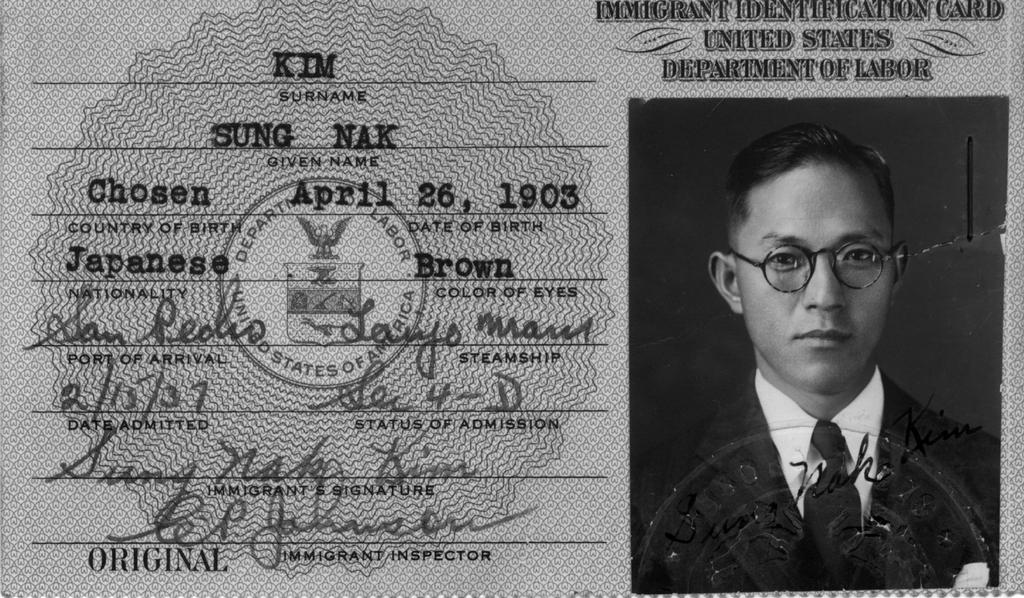
1937 "green card" (U.S. alien registration card) of Japanese national listing Chosen as country of birth.


The same U.S. Immigrant Identification Card of ethnic Korean of Japanese nationality showing country of birth as Chosen.


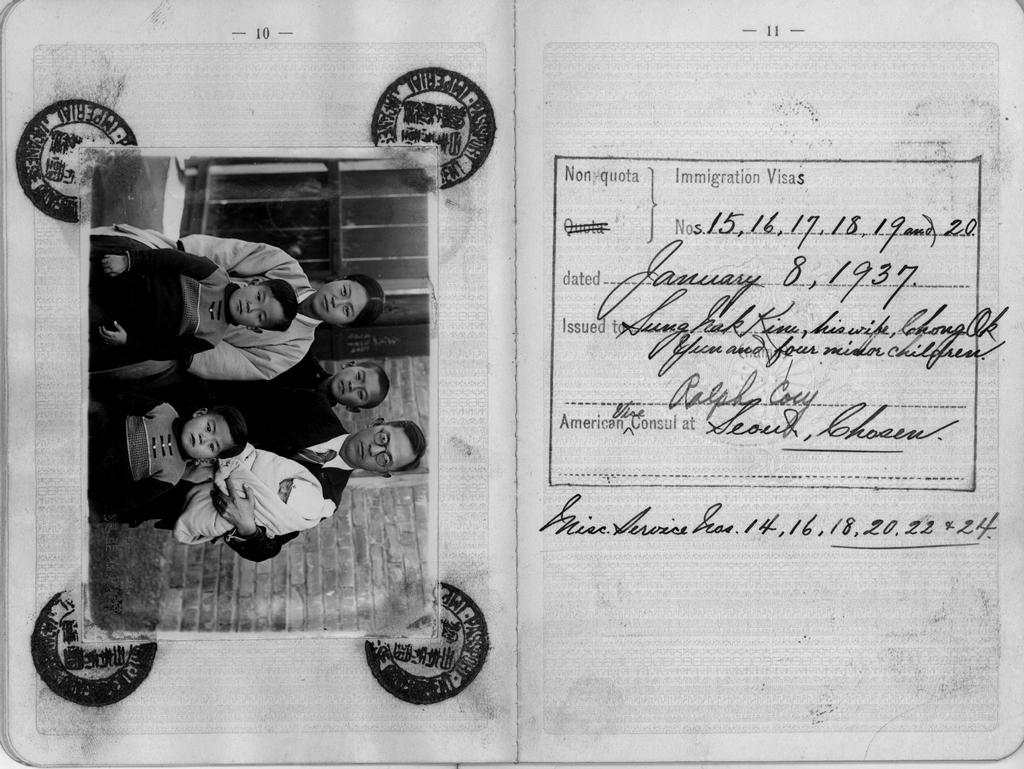
Imperial Japanese passport with U.S. visa stamp issued by American Consul at Seoul, Chosen.

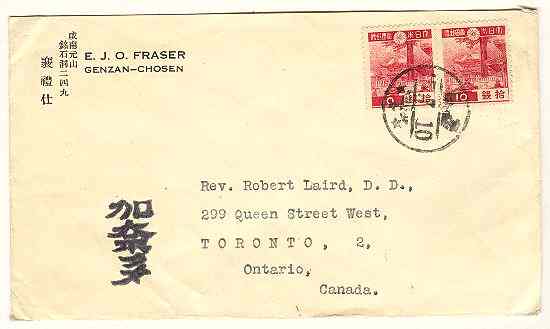
1939 postcard with Chosen stationery.

Japanese occupation-era postcard with Keijyo, Chosen postmark (Keijyo, a later alternate spelling of Keijō, is the Japanese pronunciation of Kyŏngsŏng, or 京城 , the Japanese name for Seoul).


Japanese occupation-era postcard with Corea in postmark.

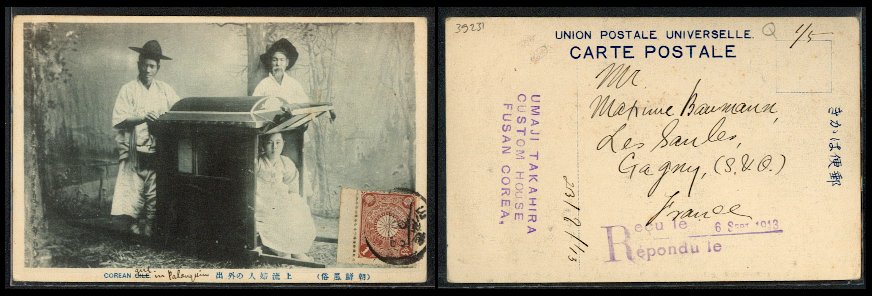
Japanese occupation-era postcard with Custom House stamp issued by Umaji Takahira at Fusan, Corea (Fusan is the Japanese pronunciation of Pusan).


Japanese consul stamp from Kensan, Corea.


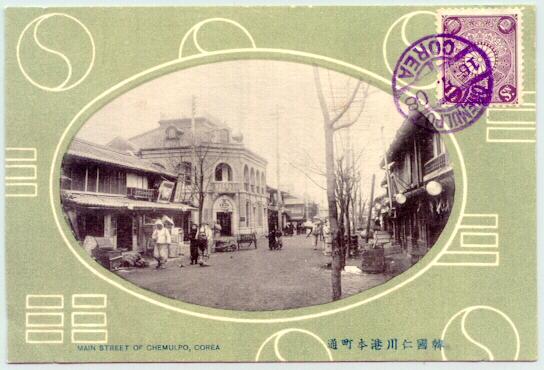
Postcard of Chemulpo, Corea with postmark from Chemulpo, Corea (Chemulp'o is the older name of port area in modern-day Inch'ŏn).


1923 postcard postmarked from Kinsen, Corea (Kinsen is the Japanese pronunciation of Inch'ŏn).
To sum up:
1. There is zero solid, documentary evidence that Japan officialdom ever set out to change Corea's spelling to Korea.

2. Having absorbed Korea, Japan would have no need to worry about whether Korea would come above it or below it in an international forum.

3. Korea's royal and imperial governments began using the Korea spelling before Japan started wielding sufficiently hefty influence over Korea around 1904.

4. The Japanese continued to spell Korea's name with a C (as Chōsen or Corea) when they controlled Korea.
The evidence is clear for anyone who wants to look into it. This is all the more reason it is so irresponsible for organizations and companies to jump on the Corea bandwagon: they are unwittingly buying into an argument exists to promote animosity toward another country.

It is also true that some, such as the artist linked here, feel that even if it is not true that the Japanese imposed the Korea spelling, the Corea spelling "represents the lost memories of a pre-occupation pre-war unified Corea, without North and South, without a communism versus freedom connotation. At the very least, it gets people to ask why I spell it like that and learn a little about Corean history, even if they disagree or do not care."

That may be fine, but what kind of history are they learning? The Corea spelling as a modern issue is inextricably tied to attempts to whip up animosity against another country.

And what exactly does Corea hearken back to? It was the spelling of the country when its people were suffering under the weight of a corrupt and oppressive monarchy that was often unable or unwilling to meet the challenges of a new era, which helped Korea become swallowed up by Japan.

Please don't get me wrong, a great deal of horrific things happened at the hands of imperial Japan prior to 1945. And it can be argued that modern-day Japan's current leadership is not facing up to that legacy with the genuine contrition that would be needed for Japan to move forward with the countries it once invaded, occupied, and brutalized. But I feel that the actual atrocities of occupation, forced labor, mobilization of the Comfort Women sex slaves, etc., are enough by themselves to make Koreans take pause when regarding Japan without making up new insults and injuries.

If anything, these fabrications diminish what has actually happened to real people at the hands of the Japanese. It is an insult to the Comfort Women and the forced laborers, for example, because it says to those people, "Sorry, but your actual suffering is not enough for us to whip up anger against Japan, so we have to make stuff up."

... 

Saturday, May 7, 2005

Keep them dogies trollin', rawhide!

I have been called a troll over at Curzon's place. Mutant Frog himself assures us that neither I nor Plunge are trolls.
Kushibo and Plunge are hardly trolls. They're having a debate, trolling is when you start calling someone gay or insulting their mother, comparing someone to Hitler or Stalin, wishing them dead, etc- basically the kind of activity that destroys civil discourse. You shouldn't accuse someone of that just for disagreeing.
That's right. Everyone knows that comparing someone to Hitler or Stalin is a big no-no, on the Internet or in real life.

Unless you're comparing Hitler to Stalin, I suppose. Or vice-versa.

This post is utterly pointless. And no one will probably read it. But Nora says that I must write something on my blog periodically or else it will be up for grabs thanks to terra nullius.

Friday, April 29, 2005

Unscrupulous White Dudes reveal the Inscrutable Occidental?

UPDATE:
Asian Media Watch reported last week that Hyundai Motor America and Cingular Wireless have withdrawn their advertising from NJ 101.5. A press release stated that, "Hyundai Motor America shares the outrage of many in the Asian and general communities about the racial slurs made on radio station WKXW on the 'The Jersey Guys' show on April 25, 2005... the company is deeply offended by the program and would never want to be associated with insensitive statements that reflect negatively on the Korean and Asian communities."

ORIGINAL ARTICLE:
"Ching chong, ching chong, ching chong!"

A lot of Asian groups are up in arms over a radio broadcast on Trenton, New Jersey, radio station 101.5's "The Jersey Guys." Below is a transcript (courtesy of Asian Media Watch, a group whose opinions about what is problematic I don't entirely agree with) of the offending material by hosts Craig Carton and Ray Rossi.

Is this the true America (and I'm not asking this rhetorically)? Do these guys represent what the average White dude and dudette thinks? My heart would say, "Oh, please, God, I hope not," which would be supported by hundreds of non-Asian friends and relatives who simply don't think this way, but sometimes--based partly on some of things I've seen and heard with my own eyes and ears--I wonder if this is not the way a lot of Caucasians in the US talk and act behind closed doors or when they think no one non-White is listening.

In Korea I here complaints that the Koreans (or the Japanese) harbor racist, superioristic, condescending attitutudes toward the "foreigners" in their midst. And it is no doubt true that many Koreans are racist, superioristic, and condescending toward 외국인, with some being in your face about it and others keeping it to themselves. This keeping it ton oneself while presenting a more pleasant and acceptable public face contributes to the old stereotype of "the Inscrutable Oriental." Well, I guess I have to ask, is there a corresponding "Inscrutable Occidental," and did these guys just out every one of them?

You be the judge.

[Continued]

Craig Carton: "Would you really vote for someone named Jun Choi [said in fast-paced, high-pitched, squeaky voice]?"

[Continued]

Craig Carton: I’m using Jun Choi [said in fast-paced, high-pitched, squeaky voice] as an example of a larger problem.

Ray Rossi: and you know…

Carton: We’re forgetting the fact that we’re Americans.

Rossi : You know that he’s going to get the… whatever that vote is

Carton : And here’s the bottom line... no specific minority group or foreign group should ever ever dictate the outcome of an American election. I don’t care if the Chinese population in Edison has quadrupled in the last year, Chinese should never dictate the outcome of an election, Americans should.

Rossi: Americans should, exactly

Craig : And it’s offensive to me… not that I have anything against uh Asians…I really don’t… i don’t like the fact that they crowd the goddamn black jack tables in Atlantic City with their little chain smoking and little pocket protectors..

Rossi: Now now now..that’s an issue with me..

Carton: I’m just saying, now that’s all Asians, not just Koreans…you know… you got Pai-Gaw poker playing.

Carton: My point is on a much larger stand..

Rossi: I understand… but you see you had to put that out there…

Carton: We’re bending over backwards to cater to fringe groups of people and I don’t like it!

Rossi: As long as we understand where you’re coming from… with the, uh poker table group...

Carton: Well go to AC for one week and try and get a table… ‘ching chong, ching chong, ching chong [Mimics Chinese accent..] hehe you hit it on 17 you stupid bitch… the dealer’s got a 5..im holding an 18…what’re you hitting for… you know? They do it all day and night…they got their little beady pocketbooks with the little beads on it… they take out wads of 100s… ching chong ching chong [accent] they don’t know how to play the game… eh, honey i got a 13 and I’m playing against a 6…

Rossi: Hehe, their money is green too!

[Laughter]

Carton: There should be like Asian-only rooms in casinos… but just to be fair, I have nothing against them…

Rossi: No, of course not

[laughter]

Carton: Very good people… very nice people...

[Commercial Break]

Carton: Asian Americans factoring in the Edison race, Korean native and mayor both court the growing segment… uh I’ve said it about the Arabs about 4 months ago, I’ve said it about uh… you name a group that’s suddenly important in politics, other than Americans as a whole and I got a problem with it… I’m not nitpicking any one specific group... I don’t like… like when Corzine came out and said…I’m counting on the Arab community to get me elected… right then and there you lost my vote!

Rossi: Well, but… you see what it is…

Carton: He was over at the Nordic lodge of Rhode Island… cuz I go to this place where its like 60 bucks for all you can eat… and I thought he was lying to me

[Unrelated Topic]

Caller: Good, hi are you guys?

Carton: Doing good, babe.

Caller: It’s government for the people of the people and by the people and as long as you guys became American citizens and now have the right to vote, why not have them vote for someone who they feel comfortable with and will take care of their issues…

Carton: Well… I’m glad you called with that… god-forsaken disgusting liberal viewpoint, uh mickey…

Caller: I’m not a liberal at all… it’s by the constitution of New Jersey…

Carton: Well, you are a liberal by definition… by definition you are a liberal….if they’re here legally and they’re Americans, I think they ought to vote for… [mocking falsetto voice] no no no…that’s liberal by definition… so let me explain to you what the problem is with it mickey so you can be a little bit brighter at the dinner table tonight, ok?

Caller: Ok

Carton: They are Americans, they have every right to vote. I will never deny them that, you know my grandparents came over here, they wound up with the right to vote and they’re very proud of it… same with Ray’s and most of our listeners’… they also have the right to run once they become Americans, and I don’t begrudge them that either, my problem is this: when we start focusing our campaigns on the minority of people and not the majority of people, I find that to be problematic… anybody running for office, whether it’s the Mayor of Edison or the Governor of New jersey, the focus should be what’s good for the breadth of people, what’s good for everybody, and its obnoxious to me, although I understand it’s a business, and its how you can get elected, if you say out loud, well if I can simply get the Asian vote I can win the election..

Rossi: Now that’s what it is…

Carton: And that’s what problematic to me… much as like we give DMV exams in Spanish, and French, and in Swahili, we’re getting away from what our core is and that is America..

Rossi: Which is true…

Carton: And I’m troubled by it… and I don’t wanna hear a candidate, whether they’re Chinese, or white, or black, saying oh if I can only get the Chinese vote I can win… well what about me? I’m… see… I’m the average guy, that’s why we’re successful, Ray and I represent the average guy in NJ, blue collar white people…

Rossi: There you go.

Carton: And no one gives a damn about us anymore…

Rossi: That’s right.

Carton: And if we cry about it… you know what’s brought up? Slavery... or if we cry about it… well you know, ching chong, ching chong [Mimics Chinese accent] you bombed us [Chinese accent] you know? The fact is, I don’t care if whites are a minority, it doesn’t matter to me, there’s no voice of the average blue collar white guy anymore, cuz all these politicians are worried about the fringe groups.

Rossi: Well that’s the thing…

Carton: God forbid you offend an Asian, really! And I hate it… god forbid that a politician was out here and offends Asians, or blacks, or old people… but at the end of

the day, I’m the guy that’s gonna get them elected…

Rossi: There you go.

Carton: And they don’t give a damn about me!

Rossi: Nope.

Carton: Well the second Thursday in May they will… cuz Ray and I are hosting the only in-state debate amongst at least the Republican candidates…

Rossi: That’s right

Carton: Almost all of them confirmed, is that right , C-dog?

C-Dog: That’s right.

Carton: It’ll be myself, Ray Rossi and Bob Ingle of the Gannet newspaper chain and every guy running for uh... governor on the Republican side will be here in studio because you know… we care! And were not gonna let these guys cater to minority groups simply cuz it makes them look good.

Rossi: Exactly

Carton: You have to cater to me, bitches.

Rossi: Hmmm, that’s it.

Carton: I’m the rain maker.

Rossi: Look at that, the rainmaker

Carton: Well, that’s a little cocky though

Rossi: Well, no, that’s a tad on the cocky tip but that’s alright, that’s okay.

Carton: It’s May 12th by the way, 4pm… If you’re running for governor, you’re invited but you have to go through C-dog cuz I don’t know want weedman showing up… ‘No, you guys said I was invited, I’m running… Typical keeping it brother… No he’ll wanna ask some of the questions… [Mimics voice]

Rossi: Right

[Laughter]

Carton: All right… here’s Sharon in Edison NJ on 101.5. How you doin’ Sharon?

Caller: Hi, I love you

Carton: Thank you.

Caller: You just said it all, the last couple of … callers, I guess they don’t know that they live in America and we’re being overrun. I had just moved out of Edison because of what has happened in the past 10 years… Orientals are all along, the whole complete route 27. And Indians have taken over Edison in north and all over.

Carton: Damn Orientals and Indians.

Caller: I..i moved out..36 years I’ve lived in Edison

Carton: And what was the biggest problem you had with the Orientals and the Indians ?

Caller: I can’t handle them! There’s no American people anymore.

Carton: Eh..

Caller: There shoving us the hell out!

Carton: It’s like you’re a foreigner in your own country isn’t it?

Caller: You go to own store and you can’t even see American people, you don’t see our own kids, American kids, working in stores anymore…

Carton: Like the next time you see an American, you think you’ll probably hug him or high five him or something?

Caller: Oh, that’s why where I moved too, that’s all I have, thank god for now anyways.

Carton: Yeah I’m with you… Sharon, we’re just the voice of the people, and I appreciate your call.

Caller: Keep up the good work.

Carton: All right, you got it baby… I think the quote was damn ‘Orientals and Indians.’

[Child rendition of American anthem on and fades into background]

Carton: That’s right baby, who wrote this, a white guy did!

Carton: By the way, did you see the girl singing the national anthem in the Canadian/US hockey game over the weekend?

[Unrelated Topic]

Carton: Listen I love my country, I’ll never make any excuses for that… and I think the majority should be catered to, not the minority

Rossi: Correct That’s how I feel… ["America, The Beautiful" song on and fades into background]

[Commercial Break]

Carton: Alright, in Edison, this is just another example of us losing our own country…the uh… Asian American candidate "Jun Choi" [said in fast-paced, high-pitched, squeaky voice] and uh… he’s capitalizing on the rapid growth of the Asian community in Edison, but so is his uh… I guess so is his competitor…

Rossi: Well, his competitor is doing the same thing.

Carton: Spadoro says " I’ve got the Asians on lockdown."

Rossi: Right exactly

Carton: Now if I was an Asian I guess I don’t know I’d vote for the Asian. Well I mean haven’t you done that before?

Rossi: Who knows my needs better than…

Carton: Haven’t you?

Rossi: Yeah, I used to vote for the Italian…

Carton: You know what?

Carton: Yeah, thinking that his corrupt ways would benefit me in the long way run.

Rossi: So did I, when I didn’t know what the hell they stood for I just say (phh) go Italian.

Carton: Look how good that did us. Look at the hole we’re in now. Nice move jack ass thanks.

Rossi: Well what do you want me to tell ya, I tried.

Carton: You da one responsible for Florio.

Wednesday, April 27, 2005

Update on past articles

UPDATE 1
The man described by North Korea as "human scum," John Bolton, is finding his nomination for U.S. Ambassador to the U.N. in trouble, in part because of the fiery speech he gave here in Seoul about North Korea.

UPDATE 2
The new pope does not speak Korean.

"Anything But Clinton" North Korea policy a failure?

The New York Times has an interesting opinion piece on the Bush Administration's apparent failures vis-à-vis North Korea.

Op-ed writer Nicholas D. Kristof points out that under the Clinton Administration, North Korea developed zero weapons, but under the Bush Administration, the number is around six, hence his title, "North Korea, 6, and Bush, 0)."

Before a Clinton naysayer can respond that the speculative Pyongyang-6 were likely started by the infamous Pyongyang-1 during Clinton's second term, Kristoff quickly cites Charles Prtichard, the ambassador and special envoy who was the point man for North Korea in the first Bush administration, as saying of this administration's decision-makers, "They blew it." (Kristoff also claims that Pyongyang had two atomic weapons by 1989, during the administration of Bush-41.)

How did they blow it? Kristoff says the Bush Administration could have adopted the policies that Colin Powell initially pushed for but that Bush's handlers pushed off in favor of what people call the "anything but Clinton" approach.

I remember back when Bush first came to office, before 9/11 and before Hainan Island, and admitted that his administration didn't have a North Korea policy, that they were "working on one" while they decide what to do. That our leader could leave us adrift in the East Sea (or Sea of Japan) for several months like that is almost criminally stupid.

But that's what happened, because "anything but Clinton" was essentially nothing. And that's why, years later, Bush finds hiimself with the same options as Clinton did.

The Rush Limbaugh types so derided Clinton for engaging North Korea and making a deal (and yes, this is something I've listened to repeatedly with my own ears on AFN Radio), there was no way Bush could go down that same road, even though a more pragmatic and less ideological Republican would have at least continued his predecessor's policies until something better presented itself (or could be engineered). Much like how Clinton continued to follow his predecessor on containing Iraq and protecting the Kurds.

Yes, there is something inherently off-putting about making a deal with a murderous dictatorial regime, but there were few other options before Clinton short of war, which has a tendency to kill one's allies. Getting things to stop, while simulaneously hoping for a collapse from within (or a change, thanks to engagement) was the best that could be managed then. And probably now.

But Bush instead sought to raise Pyongyang's own anxiety level (and thus their justification for getting nukes in the first place) by stepping up its own rhetoric against Pyongyang. Was there a strategic purpose in the terms "Axis of Evil" and "Outpost of Tyranny" that outweighed the danger of ratcheting up tensions? Your diplomats don't seem to think so, Mr. Bush.

Kristoff does see hopeful signs that Bush is slowly showing signs that he is willing to negotiate (although a test at Yongbyon could reverse that). At this rate, Kristoff suggests, Bush may be willing to negotiate seriously with the North Koreans by the time he leaves office.