Showing posts with label Yasukuni. Show all posts

Sunday, August 28, 2011

Blatant apologism

If you've read my posts discussing the infamous Imperial Japanese apologist Gerry Bevers (here, here, and I guess here or even here), then you would know that I find comments like this from Mr Bevers so gallingly ignorant:
DLBarch wrote:
I could not agree more. One of the perplexing dynamics within the expat communities in Japan and Korea is that expats in Japan seem to overwhelmingly be card-carrying apologists for the country and members in good standing in the Chrysanthemum Club, while expats in Korea seem to be card-carrying members of the “I’m-white-and-privileged-but-still-manage-to-bitch-and-complaint-about-every-little-f*cking-thing club.

The irony, of course, is that Japan has SO MUCH MORE to answer for historically, and yet has all but gotten a free ride on its disgraceful historical legacy.
The ones who got off easy after World War II were the Koreans, who were allied with the Japanese. The US and her allies allowed Koreans to play the victim as much as they did because they wanted to break up the Japanese Empire. However, no matter how Koreans may try to spin it, they did support the Japanese war effort.

The Japanese did not get a free ride, Mr. Barch. Millions of Japanese soldiers were killed, along with hundreds of thousands of Japanese civilians.

The Japanese, the Chinese, the Russians, the Koreans, Australians, and Americans all committed war crimes, but it was only the Japanese and her allies who were convicted of them, and they were either executed or imprisoned. See HERE.

Japan lost all of its empire, and Japanese citizens in Korea and other places were forced to leave all of their proverty behind and return to Japan. On top of that, Japan paid a great deal in war reparations.

As for Korean comfort women, which we hear so much about, some may have been forced by Korean and Japanese pimps into the business, just as they are today, but most were probably just prostitutes looking to make an easy buck, just as they had done before and have done after.
I'm very busy this weekend, but when I have a chance, I'll write a response. Not from scratch mind you, but a collection of links, since this is old hash from Gerry that has been chased down by the antacid of truth and logic long ago.

I will acknowledge, though, that there were indeed Korean war criminals: they constituted some 1% of all the "Japanese" war criminals. There were also those who volunteered for military service, including Park Chunghee who later took over the country and was architect of its rise. But that does not negate that there were hundreds of thousands if not millions forced into hard labor, cruelty abounded, hundreds of thousands were killed at the hands of the Japanese or in Japanese military actions, hundreds of thousands of women were forced into sexual slavery, etc., etc.

And the idea that Korea — a country forcibly taken by Japan and then run with an iron fist by Japanese military leaders — could be described as a willing "ally" is just absurd.

If one has visited Yasukuni Shrine's Yushukan Museum (see here and here), it is striking how much Mr Bevers tale dovetails with that of Japan's right-wing apologists.

Oh, and DL Barch makes a valid point. In Korea, such people are called kvetchpats.

...

Monday, August 15, 2011

Yasukuni enshrinement mix-up

I imagine most of my readers are familiar with the controversial Yasukuni Shrine. Originally meant to enshrine those who died fighting for the Japanese Emperor, turning them into kami gods, it became a source of contention and bad relations with Tokyo's neighbors when the shrine keepers chose to enshrine the fourteen Class-A war criminals who had been the architects of Imperial Japanese expansionism and brutality before and during World War II.

Adding fuel to the fire, the relatives of some of the Koreans and Taiwanese who were enshrined there after dying during service in the Imperial Japanese military have sought to have their loved ones removed (ditto with some Japanese family members).

The Yasukuni shrine keepers shrug their shoulders and say once a dead soldier has been made into a kami, there ain't nothing they can do about it. It's a bit of an angels-dancing-on-the-head-of-a-pin argument.

Well, speaking of pinheads, one Mr Kim is particularly ticked off about enshrinement at Yasukuni: He was never an Imperial soldier and, just as importantly, he's not dead.

From the Los Angeles Times:
For most of his life, Kim Hui-jong has kept what he considers a shameful secret. In 1944, as a teenager, he was abducted from his village in northern Korea by Japanese soldiers and forced to dig tunnels at a World War II military camp on the island of Saipan.

It would take him a decade of marriage to tell his wife about his past. Kim, 86, still often dreams of the battlefield shelling that severely damaged his hearing and the taunts of his captors: "You Koreans are like canned meat; we can take you anywhere and use you as we see fit."

He always considered his Japanese enslavement, and the two years he later spent as a U.S. prisoner of war, as a lifelong humiliation. Then, in 2005, Kim received a new insult he insists he still cannot bear: For decades, the former conscript learned, he has been counted among Japan's war dead and, because of an administrative error, his name is listed at Tokyo's controversial Yasukuni shrine. He could no longer remain silent.

Many view Yasukuni as a symbol of Japanese militarist values that led millions to their deaths. Worse, Kim and other critics say, Shinto priests who control the shrine list Japanese leaders executed as war criminals in its ranks of the dead.
Just so we're clear, it's not Mr Kim to whom I referred as a pinhead.

Anyway, expect the Yasukuni shrine keepers to do drag their feet on this, if they do anything at all. The modus operandi in dealing with embarrassingly bad things from World War II is to ignore it, especially if it sets a slippery-slope precedent. This is why, for example, Tokyo continues to insist Tokto is Japan's, not South Korea's, because to do anything else would seem to weaken Japan's claim to islands disputed with Russia, China, Taiwan, etc.

Saturday, November 26, 2005

Who are the fourteen Class-A war criminals enshrined at Yasukuni?

The "Class-A war criminals" enshrined at the controversial Yasukuni Shrine are those found guilty of "crimes against peace" (class A), as differentiated from conventional war crimes (class B) and crimes against humanity (class C). In essence, these were supposed to be the people who were responsible for waging the war.

More than 300,000 Japanese citizens (which included a few Koreans and Taiwanese, who were Japanese citizens at the time), were charged with class B and C war crimes, mostly for prisoner abuse.

Twelve of the Yasukuni-14 were among twenty-five military and political leaders convicted of waging war, a Class-A crime against peace. This included wartime Prime Minister Hideki Tojo. The other two are people charged with Class-A crimes but died before the completion of their trial. A total of seven, including Tojo, were executed on December 23, 1948, at Sugamo Prison in Ikebukuro.


The fact that none of the so-called Yasukuni-14 actually died in war has caused some to suspect political motives for their enshrinement in the late 1970s, such as sending a message that the results of the war crimes tribunals were to be rejected. While it could reasonably be argued that those who were executed did, nonetheless, die in the service of the Emperor, albeit after the War, it is harder to make this claim for the five who were not sentenced to death. Even if one were to accept the argument that dying (of natural causes) in prison for acts done in supposed support of the Emperor made one worthy of being enshrined at Yasukuni Shinsa, it is more difficult to see how enshrinement could be justified in the case of one who dies of natural causes while a free man.

The Class-A indictment accused the defendants of promoting a scheme of conquest that:

contemplated and carried out ... murdering, maiming and ill-treating prisoners of war [and] civilian internees ... forcing them to labor under inhumane conditions ... plundering public and private property, wantonly destroying cities, towns and villages beyond any justification of military necessity; [perpetrating] mass murder, rape, pillage, brigandage, torture and other barbaric cruelties upon the helpless civilian population of the overrun countries.
The Asia Times includes the counts of the indictment:

Count 1: As "leaders, organizers, instigators, or accomplices in the formulation or execution of a common plan or conspiracy .. to wage wars of aggression, and war or wars in violation of international law."
Count 27: Waging unprovoked war against China;
Count 29: Waging aggressive war against the United States;
Count 31: Waging aggressive war against the British Commonwealth;
Count 32: Waging aggressive war against the Netherlands;
Count 33: Waging aggressive war against France (Indochina);
Count 35 & 36: Waging aggressive war against the USSR;
Count 54: "Ordered, authorized, and permitted" inhumane treatment of prisoners of war and others;
Count 55: "Deliberately and recklessly disregarded their duty" to take adequate steps to prevent atrocities.

The Class-A war criminals enshrined at Yasukuni are:

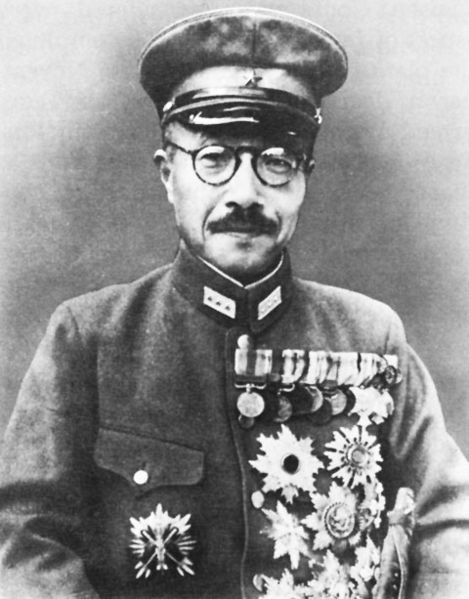
General Hideki Tojo* (1884-1948). Sentenced to death. Photo at left.

Chief, Manchurian secret police, 1935; councillor, Manchurian Affairs Bureau, 1936; chief of staff, Kwantung Army, 1937-38; vice minister of war, 1938; minister of war 1940-44; premier, 1941-44. Considered the arch-criminal of the Pacific War. Tojo assumed full responsibility for all the actions of his government and the military during the war. Convicted on Counts 1, 27, 29, 31, 32, 33, 54. Tōjō Hideki was hanged on December 23, 1948.

General Kenji Doihara (1883-1948). Sentenced to death.

Commander, Kwantung Army, 1938-40; Supreme War Council, 1940-43; army commander in Singapore, 1944-45. Deeply involved in the army's drug trafficking in Manchuria. Later ran brutal POW and internee camps in Malaya, Sumatra, Java and Borneo. Convicted on counts 1, 27, 29, 31, 32, 35, 36, 54. Doihara Kenji was hanged on December 23, 1948.

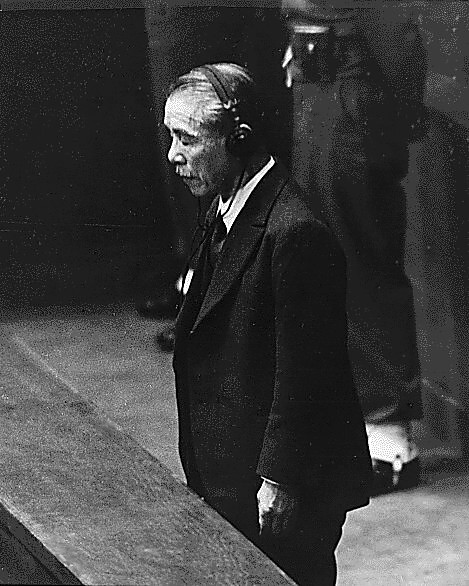
Baron Koki Hirota (1878-1948). Sentenced to death. Photo at left.

Ambassador to the Soviet Union, 1928-31; foreign minister, 1933-36; premier, 1936-37. Was foreign minister during the Rape of Nanjing and other atrocities perpetrated by the army. As premier, he led his cabinet in planning the invasions of Southeast Asia and the Pacific islands, in addition to continuing the undeclared war against China. Convicted on Counts 1, 27, 55. Hirota Kōki was hanged on December 23, 1948.

General Seishiro Itagaki (1885-1948). Sentenced to death.

Chief of Staff, Kwantung Army, 1936-37; minister of war, 1938-39; chief, army general staff, 1939; commander in Korea, 1941; Supreme War Council, 1943; commander in Singapore, 1945. Troops under his command in China terrorized prisoners and civilians. Was responsible for prison camps in Java, Sumatra, Malaya, Borneo and elsewhere. Convicted on Counts 1, 27, 29, 31, 32, 35, 36, 54. Itagaki Seishirō was hanged on December 23, 1948.

General Heitaro Kimura (1888-1948). Sentenced to death.

Chief of Staff, Kwantung Army, 1940-41; vice minister of war, 1941-43; Supreme War Council, 1943; army commander in Burma, 1944-45. Helped plan the China and Pacific wars, including surprise attacks. Involved in the brutalization of the Allied POWs and was the field commander in Burma when civilian and POW slave labor built and died on the Siam-Burma Railway. Convicted on Counts 1, 27, 29, 31, 32, 54, 55. Kimura Heitaro was hanged on December 23, 1948.

General Iwane Matsui (1878-1948). Sentenced to death.

Personal appointee of the emperor to the Geneva Disarmament Conference, 1932-37; commander, China Expeditionary Force, 1937-38. Troops under his overall command were responsible for the Rape of Nanjing in 1937 and other atrocities. He retired in 1938 and then ceased to play an active role in military affairs. Convicted on Count 55. Matsui Iwane was hanged on December 23, 1948.

General Akira Muto (1892-1948). Sentenced to death.

Vice chief of staff, China Expeditionary Force, 1937; director, military Affairs Bureau, 1939-42; army commander in Sumatra, 1942-43; army chief of staff in the Philippines, 1944-45. Troops under his command participated in both the Rape of Nanjing and the Rape of Manila. Convicted on Counts 1, 27, 29, 31, 32, 54, 55. Mutō Akira was executed on December 23, 1948.

Baron Kiichiro Hiranuma (1867-1952). Sentenced to life imprisonment, but released five years later.
Privy Council, 1924-39; founder and president of Kokuhonsha (a right-wing nationalistic society), 1926-28; premier, 1938; minister of home affairs, 1940; minister without portfolio, 1940-41; president, Privy Council, 1945. Convicted on Counts 1, 27, 29, 31, 32, 36. Despite his life sentence, Hiranuma Ki'ichirō was released from prison in 1951, and died of natural causes the following year.

General Kuniaki Koiso (1880-1950). Sentenced to life imprisonment.
Vice minister of war, 1932; Chief of Staff, Kwantung Army, 1932-34; army commander in Korea, 1935-38; minister of overseas affairs, 1939; governor-general, Korea, 1942-44; premier 1944-45. Was known among the Korean population as "the Tiger of Korea" because of his brutality. As premier, he was aware of POW death camps. Convicted on Counts 1, 27, 29, 31, 32, 55. Koiso Kuniaki died in prison of natural causes while serving his sentence.

Toshio Shiratori (1887-1949). Sentenced to life imprisonment.

Director, Information Bureau, Foreign Ministry, 1929-33; ambassador to Italy, 1938-40; adviser to the foreign minister, 1940. A supporter of military expansionism, he favored an alliance among Germany, Italy the Soviet Union and Japan to dominate the world. Convicted on Count 1. Shiratori Toshio died in prison of natural causes while serving his sentence.

General Yoshijiro Umezu (1882-1949). Sentenced to life imprisonment.

Section chief, general staff, 1931-34; commander, China Expeditionary Force, 1934; vice minister of war, 1939-44; army chief of staff, 1944-45. Convicted on Counts 1, 27, 29, 31, 32. Umezu Yoshijirō died in prison while serving his sentence.

Shigenori T
ogo (1882-1950). Sentenced to twenty years in prison.
Ambassador to Germany, 1937; ambassador to the Soviet Union, 1938; foreign minister, 1941-42, 1945. Convicted on Counts 1, 27, 29, 31, 32. Tōgō Shigenori, a descendant of Korean potters who were forcibly taken to Japan during the Imjin War of the 1590sdied in prison while serving his sentence.

Yosuke Matsuoka (1880 - 1946). Died before trial was completed.
The one-time Oakland and Portland resident and University of Oregon graduate gained international notoriety in 1933 when he announced Japan's departure from the League of Nations as a result of the League's criticism of Japan's operations in "Manchu State". After leaving the foreign service, he became president of the South Manchurian Railroad, at which time he worked closely with Hideki Tojo, who was then serving as chief of the Kwantung Army's secret police. In 1940, Matsuoka became minister of foreign affairs under prime minister Konoe Fumimaro. Matsuoka Y
ōsuke was a major advocate of a Japanese alliance with Nazi Germany and fascist Italy.

Osami Nagano (1880 -1947). Died before trial was completed.
Appointed minister of the navy under Koki Hirota in 1936, and was appointed Commander in Chief of the Fleet in 1937. In 1941, Nagano became Chief of the Naval General Staff. In this capacity, he ordered the attack against the United States Pacific Fleet in Pearl Harbor. He was promoted to fleet admiral in 1943. While standing trial Nagano Osami assumed responsibility for the Pearl Harbor attack, but he died of a heart attack before the trial was complete.


* Names are listed initially in a "Western"-style format of given name followed by surname. At the end of each listing, I have written the names in "traditional" surname-followed-by-given-name format, with diacritical marks (e.g.,
ō) where appropriate.