
Something more to fisk later, but the Economist has a story on what Japan can do (or not do) about its past in East Asia.
I think in the US (and Canada) there’s less of a tendency to buy merely for nationalistic reasons--after all, why is the US’s balance of imports/exports totally out of whack in favour of imports?While I do think the average American consumer--no wait, I really can't speak for any place outside of where I've lived, like California--does tend to employ nationalism less commonly than the average Korean consumer, I don't think the gap is that wide. And certainly American companies are not above appealing to nationalism/jingoism/patriotism when it suits them.
In many cases, an overt appeal to patriotism isn't necessary or palatable. Take the Big Three carmakers. The Commerce Secretary asked them to pump up demand, which they've done with 0% financing. Given the state of the economy, these guys would be offering rebates and discounts right now in any case. So why does GM have to boast that it's aiming to "Keep America Rolling," while Ford pledges to "Help Move America Forward"? Free financing can slice up to $4,000 off the total cost of a $22,000 car. For many, that's reason enough to buy. Wrapping those sorts of deals in Old Glory, and doing so to the accompaniment of chest-beating rhetoric, just adds a saccharine tone to what is otherwise a great deal.In all fairness, I think appeals to American patriotism can be forgiven in such a trying and scary time (and I would be somewhat forgiving toward some of the Korean corporate appeals to Korean consumers in the wake of the economic collapse of 1997 and 1998). My point was that corporate appeals to patriotism are not unique to Korea, and they are certainly not unheard of even in today's United States.

 I like taking pictures of traditional things, even though a lot of the traditional things are remakes. This is a walkway down a reasonably authentic-looking Chosŏn-era home at the Minsokchon (Folk Village) in Yong-in. It looks so inviting, I think. The folk village is a nice re-creation of life back then, but without the syphilis and the cholera.
 In October 2004 I went to Italy with my parents, traveling around what is my #1 favorite country, seeing the sights, trying to get by with barely passable Italian language skills. This scene is the cliffs on the island of Capri, one of the most mispronounced places in Italy (the accent is on the first syllable). I am proud of myself for having ordered Caprese salad (mozzarella and tomatoes) while in Capri, for which it was named. That set me back about six euros. Capri is expensive.
In his second interview, he denied that he was senior author, saying that his only specially designated role as a co-author was as one of the two co-corresponding authors. This second version does not correspond with the fact, for example, that he is the one who responded to reviewers’ comments.
So we have backpedalling, attempts to deceive, and self-aggrandizement. There's more:
We believe that Dr. Schatten was disingenuous in his second interview in harping on strict definitions of ‘writing’ and ‘senior author’. Furthermore, taken together with written commentsto the committee, this appears to be part of a concerted and deliberate effort on the part of Dr. Schatten to further distance himself from Dr. Hwang and their joint publications. This is in sharp contrast to the full participation of Dr. Schatten in the media spotlight following publication of the paper.
We believe that Dr. Schatten entered into this relationship with Dr. Hwang on the 2005 paper not only to help a colleague whom he admired, but also to gain some authoritative input and reputational enhancement from a paper which he thought had high potential of being a major breakthrough.Reputational enhancement? Here U Pitt is saying essentially that Dr. Schatten thought that the research might be significant, so he latched himself on. He also tried to help increase the limelight. You know all those Koreans hoping Dr. Hwang would be a future Nobel laureate? Dr. Schatten was helping that go through:
He obviously had high expectations of the impact the paper would have. For example, he nominated Dr. Hwang for foreign membership in the United States National Academy of Sciences and, with others, for a Nobel Prize.U Pitt seems to suggest there were questionable financial dealings on Dr. Schatten's part:
He was not averse to accepting honoraria totaling $40,000 within a 15-month period from Dr. Hwang – including $10,000 paid in cash while attending a press conference following publication of the 2005 paper – amounts that seems to us as far above normal honoraria for consultation.Hmm... it gets even messier:
Nor did he hesitate to help to relieve Magee’s financial responsibilities in supporting his work, when he could not call on federal funds for his activities with human embryonic stem cells, by submitting a proposal to Dr. Hwang for laboratory support amounting to $200,000 for the last four months of 2005, an amount which he hoped would turn out to be the amount of an annual subsidy in subsequent years.And what about the criticism by some in Korea that Schatten was trying to patent things he had no business patenting? U Pitt says this:
Also, Dr.Schatten’s patent application of 2004, submitted through Magee, presents claims that likely could not be fulfilled by inventions developed at Magee alone, but might plausibly be supported by technologies reportedly developed by Dr. Hwang’s group between the filings of provisional and actual patents.Are we done? Even Dr. Schatten's involvement with Snuppy causes us to scratch out heads:
We comment just briefly on the 2004 paper and the 2005 communication to Nature about the cloning of the dog. Dr. Schatten was not a co-author of the 2004 paper and, at his own request, he was not even acknowledged. A full manuscript had already been written, and rejected, before Dr. Schatten became involved. He may have contributed with suggestions and with political influence to help the paper through to acceptance, but we have no basis to associate him with any of the substantive work described in the paper. Nonetheless, he lobbied hard for publication of this paper in Science, without any direct knowledge of the veracity of the data. Dr. Schatten’s role in successfully getting the 2004 paper published in Science is likely to have provided considerable encouragement to Dr. Hwang to offer him authorship on the 2005 paper. As for the brief communication to Nature about the cloning of the dog Snuppy, for which Dr. Schatten was a listed co-author, we have no reason to doubt Schatten’s statement to us that his major contribution to the paper was a suggestion that a professional photographer be engaged so that Snuppy would appear with greater visual appeal. It is less clear that this contribution fully justifies co-authorship.So we've got a guy who got into Dr. Hwang's good graces by helping him publish stuff about the dog (which so far appears to be the only legitimate thing Dr. Hwang did in 2004 or 2005). Technical stuff? No: political and cosmetic.
We conclude that Dr. Schatten likely did not intentionally falsify or fabricate experimental data, and that there is no evidence that he was aware of the misconduct reported to have occurred in Dr. Hwang’s group in Korea. Given his dominant role in the writing of the 2005 paper his authorship is not unreasonable, but his positions as co-corresponding author and senior author were determined with considerable care and deliberation. Dr. Schatten’s listing as the last author not only conferred considerable credibility to the paper within the international scientific community, but directly benefited Dr. Schatten in numerous ways including enhancement of his scientific reputation, improved opportunities for additional research funding, enhanced positioning for pending patent applications, and considerable personal financial benefit.If only it hadn't all fallen apart.
However, these benefits are accompanied by responsibilities for the manuscript as a whole, approval of the manuscript by all co-authors, and the veracity of the data reported. Dr. Schatten shirked these responsibilities, a serious failure that facilitated the publication of falsified experiments in Science magazine. While this failure would not strictly constitute research misconduct as narrowly defined by University of Pittsburgh policies, it would be an example of research misbehavior.Okay, so maybe Pitt is not letting him off the hook. Or are they?
Finally, we would like to acknowledge Dr. Schatten’s expeditious and appropriate actions upon learning of allegations of Dr. Hwang’s misconduct. The first instance was his finding on Friday, November 11, that at least one of Dr. Hwang’s staff had been an egg donor, although Dr. Hwang had forcibly denied this only three days earlier. Dr. Schatten publicly dissociated himself from his collaboration with Dr. Hwang on the next working day. The second instance occurred on December 10, when Dr. Schatten first received direct testimony that NT-hES cell lines 4-11 did not exist. This discovery prompted Dr. Schatten to write to Science on December 12 to initiate retraction of the paper.I think I'm a little less generous than Pitt. I think, given Dr. Schatten's savvy and connections that helped Dr. Hwang get the once-rejected Snuppy paper accepted, I think it is plausible that some of the ethical corner-cutting that led to wholesale dishonesty may have been instigated by Dr. Schatten himself, who knew how to massage research to get it accepted. As I have said before, I don't think Dr. Schatten is some babe in the woods who was awestruck by Dr. Hwang and got taken in by him. I think that he may have been the one who showed Dr. Hwang the easy path to the dark side, though ultimately it was Dr. Hwang who chose to run willy-nilly down it.
Schatten got off easy. Too easy. Read KushiboI wrote that post after checking out U Pitt's actual report (Brendon's link above), which has a somewhat different take on the matter than the article ("Peers supporting Schatten, consider him a victim of fraud") Marbert cited in the original post.
While this failure would not strictly constitute research misconduct as narrowly defined by University of Pittsburgh policies, it would be an example of research misbehavior....shows how narrowly he dodged this bullet. I wonder how narrowly he dodged it in Wisconsin, during the last major scientific scandal in which Dr. Schatten happened to be involved.


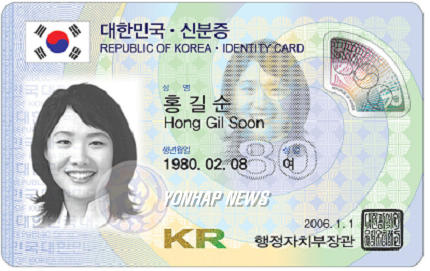 Starting in 2008, the Korean government will be issuing new Republic of Korea Identity Cards (신분증 or 주민등록증) that do not include the unique thirteen-digit identification number (주민번호) that is based on one's birthdate and gender.
 [photo: A large-screen television shows a beaming Princess Kiko. Judging by the English subtitle, she is apparently telling the Japanese press what a sizable and capable man her husband is.]
 [photo: non-nude Ha Jiwon]
 [photo: nude Koreans]
 [photo: haenyŏ,also non-nude Koreans]
Kim Dae-jung hopes to visit Pyongyang by train some time in April. The South Korean government has relayed that wish to the North.The Dear Leader has yet to reciprocate Kim Daejung's visit, even though this was apparently promised. He probably fears what might happen to him while he's here, or perhaps what will happen to his control while he's away.
 [photo: North Korea strongman Kim Jong-il and then ROK President Kim Daejung embrace at Sunan Airport near Pyongyang. Though it went undetected at the time, the Dear Leader, in an adept sleight of hand, apparently stole Kim Daejung's wallet, which contained a $200 million check and some family photos.]
Under the reign of His Imperial Majesty the people of Japan sought to join in spirit to revive the beautiful traditions of the nation. They desired to create a modern, yet wonderful country, that sought good will and understanding with the people of the world.A country that sought good will and understanding with the people of the world. It is my belief that there truly were Japanese who believed in this noble goal: Japan was on the verge of reforming itself and modernizing itself and becoming a light across Asia. Unfortunately, militarists got hold of the country and mesmerized many across the land with their visions of Japan not as an enlightened partner but as a controlling ruler of Asia. And these people brought Japan to ruin. And it is these destroyers of Japan, among them the Yasukuni-14, who the Yasukuni Jinja shrinekeepers chose to honor in 1978.
During this time of rebirth for the nation an unfortunate dispute arouse (Boshin Civil War). Many gave up their lives for the sake of the nation. To convey to posterity the noble sacrifice of those who worked for the Imperial Restoration, the Emperor Meiji decreed in June 1869 that a shrine be built in Kudanshita of Tokyo called Tokyo Shokonsha. In 1879, Tokyo Shokonsha was renamed Yasukuni Shrine.What does Yasukuni Shrine mean?
The name "Yasukuni" was designated by the Emperor Meiji. In this name is His Majesty's sincere hope for the eternal peace and tranquility of the nation.Note that this is not the world, but the nation. Peace for Japan, as we can see in the Sino-Japanese War, the Russo-Japanese War, and the lead-up to World War II, does not necessarily have anything to do with peace for the rest of the world.
Later, also enshrined were those who had gave up their lives for the country in the 15 year period of the troubled times starting with the coming of Commodore Perry and his four warships to Uraga in 1853 to the end of the Tokugawa Shogunate.So these people are enshrined and worshipped because they "gave up their lives for the country," something we see with the Yasukuni-14 does not necessarily include giving up one's actual life.
In the process of building a firm foundation for the nation several domestic struggles occurred such as the Saga Rebellion and the Satsuma Rebellion. Those who offered their lives for the country during these struggles were also worshiped at Yasukuni Jinja.So the enshrinement leads to "worship." Okay, as long as we have that straight. It is not just honoring, but worshiping, which makes sense since it is a religious shrine.
Nevertheless, to defend the independence of the nation as well as the peace of Asia, the sad development of wars with other countries arose. In the Meiji Period there was the Sino-Japanese War and the Russo-Japanese War. In the Taisho Period there was the First World War. Then in the Showa Period occurred the Manchurian Incident, the China Incident and the Greater East Asian War (Second World War).Japan launched a war of conquest against Korea, China, and then other parts of Asia, yet the Yasukuni shrinekeepers seek to teach that these conflicts were "defending the independence of Japan" and "the peace of Asia."
War is truly sorrowful. Yet to maintain the independence and peace of the nation and for the prosperity of all of Asia, Japan was forced into conflict. The precious lives that were lost in these incidents and wars are worshiped as the Kami (Deities) of Yasukuni Jinja.So Japan's wars were to "maintain the independence and peace of the nation" and "the prosperity of Asia"? Japan's incursions into Korea, China, and then the rest of Asia were "defensive" and were "to promote prosperity"?! Despite millions of deaths, the Yasukuni shrinekeepers hold tight to this nonsensical wartime propaganda.
Do you know how many Kami are enshrined in Yasukuni Jinja? The answer is 2,466,000 Kami. There are these great many Kami in your presence when your worship at Yasukuni Jinja. Allow me to speak about these Kami.The article goes on to talk about how the kami are not just soldiers, but tens of thousands of women, thousands of children even, cameramen, etc.
Moreover, there were those who gave up their lives after the end of the Great East Asian War, taking upon themselves the responsibility for the war. There were also 1,068 "Martyrs of Showa" who were cruelly and unjustly tried as war criminals by a sham-like tribunal of the Allied forces (United States, England, the Netherlands, China and others). These martyrs are also the Kami of Yasukuni Jinja.Ah, but some of the Yasukuni-14 did not "give up their lives." About half were sentenced not to death but to life imprisonment or a limited sentence and two died before their trials were even over. In particular, one died a free man after being released from prison a year later! Let's think on that man. Why is he even enshrined in Yasukuni? Doesn't his enshrinement betray the political motivations of the Yasukuni shrinekeepers? [more details on that later]
The peace and prosperity of Japan today is the fruit of the noble work of the Kami of Yasukuni Jinja.Not quite. The peace and prosperity of Japan--those who make Japan of today an excellent member of the world community--are those who recognize that self-serving, unwarranted wars of aggression are a very bad thing. They are the ones who stand in opposition to the current teachings of the keepers of Yasukuni Jinja.

