The South Korean government has announced plans to build a second research base, to the tune of 70 billion won over the next six years. The 1500-pyŏng (5000-square-meter) facility will be Seoul's second base, after the King Sejong Base on King George Island, established in 1988. At present there are forty-four such bases in the Antarctic region, a kind of geopolitical no-man's land.
Critics of the Roh government are already expressing their dismay. After all, considering all the billions of wons that the ROK has pumped into Antarctica, how has the southern continent recriprocated? It's done nothing in return. The penguins are still getting fat by killing off the krill and the squid. It's time to put an end to this one-way gravy train.
Thursday, July 21, 2005


Tuesday, July 19, 2005
Chinese senior military leader threatens to nuke U.S.
I'm surprised this didn't come down the pipeline over at the Ahssa Hole, but senior PRC military advisor Zhu Chenghu said that if the U.S. were involved in an attack on Chinese soil in some conflict related to Taiwan, China should fire nuclear weapons at the United States.
Wouldn't happen? China is our friend? Our economic partner?
Well, guess again: by treaty, the United States has vowed to defend the Republic of China (that's Taiwan for those of you in Rio Linda) if it is attacked by the People's Republic of China (that's the communist one with the 1.2 or 1.3 billion people, the one that is rounding up North Korean refugees and sending them back to North Korea, and also a major trading partner of the United States despite these and myriad other human rights abuses of great seriousness). That bit of political trivia, plus the fact that Beijing considers all of Taiwan to be Chinese territory, makes things a lot dicier than they should be.
US Defense Secretary Donald Rumsfeld wondered out loud if this reflects Beijing's official viewpoint, but even if it doesn't and this guy is a loose cannon (excuse the pun), it could still represent a serious military danger.
So, to sum up, a military leader from China, our friend and Everybody's Economic Partner, has essentially threatened to turn Washington into a sea of fire, to paraphrase the late Great Leader.
It almost makes Seoul look like the safe place to be.
Wouldn't happen? China is our friend? Our economic partner?
Well, guess again: by treaty, the United States has vowed to defend the Republic of China (that's Taiwan for those of you in Rio Linda) if it is attacked by the People's Republic of China (that's the communist one with the 1.2 or 1.3 billion people, the one that is rounding up North Korean refugees and sending them back to North Korea, and also a major trading partner of the United States despite these and myriad other human rights abuses of great seriousness). That bit of political trivia, plus the fact that Beijing considers all of Taiwan to be Chinese territory, makes things a lot dicier than they should be.
US Defense Secretary Donald Rumsfeld wondered out loud if this reflects Beijing's official viewpoint, but even if it doesn't and this guy is a loose cannon (excuse the pun), it could still represent a serious military danger.
So, to sum up, a military leader from China, our friend and Everybody's Economic Partner, has essentially threatened to turn Washington into a sea of fire, to paraphrase the late Great Leader.
It almost makes Seoul look like the safe place to be.
Thursday, July 14, 2005
University of California drops out of National Merit Scholarship program
The University of California has, at least since the 1990s, been critical of the idea that PSAT scores, SAT scores, and GRE scores are a fair assessment of a student's potential ability. Dropping out of the National Merit Scholarship program, which relies heavily on PSAT scores, is a very big step. I welcome it.
Going back to my days as a Princeton Review teacher/manager while an undergrad at UCI, and maybe even before that, I have thought that the profit-oriented Educational Testing Service's testing monopoly in the US, along with Americans' over-reliance on their tests that went hand in hand with that monopoly, was a blight on educational standards.
When a person is deemed qualified or not qualified, based on a multiple-choice test that measures skills contrary to what one would actually need in school, we have failed our students and ourselves.
[Don't misconstrue my opposition to ETS exams as sour grapes; I had excellent PSAT, SAT, and GRE scores (my dad had me practicing them since sixth grade), and I won some important scholarships based on those scores. But one thing that was easy to see was that what I was learning for those tests was simply not all that useful in college. Later I would see that a lot of essential academic skills I needed in college and graduate school were not measured on the tests, and in some cases possessing those skills would actually be detrimental to a good score.]
UC Quits National Merit Program
By Stuart Silverstein, Times Staff Writer
The scholarship plan, based largely on PSAT scores, does not fairly assess students, officials say. Current awardees will still receive aid.
The University of California announced Wednesday that its campuses will stop participating in the National Merit Scholarship program, contending that the annual competition doesn't fairly assess academic talent.
The decision means that the six campuses that had been funding scholarships of up to $2,000 a year for National Merit finalists will channel the money into other student awards, starting with the fall 2006 freshman class.
The move is considered a blow to the 50-year-old National Merit program, which is partly funded by campuses and corporations. It annually names about 8,000 scholarship winners, many of whom are recruited as intensely as star athletes by universities around the country.
UC officials faulted the National Merit program's reliance on the PSAT as the initial screening filter for the 1.3 million high school juniors who take that practice version of the SAT college entrance exam each year.
M.R.C. Greenwood, the UC system's provost, said during a telephone news conference that UC bases its undergraduate admissions on a wide variety of academic and personal accomplishments. By contrast, Greenwood said, "The National Merit Scholarship program uses the score on the PSAT to eliminate the vast majority of students from further consideration in their process. This particular procedure of theirs is just not consistent with our own academic principles and policies."
Last year, National Merit scholarships funded by UC campuses went to 618 students and amounted to $735,000. UC officials emphasized that undergraduates already chosen for the system's National Merit scholarships will continue to receive them for a full four years.
Pulling out of the program are UCLA, along with the UC campuses in Irvine, San Diego, Santa Barbara, Santa Cruz and Davis. UC Berkeley dropped out three years ago, and the two remaining UC campuses with undergraduate programs, Riverside and Merced, never participated.
Greenwood emphasized that the National Merit awards represented only a small portion of the merit scholarships granted throughout the UC system. In all, UC campuses provide scholarships based on academic merit to 16,700 undergraduates at a cost of $62 million annually.
The action by the UC campuses follows a 17-0 vote by UC faculty leaders late last month recommending withdrawal from the program. Along with faulting the reliance on the PSAT, faculty leaders noted that Latinos, African Americans and Native Americans accounted for only 3.2% of UC's National Merit scholarship winners; those groups make up about 19% of all UC undergraduates who receive any type of merit scholarships.
UCLA Chancellor Albert Carnesale said some UC chancellors initially might have harbored concerns that, if they scrapped the National Merit program, they would lose out on talented students and be punished in the rankings published by such magazines as U.S. News & World Report. He called the decision "another move in the direction of doing what you think makes the most sense rather than be concerned about what it will mean for the rankings."
Elaine S. Detweiler, a spokeswoman for the nonprofit National Merit Scholarship Corp. in Evanston, Ill., dismissed speculation by Carnesale and other academics that some of the 200 other participating universities might follow UC's path. Detweiler called the PSAT "the most equitable way" to identify academically talented students from around the country, noting that the same exam is given to students at 22,000 high schools in all 50 states.
"We regret that finalists in the extremely competitive National Merit program who may wish to attend a UC campus will no longer have the opportunity to earn a Merit Scholarship sponsored by the university and, more importantly, receive the recognition for academic excellence that accompanies a Merit Scholarship," she said.
Other defenders of the National Merit program, including other universities that actively recruit the winners and the winning students themselves, say it remains a helpful way to identify talented candidates even if the selection process is flawed. Some have pointed out, for example, that students are less likely to have taken test preparation courses before the PSAT than before the SAT.
Going back to my days as a Princeton Review teacher/manager while an undergrad at UCI, and maybe even before that, I have thought that the profit-oriented Educational Testing Service's testing monopoly in the US, along with Americans' over-reliance on their tests that went hand in hand with that monopoly, was a blight on educational standards.
When a person is deemed qualified or not qualified, based on a multiple-choice test that measures skills contrary to what one would actually need in school, we have failed our students and ourselves.
[Don't misconstrue my opposition to ETS exams as sour grapes; I had excellent PSAT, SAT, and GRE scores (my dad had me practicing them since sixth grade), and I won some important scholarships based on those scores. But one thing that was easy to see was that what I was learning for those tests was simply not all that useful in college. Later I would see that a lot of essential academic skills I needed in college and graduate school were not measured on the tests, and in some cases possessing those skills would actually be detrimental to a good score.]
UC Quits National Merit Program
By Stuart Silverstein, Times Staff Writer
The scholarship plan, based largely on PSAT scores, does not fairly assess students, officials say. Current awardees will still receive aid.
The University of California announced Wednesday that its campuses will stop participating in the National Merit Scholarship program, contending that the annual competition doesn't fairly assess academic talent.
The decision means that the six campuses that had been funding scholarships of up to $2,000 a year for National Merit finalists will channel the money into other student awards, starting with the fall 2006 freshman class.
The move is considered a blow to the 50-year-old National Merit program, which is partly funded by campuses and corporations. It annually names about 8,000 scholarship winners, many of whom are recruited as intensely as star athletes by universities around the country.
UC officials faulted the National Merit program's reliance on the PSAT as the initial screening filter for the 1.3 million high school juniors who take that practice version of the SAT college entrance exam each year.
M.R.C. Greenwood, the UC system's provost, said during a telephone news conference that UC bases its undergraduate admissions on a wide variety of academic and personal accomplishments. By contrast, Greenwood said, "The National Merit Scholarship program uses the score on the PSAT to eliminate the vast majority of students from further consideration in their process. This particular procedure of theirs is just not consistent with our own academic principles and policies."
Last year, National Merit scholarships funded by UC campuses went to 618 students and amounted to $735,000. UC officials emphasized that undergraduates already chosen for the system's National Merit scholarships will continue to receive them for a full four years.
Pulling out of the program are UCLA, along with the UC campuses in Irvine, San Diego, Santa Barbara, Santa Cruz and Davis. UC Berkeley dropped out three years ago, and the two remaining UC campuses with undergraduate programs, Riverside and Merced, never participated.
Greenwood emphasized that the National Merit awards represented only a small portion of the merit scholarships granted throughout the UC system. In all, UC campuses provide scholarships based on academic merit to 16,700 undergraduates at a cost of $62 million annually.
The action by the UC campuses follows a 17-0 vote by UC faculty leaders late last month recommending withdrawal from the program. Along with faulting the reliance on the PSAT, faculty leaders noted that Latinos, African Americans and Native Americans accounted for only 3.2% of UC's National Merit scholarship winners; those groups make up about 19% of all UC undergraduates who receive any type of merit scholarships.
UCLA Chancellor Albert Carnesale said some UC chancellors initially might have harbored concerns that, if they scrapped the National Merit program, they would lose out on talented students and be punished in the rankings published by such magazines as U.S. News & World Report. He called the decision "another move in the direction of doing what you think makes the most sense rather than be concerned about what it will mean for the rankings."
Elaine S. Detweiler, a spokeswoman for the nonprofit National Merit Scholarship Corp. in Evanston, Ill., dismissed speculation by Carnesale and other academics that some of the 200 other participating universities might follow UC's path. Detweiler called the PSAT "the most equitable way" to identify academically talented students from around the country, noting that the same exam is given to students at 22,000 high schools in all 50 states.
"We regret that finalists in the extremely competitive National Merit program who may wish to attend a UC campus will no longer have the opportunity to earn a Merit Scholarship sponsored by the university and, more importantly, receive the recognition for academic excellence that accompanies a Merit Scholarship," she said.
Other defenders of the National Merit program, including other universities that actively recruit the winners and the winning students themselves, say it remains a helpful way to identify talented candidates even if the selection process is flawed. Some have pointed out, for example, that students are less likely to have taken test preparation courses before the PSAT than before the SAT.
Japan drilling in waters also claimed by China
In a bit of news related to this story, Japan has awarded a Japanese oil company test drilling rights in waters hotly disputed by both Beijing and Tokyo. The two countries' claims center around waters not far from the Diaoyu/Senkaku Islands, which are near Taiwan and Japan's Ryukyu Islands. The reason for the dispute is overlapping Exclusive Economic Zones (EEZ).
Observers warn this could be a potential flashpoint in the future. Chinese Foreign Ministry spokesman Liu Jianchao had this to say:
The decision to allow test drilling could already worsen relations that have already been battered by the Japan's right-wing-sponsored textbooks and Japanese PM Junichiro Koizumi's visits to Yasukuni Shrine, where Class-A war criminals from World War II are enshrined.
Observers warn this could be a potential flashpoint in the future. Chinese Foreign Ministry spokesman Liu Jianchao had this to say:
If Japan persists in granting drilling rights to companies in disputed waters it will cause a serious infringement of China's sovereign right.The two sides have tried to work out a way to share the resources of the disputed waters, as Korea and Japan did in the waters surrounding Tokto/Takeshima in 1998, but both sides failed to agree. China already drills for gas in nearby waters both sides agree are China's.
The decision to allow test drilling could already worsen relations that have already been battered by the Japan's right-wing-sponsored textbooks and Japanese PM Junichiro Koizumi's visits to Yasukuni Shrine, where Class-A war criminals from World War II are enshrined.
Tuesday, July 12, 2005
Uri Party Lawmaker on Islamist terrorists: If we do what they want, the threat will disappear.
A coalition of Uri Party lawmakers and like-minded lawmakers from other parties, who have long opposed Roh Moohyun's US-ROK alliance-affirming measure to send troops to Iraq (the so-called Zaytun unit, located in the Kurd-dominated city of Irbil), is planning to vote en bloc for their return soon. They hope to submit and vote on a bill by September.
This should come as no surprise. The left wing of Roh's party has its share of lawmakers who view Bush and the US military and Bush with suspicion, if not outward hostility (which would make them no different from left-wing Democrats back in the United States).
But what I found most telling about these leftists' world view was this statement by Uri Party lawmaker Im Jong-in:
Never mind that this will show that South Korea will instantly cave to future demands by Islamist terrorists. I am not a huge fan of President Roh Moohyun, but he did the absolutely right thing by saying prior to Kim Sun-il's beheading that he could not give in to terrorist demands and remove his troops. Such a thing would be putting a target sign on every single Korean citizen around the world, both in and outside of Korea, particularly in places like the Philippines, Indonesia, and other places where Islamist terror occurs.
But it is places like Pusan that these lawmakers worry about. Korea's number-one port city is to host the APEC (Asia-Pacific Economic Cooperation) summit in November. Some worry this could make it a prime target for terrorists (the fact that the 7-7 attacks occurred while the G-8 summit was going on in the UK is not lost on these folks).
This coalition of the unwilling in the National Assembly says that democracy has been established and Iraq has re-gained its sovereignty, so "there is no justification or practical benefits" from keeping troops there.
But as anyone can see, the situation is less than stable. Coalition troops will be needed for some time. I myself was against the war, feeling Bush was rushing in on very flimsy evidence and an even flimsier pretext that would become clearly stronger or weaker if the UN's more moderate course of action could go forward first. But now that we're there, we have to stay and finish the job. That's our moral responsibility.
And it was pretty admirable and gutsy for Roh to not only send troops but to send the third-largest contingent after only the US and the UK. Roh, I believe, was demonstrating that he is firmly in favor of a continued US-ROK alliance, and he was doing his part, to the detriment of his core support base.
Reflecting Korea's ideological divide to some degree, many Koreans are against the deployment, fearing South Koreans will be put in harm's way and South Korea itself will be a terror target. Even those who generally support US-ROK relations were cool to the idea of sending troops to Iraq because this is seen as the unwarranted war of an overly belligerent Bush.
Supporters, on the other hand, see this as a way to enhance Korea's prestige, reaffirm the US-ROK alliance, gain practical overseas wartime experience it hasn't had since it was a major partner of the US during the Vietnam War (50,000 troops sent to do very serious fighting), and maybe create a good image with the local Iraqis whose cities they are helping rebuild. Korea Exchange Bank, in fact, uses the Zaytun troop image in one of its widely placed ads.
But to leftist lawmakers, suspicion of the ROK military runs as deep as suspicion of Bush. Why give them a chance to enhance their prestige?
And their lack of understanding of South Korea as a potential target of terrorism is just as deep. Representative Im thinks that taking the Zaytun out of Iraq will take South Korea off the terrorists' hit list, but he is mistaken. Islamist groups like al Qaeda would still see South Korea as a target because it is a Western nation, a largely Christian nation, a free-wheeling capitalist nation, an ally of the United States, and in general a place where people are free to do what they please. No shari'a, no peace.
This should come as no surprise. The left wing of Roh's party has its share of lawmakers who view Bush and the US military and Bush with suspicion, if not outward hostility (which would make them no different from left-wing Democrats back in the United States).
But what I found most telling about these leftists' world view was this statement by Uri Party lawmaker Im Jong-in:
Threats of terrorism will disappear if the Zaytun troops return home.That's right. The terrorists want Korea out of Iraq (and they brutally executed a Korean civilian to make this point), so if we don't want London- or Madrid-style terrorism in Seoul or Pusan, let's do what they want and get our troops out of there!
Never mind that this will show that South Korea will instantly cave to future demands by Islamist terrorists. I am not a huge fan of President Roh Moohyun, but he did the absolutely right thing by saying prior to Kim Sun-il's beheading that he could not give in to terrorist demands and remove his troops. Such a thing would be putting a target sign on every single Korean citizen around the world, both in and outside of Korea, particularly in places like the Philippines, Indonesia, and other places where Islamist terror occurs.
But it is places like Pusan that these lawmakers worry about. Korea's number-one port city is to host the APEC (Asia-Pacific Economic Cooperation) summit in November. Some worry this could make it a prime target for terrorists (the fact that the 7-7 attacks occurred while the G-8 summit was going on in the UK is not lost on these folks).
This coalition of the unwilling in the National Assembly says that democracy has been established and Iraq has re-gained its sovereignty, so "there is no justification or practical benefits" from keeping troops there.
But as anyone can see, the situation is less than stable. Coalition troops will be needed for some time. I myself was against the war, feeling Bush was rushing in on very flimsy evidence and an even flimsier pretext that would become clearly stronger or weaker if the UN's more moderate course of action could go forward first. But now that we're there, we have to stay and finish the job. That's our moral responsibility.
And it was pretty admirable and gutsy for Roh to not only send troops but to send the third-largest contingent after only the US and the UK. Roh, I believe, was demonstrating that he is firmly in favor of a continued US-ROK alliance, and he was doing his part, to the detriment of his core support base.
Reflecting Korea's ideological divide to some degree, many Koreans are against the deployment, fearing South Koreans will be put in harm's way and South Korea itself will be a terror target. Even those who generally support US-ROK relations were cool to the idea of sending troops to Iraq because this is seen as the unwarranted war of an overly belligerent Bush.
Supporters, on the other hand, see this as a way to enhance Korea's prestige, reaffirm the US-ROK alliance, gain practical overseas wartime experience it hasn't had since it was a major partner of the US during the Vietnam War (50,000 troops sent to do very serious fighting), and maybe create a good image with the local Iraqis whose cities they are helping rebuild. Korea Exchange Bank, in fact, uses the Zaytun troop image in one of its widely placed ads.
But to leftist lawmakers, suspicion of the ROK military runs as deep as suspicion of Bush. Why give them a chance to enhance their prestige?
And their lack of understanding of South Korea as a potential target of terrorism is just as deep. Representative Im thinks that taking the Zaytun out of Iraq will take South Korea off the terrorists' hit list, but he is mistaken. Islamist groups like al Qaeda would still see South Korea as a target because it is a Western nation, a largely Christian nation, a free-wheeling capitalist nation, an ally of the United States, and in general a place where people are free to do what they please. No shari'a, no peace.
Sunday, July 10, 2005
North Korea promises return to talks this month
I really hate to report on the latest promises of North Korea, since they so often end up being not panning out, but Pyongyang has agreed to return to the six-way talks this month. The week of July 25, to be precise. Mark your calendars.
This is according to U.S. Assistant Secretary of State Christopher Hill, who met with North Korea's Vice Foreign Minister Kim Kyegwan during a dinner in Beijing. It was confirmed by the KCNA, which added Pyongyang's justification:
Hill says Kim told him that the purpose of the late July meeting would be ridding the Korean peninsula of nuclear weapons and that North Korea was intent of making progress toward this goal.
This is according to U.S. Assistant Secretary of State Christopher Hill, who met with North Korea's Vice Foreign Minister Kim Kyegwan during a dinner in Beijing. It was confirmed by the KCNA, which added Pyongyang's justification:
The U.S. side clarified its official stand to recognize (North Korea) as a sovereign state, not to invade it and hold bilateral talks within the framework of the six-party talks.The news comes as Secretary of State Condaleeza Rice is visiting Beijing, Tokyo, and Seoul. In good form, she refrained from some of the negative rhetoric that Pyongyang has complained about, and she made assurances that Washington has no intention to attack North Korea (but who knows what Oregon is up to), which it recognizes as a sovereign state. (Iraq was a sovereign state, too).
Hill says Kim told him that the purpose of the late July meeting would be ridding the Korean peninsula of nuclear weapons and that North Korea was intent of making progress toward this goal.
Thursday, July 7, 2005
Governor Bill Richardson invited to North Korea

New Mexico Governor Bill Richardson, former President Bill Clinton's UN Ambassador and Secretary of Energy, has been invited by Pyongyang for a visit. There are no confirmed plans on a visit, but a spokesman for the governor said Richardson would coordinate with the Bush Administration should the visit take place.
Governor Richardson has been a liaison between Pyongyang and Washington before, including in 2003 when he held three days of talks with North Korean envoys in Santa Fe (the New Mexico capital, not the Hyundai SUV).
North Korea is almost certainly trying to milk as much from Washington as possible, whether its security assurances, diplomatic relations, or economic incentives, but that doesn't mean that Washington shouldn't meet with Pyongyang to see what it can get from them (holding a meeting doesn't require signing making an undesirable agreement). I've always felt that a pragmatic, non-ideological approach to North Korea is what is needed, and Governor Richardson representing the Bush Administration might foot the bill.
Tuesday, June 21, 2005
Diaoyu is our land!
So it's not just the Koreans who have maritime territorial disputes with Japan. A Taiwanese warship has been sent to the fishing grounds around the disputed Diaoyu Islands (called the Senkaku Islands by the Japanese) in an apparent show of strength after complaints of harassment by Japanese patrol boats.
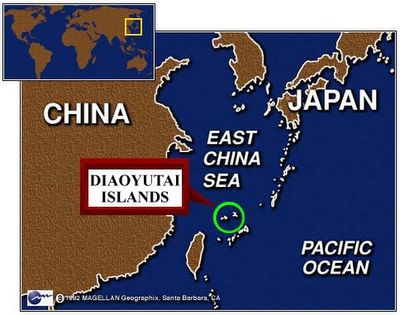
Location of Diaoyu Islands.
China also claims these islands (not to mention, all of Taiwan, which in turn claims all of China, so there).
Tokto/Takeshima redux? Listen to Parliament speaker Wang Jin-pyng and decide for yourself:
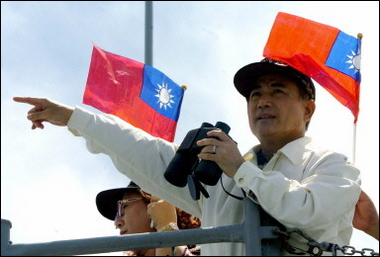
Wang Jin-pyng points at disputed Diaoyu Islands.
And just as Japan's Tokto declarations have led some Koreans to think they'll have a better ally in Beijing, some Taiwanese fishermen have reportedly called for protection from China, Taiwan's historical arch-rival.
While it would be tempting to gloat a little that Japan is having almost the same problem with another "ally," I really wish Tokyo (and Seoul, and now Taipei) would get their act together and see that they have far, far more in common than they realize, and they make better friends than adversaries. Just as important, they all need to stand together in the face of a rising China.

Location of Diaoyu Islands.
China also claims these islands (not to mention, all of Taiwan, which in turn claims all of China, so there).
Tokto/Takeshima redux? Listen to Parliament speaker Wang Jin-pyng and decide for yourself:
This area belongs to us historically, geographically, and legally. We must defend our sovereignty and protect our fishing rights.Or how about this from a Taiwanese fisherman:
It's good to see it's finally our turn to scare the Japanese. They have always bullied us and make us feel we are thieves at sea.And from opposition parliamentarian May Chin:
The entire nation is waiting for the government to show its guts and stand up to Japan.According to the BBC, Taiwanese fishermen have been protesting against being frequently driven out of the waters by Japanese patrol boats. This is all a bit odd considering how so many critics of China and the Koreas have cited the Taiwanese people's love of Japan as a sign that at least one former colony didn't really mind former colonizer Japan's increasing militarism.

Wang Jin-pyng points at disputed Diaoyu Islands.
And just as Japan's Tokto declarations have led some Koreans to think they'll have a better ally in Beijing, some Taiwanese fishermen have reportedly called for protection from China, Taiwan's historical arch-rival.
While it would be tempting to gloat a little that Japan is having almost the same problem with another "ally," I really wish Tokyo (and Seoul, and now Taipei) would get their act together and see that they have far, far more in common than they realize, and they make better friends than adversaries. Just as important, they all need to stand together in the face of a rising China.
Monday, June 20, 2005
Engineering animosity toward Japan
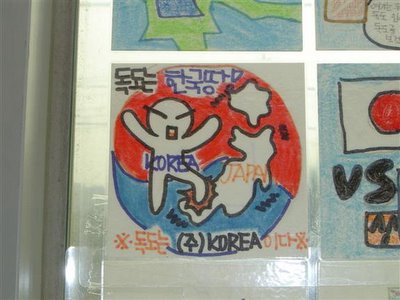
Reason is nectar.
Emotion is wine.
Anger is vinegar.
Hatred is acid.
The teachers and subway employees who are behind the creation and display (at Kyulhyŏn Station [귤현역; NAKL: Gyulhyeon] in Inchon) of these children's works about Tokto should be ashamed of themselves for trying to instill such animosity in young children.
People who would actively try to promote such hatred in impressionable young minds are simply not fit to be teachers.
ADDENDUM TO POST:
This update comes many months later, after the first five comments left below. Anyway, when I first heard about this, I made plans to go to Kyulhŏn Station to see the whole thing for myself, and perhaps lodge a complaint. But then came news that the display had been taken down a few weeks earlier than its scheduled "closing date." I called and asked, and I was told that there had been local complaints (i.e., people from the area had complained directly). I asked if foreigners had come to see the display, and I was told yes. There was no mention of the foreigners specifically being the ones to complain. It was more of a generic "people in the neighborhood," which one would assume to be primarily Koreans. Had it been primarily "foreigners" who had complained, I think that would have been stated.
At any rate, after looking into this some more and discussing it with a few people, I am almost certain that teachers of the far-leftist, neo-Marxist, pro-Pyongyang Korea Teachers Union, also known by their former Korean acronym Chonkyojo, were behind this. If you want to know who is teaching animosity in schools—not just against Japan but also against the United States, the Korean government, anyone perceived to be "too rich," free-market capitalism, etc.—this is your main culprit.
As a main part of the chinbo (literally "progressive," but some of the groups in this umbrella clearly distort that word's positive intent) movement, they are responsible for inculcating Korean children with pro-Pyongyang, anti-Seoul, class-conscious, anti-capitalist, anti-Western views. In schools where their leftist textbooks have not been authorized, the Chonkyojo teachers use Chonkyojo-approved "teachers guides" to supply the Cumings-esque viewpoint (after Bruce Cumings, the University of Chicago historian whose Pyongyang apologist pap is a staple of Korea's radical far left "thought").
Until just a few years ago, in fact, this radical labor union was outlawed in Korea (former President Kim Daejung legalized them as a way of breaking away from Korea's hard-line past), and mainstream educators distrust members for their far-leftist views.
Current President Roh Moohyun, who has stocked his cabinet with government ministers who are so far left you can't see them because of the curvature of the Earth, is trying to force private schools (40% of all schools) to accept local advisors on the school boards. This is nothing more than an invitation for Chonkyojo teachers to make their way onto the boards of even private, supposedly independent schools. Needless to say, the private schools haven't been taking this lying down.
One final note. The original poster who presented this display was very liberal in using the phrase "Fuck Japan!" in his explanations of what was being said in the various pictures. For those who don't read Korean, this might lead to an inaccurate impression of what the Korean words were saying in some cases. Often, the words accompanying the pictures were far milder than that bit of profanity would suggest.
...
Sunday, June 12, 2005
Tragic story below the radar
On Friday night I had drinks with some people associated with US interests here in Seoul. They recounted the very stressful afternoon they had in the wake of news that a 51-year-old Korean woman had been killed by a vehicle driven by a USFK truck at 2 p.m. that day in Tongduch'ŏn. With reports that there were already to be vigils marking the third anniversary of the two junior high school girls tragically killed by a USFK military vehicle in 2002, which sparked a major wave of anti-Americanism that year, there was a great deal of concern that a new round of angry protests would be coming.
I went to bed on Friday night without looking at any news sites, fearing it would make me too upset about the ensuing chaos. The next morning, I was surprised at what I found -- or didn't find.
The Korea Times carried the above linked story that US President George W. Bush, meeting with South Korea President Roh Moohyun, had expressed condolences to the family of the accident victim. His words at the beginning of their joint appearance:
Among a variety of things, that "small footprint" means (for some) few or no foreign troops in the capital (something based on historical reasons), bases that don't occupy huge tracts of prime real estate, and a US military population that is perceived as playing by the rules and behaving themselves.
To be fair, the USFK's reputation for crime may be somewhat exaggerated, with anti-Americanism pushed along by agenda-driven segments of the press that promote anti-USFK, anti-American, anti-Japanese, anti-business, anti-this, or anti-that sentiment. I have also frequently asserted that if even half of what the average Korean finds in the media were true, that would be reason to be very, very upset.
So I was fully expecting at least some parts of the press to be making a big deal out of this tragic story. But there it wasn't. Some news sources carried no stories in English at all, and few in Korean.
Was it Bush's nearly instantaneous apology (matched by an as-swift USFK apology), the type of treatment Koreans have long complained Washington gave to Tokyo but not Seoul? Was it careful treatment by the Korean media, which has learned the painful lesson that constant bashing of the US really can damage the US-ROK alliance and make some Americans consider leaving? Was it the lack of outrage on the part of the Korean viewers/readers, who can distinguish between negligence and an unavoidable accident?
I went to bed on Friday night without looking at any news sites, fearing it would make me too upset about the ensuing chaos. The next morning, I was surprised at what I found -- or didn't find.
The Korea Times carried the above linked story that US President George W. Bush, meeting with South Korea President Roh Moohyun, had expressed condolences to the family of the accident victim. His words at the beginning of their joint appearance:
I first want to express my country’s deepest condolences for the accident that took place, where a U.S. military vehicle killed a Korean woman. And we send our deepest sympathies to the woman’s families. And Mr. President [Roh], I just want you to know our hearts are sad as a result of this incident.This was done with amazing swiftness and tact, no doubt helped along by the focus on the two leaders' potentially tense meeting. But I believe it was also reflective of the US embassy in Seoul and USFK learning that they need to handle Korean grievances more swiftly and with more care. I have long asserted that most South Koreans want the US military presence in Korea to remain (some enthusiastically, some grudgingly), but they want the US military to remain as small a footprint as possible.
Among a variety of things, that "small footprint" means (for some) few or no foreign troops in the capital (something based on historical reasons), bases that don't occupy huge tracts of prime real estate, and a US military population that is perceived as playing by the rules and behaving themselves.
To be fair, the USFK's reputation for crime may be somewhat exaggerated, with anti-Americanism pushed along by agenda-driven segments of the press that promote anti-USFK, anti-American, anti-Japanese, anti-business, anti-this, or anti-that sentiment. I have also frequently asserted that if even half of what the average Korean finds in the media were true, that would be reason to be very, very upset.
So I was fully expecting at least some parts of the press to be making a big deal out of this tragic story. But there it wasn't. Some news sources carried no stories in English at all, and few in Korean.
Was it Bush's nearly instantaneous apology (matched by an as-swift USFK apology), the type of treatment Koreans have long complained Washington gave to Tokyo but not Seoul? Was it careful treatment by the Korean media, which has learned the painful lesson that constant bashing of the US really can damage the US-ROK alliance and make some Americans consider leaving? Was it the lack of outrage on the part of the Korean viewers/readers, who can distinguish between negligence and an unavoidable accident?
Japan's bereaved families speak out against Yasukuni visits
A lot of Japan apologists who make excuses for Japanese Prime Minister Junichiro Koizumi's visits to Yasukuni Shrine, where Class-A war criminals whose actions and decisions terrorized and brutalized much of East Asia, make excuses ranging from, "You don't understand the peaceful meaning of the visits," to a more in-your-face, "It's not your country, so butt the hell out!"
Lots of Japanese are aware that the Yasukuni Shrine visits by Koizumi do cause seriously strained relationships with Japan's continental neighbors, especially China (where violent protestors made Koreans look like the sane ones). It's actually not too hard to find people opposed to the visits.
But the right-wingers in Japan continue to visit, claiming that to not do so would be an insult to the war dead. So it is interesting to see in today's Kyodo that Nippon Izokukai (the Japan War-Beareaved Association), headed by former LDP Secretary General Makoto Koga and a major supporter of that party, has issued a statement on the PM visits.
Kyodo reports that the statement also said politics should not be brought into the argument about whether Class-A war criminals should be separately enshrined from the war dead.
The association, however, expressed their opposition to the building of a separate shrine, an act which some have said would resolve the issue. The association considers Yasukuni Shrine as "the only memorial facility for the spirits of the war dead" and thus opposes establishment of any new facilities for the war dead in the future. They also oppose separate enshrinement of the Class-A war criminals.
Still, it's important to hear that even many on the right in Japan recognize that it's not in Japan's best interest to go pissing off the neighbors.
Lots of Japanese are aware that the Yasukuni Shrine visits by Koizumi do cause seriously strained relationships with Japan's continental neighbors, especially China (where violent protestors made Koreans look like the sane ones). It's actually not too hard to find people opposed to the visits.
But the right-wingers in Japan continue to visit, claiming that to not do so would be an insult to the war dead. So it is interesting to see in today's Kyodo that Nippon Izokukai (the Japan War-Beareaved Association), headed by former LDP Secretary General Makoto Koga and a major supporter of that party, has issued a statement on the PM visits.
[Having prime ministers paying homage at the shrine] has been an ardent wish of the association and we appreciate it very much but, at the same time it is most important that the spirits of the war dead rest in peace. It is necessary to give consideration to neighboring countries and obtain their understanding.One major policy of the association is to have regular Yasukuni visits by Japanese prime ministers, but the statement urged Koizumi, in an unusual move, to consider the criticisms of neighboring countries such as China and South Korea.
Kyodo reports that the statement also said politics should not be brought into the argument about whether Class-A war criminals should be separately enshrined from the war dead.
The association, however, expressed their opposition to the building of a separate shrine, an act which some have said would resolve the issue. The association considers Yasukuni Shrine as "the only memorial facility for the spirits of the war dead" and thus opposes establishment of any new facilities for the war dead in the future. They also oppose separate enshrinement of the Class-A war criminals.
Still, it's important to hear that even many on the right in Japan recognize that it's not in Japan's best interest to go pissing off the neighbors.
Saturday, June 4, 2005
Inch'ŏn and the Ryugyŏng Hotel
Note: This post is also known as "the China Rant."
Here's an odd bit of peninsula news from yesterday. We all knew that Inch'ŏn has been trying to jointly hold the 2014 Asian Games with P'yŏng'yang, but the new twist is that the mayor of Inchon said his city will invest the equipment and money needed --about half a billion dollars (or more) -- to fix up and finish Pyongyang's 105-story Ryugyŏng Hotel, the 300-meter-high unfinished phallic shell that dominates the Pyongyang skyline like the water tower in a Minnesota town. (Marmot's Hole has a good intro on this).
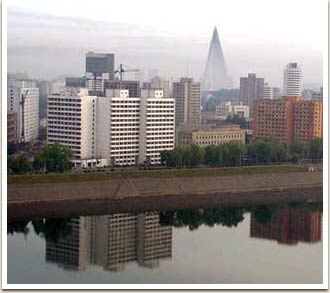
The Ryugyong Hotel is the pointy thing in the background.
What does it mean if they fix up the hotel? Yes, it means SK money and equipment pumped into NK, but it also means that Pyongyang will end up allowing a whole bunch of South Koreans (and others?) up into North Korea. Not just in controlled areas like Kaesŏng and Kŭmgangsan or even Najin, but in the heart of the country: the capital.
And I think this is part of the point of the gradualist approach to reunification: aiming not toward collapse of the system, but of a creeping in of southern/Western values for two purposes. First, this gradual influx of capital, infrastructure, and know-how will make things a hell of a lot easier when reunification does come. And second, the more and deeper these connections are, the harder it is for the regime to control thoughts and ideas, which helps build up a critical mass of perception of both the outside world and the inside world, which may become very crucial at some future crisis point in the regime's existence, leading to an East German-style throwing-in-of-the-towel rather than a going-down-with-both-guns-blazing scenario from the military or some other "leadership."
Of course, there is the problem with all the refugees and the starvation, which this seems to fail to address. But are the two mutually exclusive? Can't these ties be fostered while also providing food aid? Of course they can.
But then there's the ugly idea that these ties are actually propping up the Pyongyang regime, forestalling the collapse of the Kim Jong-il regime, thus prolonging the torture and death of many more.
But is this really true? Is South Korea's "Sunshine Policy" really forestalling their collapse while a hard-line approach would hasten their demise? I don't think the evidence is there, considering that nearly fifty years of the latter did NOTHING to lead to Pyongyang's collapse, and perhaps the greatest number of famine-related deaths occurred as a result of policies and actions took during that time.
In other words, decades of a hard-line approach did NOT lead to the collapse of the northern regime and it did not prevent the deaths of hundreds of thousands or millions. Thus, calling the so-called "Sunshine Policy" of engagement morally bankrupt because it props up Pyongyang is a bit specious.
And it also ignores a very, very important point, that there is another elephant in the room we choose to ignore: China.
It is China that props up Pyongyang. China. That's right: China. China props up Pyongyang. It is not Seoul, it is China.
South Korea could double, triple, quadruple, halve, or eliminate (zeruple?) its investment in North Korea and it would make little or not difference on when and if Pyongyang collapses. China controls that switch.
I think this is why it bothers me so that conservatives are so quick to bash Seoul for its political and economic engagement with the North while virtually ignoring Beijing's role. Seoul is playing the piss-poor hand it was dealt, but it is China that set up the table and the rules.
Bash Beijing if you're going to criticize Seoul.
But who is doing that? Virtually no one. China is a major economic cow to be milked, so we don't criticize China. We don't criticize China for torturing its own citizens, much less actively rounding up North Korean refugees and sending them back to North Korea where they will likely be tortured and imprisoned, likely forced to do hard labor, and possibly killed.
We don't criticize China for keeping Pyongyang propped up even though they know that North Korea is a human rights nightmare that makes China look like a kindergarten by comparison.
No. We send them billions up billions of dollars in investment instead.
But we criticize every step South Korean government or business takes as part of the Sunshine Policy.
Not only is this hypocritical, but it may also be counterproductive. At least the Sunshine Policy has a shared goal (eventually) with the hardliners: eventual elimination of the North Korean regime and absorption of North Korea into South Korea. The difference is in tack: Sunshine Policy seeks to kill with kindness while the "Moonshine Policy" (Dr. Lee Jungmin of Yonsei) seeks to isolate it and let it die a quicker death.
But China has no such goal in mind. It wants its buffer state against Japan and the US (and perhaps Korea and democracy in general). It wants to keep propping up Pyongyang. It does not share the goals of Sunshine Policy. China is the culprit. China is country responsible (beyond North Korea itself) for keeping Pyongyang afloat.
China.
The People's Republic of China, whose government still shares, nominally at least, a communist ideology with the Democratic People's Republic of Korea.
China in which we invest tens of billions of dollars and then tens of billions of dollars more. China which gives us cheap electronics to buy at Walmart. China.
So what am I advocating? Am I saying we should slap sanctions on China until they come around on North Korea? That may not be practical, given how deeply enmeshed we are, economically, with the People's Republic of China.
But it does mean two things: we need to recognize that China is the one that needs to be pressured. We need to make China feel comfortable -- or less uneasy -- with the prospect of a democratic and capitalist and unified Korea at its doorstep and allied with the US and Japan. We need to plant the idea in Beijing's head that they can and should flip the switch on Kim Jong-il. Whatever that entails.
And second, stop beating up on South Korea for the Sunshine Policy. It's not anti-US. It's not even pro-North. It's an attempt to try something when the hardline way failed to work after half a century. It will take time, if it works at all.
Now, having said that, I do think there are some things that are deserving of criticism. The Roh administration and much of the press seem to go overboard not to offend Pyongyang or Beijing, almost to the point of kowtowing to them.
In particular, I think that Roh's policy of preventing the refugees from coming here to South Korea crosses the line: it is not necessary to do so from a Sunshine Policy perspective, and it borders on moral repugnance. But again, the true culpability falls on Beijing, which is rounding up these North Koreans and sending them back. South Korea is merely slowing its process of accepting them, at a time when few other countries -- including the United States -- are willing to accept any North Koreans except those who make it to that country's shores on their own.
South Korea is given the Hobson's choice between continuing Sunshine Policy unabated but turning down the volume on the refugee issue or endangering Sunshine Policy progress, which (its proponents believe) could end up causing more good in the long run. Both choices may lead to considerable losses.
But Beijing is the one with the real choice: actively maintain its agreement with Pyongyang to round up and send refugees back to North Korea, knowing that they will likely be tortured and possibly killed, or tone down or even end the round-ups and let the North Koreans stay in China or quietly go to South Korea or some other country.
Ultimately, it is China's choice, not South Korea's. China, our economic partner.
Finally, and this is perhaps an entirely different issue, is the idea of Inch'ŏn taxpayers subsidizing a P'yŏng'yang hotel. I'm a Seoul taxpayer, but if I were an Inch'ŏn taxpayer, I might be livid.
But people will do strange things for civic pride, like building stadiums for sports franchises or for Olympic bragging rights. The 2014 Asiad that Inchon and Pyongyang are trying to jointly hold could lead to a 2020 Olympic bid for one or both of them (though I think the only way Pyongyang will get the Olympics anytime soon is as a nod to a newly reunified Korea).
But this does bring an odd twist: would, say, Detroit build subsidize a new stadium in Windsor, Ontario, just to get a sports franchise in the area? Would Seattle do this even for Vancouver, Washington, much less Vancouver, British Columbia? I couldn't even see Los Angeles County doing this for Orange County (not that we need it, because we have Disney dollars).
Here's an odd bit of peninsula news from yesterday. We all knew that Inch'ŏn has been trying to jointly hold the 2014 Asian Games with P'yŏng'yang, but the new twist is that the mayor of Inchon said his city will invest the equipment and money needed --about half a billion dollars (or more) -- to fix up and finish Pyongyang's 105-story Ryugyŏng Hotel, the 300-meter-high unfinished phallic shell that dominates the Pyongyang skyline like the water tower in a Minnesota town. (Marmot's Hole has a good intro on this).

The Ryugyong Hotel is the pointy thing in the background.
What does it mean if they fix up the hotel? Yes, it means SK money and equipment pumped into NK, but it also means that Pyongyang will end up allowing a whole bunch of South Koreans (and others?) up into North Korea. Not just in controlled areas like Kaesŏng and Kŭmgangsan or even Najin, but in the heart of the country: the capital.
And I think this is part of the point of the gradualist approach to reunification: aiming not toward collapse of the system, but of a creeping in of southern/Western values for two purposes. First, this gradual influx of capital, infrastructure, and know-how will make things a hell of a lot easier when reunification does come. And second, the more and deeper these connections are, the harder it is for the regime to control thoughts and ideas, which helps build up a critical mass of perception of both the outside world and the inside world, which may become very crucial at some future crisis point in the regime's existence, leading to an East German-style throwing-in-of-the-towel rather than a going-down-with-both-guns-blazing scenario from the military or some other "leadership."
Of course, there is the problem with all the refugees and the starvation, which this seems to fail to address. But are the two mutually exclusive? Can't these ties be fostered while also providing food aid? Of course they can.
But then there's the ugly idea that these ties are actually propping up the Pyongyang regime, forestalling the collapse of the Kim Jong-il regime, thus prolonging the torture and death of many more.
But is this really true? Is South Korea's "Sunshine Policy" really forestalling their collapse while a hard-line approach would hasten their demise? I don't think the evidence is there, considering that nearly fifty years of the latter did NOTHING to lead to Pyongyang's collapse, and perhaps the greatest number of famine-related deaths occurred as a result of policies and actions took during that time.
In other words, decades of a hard-line approach did NOT lead to the collapse of the northern regime and it did not prevent the deaths of hundreds of thousands or millions. Thus, calling the so-called "Sunshine Policy" of engagement morally bankrupt because it props up Pyongyang is a bit specious.
And it also ignores a very, very important point, that there is another elephant in the room we choose to ignore: China.
It is China that props up Pyongyang. China. That's right: China. China props up Pyongyang. It is not Seoul, it is China.
South Korea could double, triple, quadruple, halve, or eliminate (zeruple?) its investment in North Korea and it would make little or not difference on when and if Pyongyang collapses. China controls that switch.
I think this is why it bothers me so that conservatives are so quick to bash Seoul for its political and economic engagement with the North while virtually ignoring Beijing's role. Seoul is playing the piss-poor hand it was dealt, but it is China that set up the table and the rules.
Bash Beijing if you're going to criticize Seoul.
But who is doing that? Virtually no one. China is a major economic cow to be milked, so we don't criticize China. We don't criticize China for torturing its own citizens, much less actively rounding up North Korean refugees and sending them back to North Korea where they will likely be tortured and imprisoned, likely forced to do hard labor, and possibly killed.
We don't criticize China for keeping Pyongyang propped up even though they know that North Korea is a human rights nightmare that makes China look like a kindergarten by comparison.
No. We send them billions up billions of dollars in investment instead.
But we criticize every step South Korean government or business takes as part of the Sunshine Policy.
Not only is this hypocritical, but it may also be counterproductive. At least the Sunshine Policy has a shared goal (eventually) with the hardliners: eventual elimination of the North Korean regime and absorption of North Korea into South Korea. The difference is in tack: Sunshine Policy seeks to kill with kindness while the "Moonshine Policy" (Dr. Lee Jungmin of Yonsei) seeks to isolate it and let it die a quicker death.
But China has no such goal in mind. It wants its buffer state against Japan and the US (and perhaps Korea and democracy in general). It wants to keep propping up Pyongyang. It does not share the goals of Sunshine Policy. China is the culprit. China is country responsible (beyond North Korea itself) for keeping Pyongyang afloat.
China.
The People's Republic of China, whose government still shares, nominally at least, a communist ideology with the Democratic People's Republic of Korea.
China in which we invest tens of billions of dollars and then tens of billions of dollars more. China which gives us cheap electronics to buy at Walmart. China.
So what am I advocating? Am I saying we should slap sanctions on China until they come around on North Korea? That may not be practical, given how deeply enmeshed we are, economically, with the People's Republic of China.
But it does mean two things: we need to recognize that China is the one that needs to be pressured. We need to make China feel comfortable -- or less uneasy -- with the prospect of a democratic and capitalist and unified Korea at its doorstep and allied with the US and Japan. We need to plant the idea in Beijing's head that they can and should flip the switch on Kim Jong-il. Whatever that entails.
And second, stop beating up on South Korea for the Sunshine Policy. It's not anti-US. It's not even pro-North. It's an attempt to try something when the hardline way failed to work after half a century. It will take time, if it works at all.
Now, having said that, I do think there are some things that are deserving of criticism. The Roh administration and much of the press seem to go overboard not to offend Pyongyang or Beijing, almost to the point of kowtowing to them.
In particular, I think that Roh's policy of preventing the refugees from coming here to South Korea crosses the line: it is not necessary to do so from a Sunshine Policy perspective, and it borders on moral repugnance. But again, the true culpability falls on Beijing, which is rounding up these North Koreans and sending them back. South Korea is merely slowing its process of accepting them, at a time when few other countries -- including the United States -- are willing to accept any North Koreans except those who make it to that country's shores on their own.
South Korea is given the Hobson's choice between continuing Sunshine Policy unabated but turning down the volume on the refugee issue or endangering Sunshine Policy progress, which (its proponents believe) could end up causing more good in the long run. Both choices may lead to considerable losses.
But Beijing is the one with the real choice: actively maintain its agreement with Pyongyang to round up and send refugees back to North Korea, knowing that they will likely be tortured and possibly killed, or tone down or even end the round-ups and let the North Koreans stay in China or quietly go to South Korea or some other country.
Ultimately, it is China's choice, not South Korea's. China, our economic partner.
Finally, and this is perhaps an entirely different issue, is the idea of Inch'ŏn taxpayers subsidizing a P'yŏng'yang hotel. I'm a Seoul taxpayer, but if I were an Inch'ŏn taxpayer, I might be livid.
But people will do strange things for civic pride, like building stadiums for sports franchises or for Olympic bragging rights. The 2014 Asiad that Inchon and Pyongyang are trying to jointly hold could lead to a 2020 Olympic bid for one or both of them (though I think the only way Pyongyang will get the Olympics anytime soon is as a nod to a newly reunified Korea).
But this does bring an odd twist: would, say, Detroit build subsidize a new stadium in Windsor, Ontario, just to get a sports franchise in the area? Would Seattle do this even for Vancouver, Washington, much less Vancouver, British Columbia? I couldn't even see Los Angeles County doing this for Orange County (not that we need it, because we have Disney dollars).
Thursday, June 2, 2005
Bill for World President
In late February, when former President Bill Clinton came to Seoul for a booksigning, I had a chance to meet him at the Kyobo Bookstore in Kangnam. Either he is really tall, or I am really short, since he towered over me.
He was gaunt — a result of his bypass surgery — but he powerfully shook my hand and spoke to me in his charmingly gravelly voice. I carried on a very brief conversation with the man while he signed my copy of his book, My Life.
This talk apparently isn't just talk, according to this article in the Washington Post.
*Actually, I told him something else, but I'd rather not say here.
Anyway, there has long been talk about Bill lobbying to become the next UN Secretary-General, a position for which he is eminently qualified. And if that really happens, it would be a needed balance to the image of Bush's America that does whatever the hell it wants to for whatever reasons it wants to."It's an honor to meet you, Sir. I voted for you twice."
"Well, thank you. So what do you do here in Seoul?"
"I blog*."
"That's just great."
This talk apparently isn't just talk, according to this article in the Washington Post.
*Actually, I told him something else, but I'd rather not say here.
Subscribe to:
Posts (Atom)