I will have more on this later, but for now I'll just reprint the entire obituary of this great leader for the Korean- and Japanese-American communities, as well as for the Asian-American community in general.
Young O. Kim, 86; World War II and Korean War Hero, Uniter of L.A. Asian Communities
By Myrna Oliver, Times Staff Writer
Retired Army Col. Young O. Kim, one of the most celebrated heroes of World War II and the Korean War, who later became Los Angeles' elder statesman and link among Korean, Japanese and other Asian American communities, has died. He was 86.
Kim died Thursday of cancer at Cedars-Sinai Medical Center in Los Angeles.
Kim was a major co-founder of Los Angeles' Japanese American National Museum, Korean American Museum, Korean Health Education Information and Research Center, Korean American Coalition, Korean Youth and Culture Center, and Center for the Pacific Asian Family.
He also led efforts to build the Go for Broke monument in Little Tokyo, completed in 1999, which honors the primarily Japanese American members of World War II's combined 100th Infantry Battalion and 442nd Regimental Combat Team. The monument and a related Educational Foundation that Kim chaired were named for the book "Go for Broke," which chronicled the combined units' exploits in Italy and France.
"He's a bridge-builder. He's part of an elite group that has a scope beyond his or her own ethnic community," Stewart Kwoh, executive director of the Asian Pacific American Legal Center of Southern California, told The Times in 1987, when Kim was honored by the Japanese American National Museum board.
"Especially for someone of his generation, that's fairly unique," Kwoh said. "His efforts have served ethnic communities beyond the Korean and Japanese American communities. He's vitally concerned about other Asian groups as well."
Born in Los Angeles in 1919 to immigrant Koreans, Kim grew up on Bunker Hill, where his parents ran a grocery store at Temple and Figueroa streets. He worked in the store as a boy in the 1920s and '30s, an era when Asian groups were not on good terms with one another, particularly Koreans and Japanese because of Japan's occupation of Korea.
Yet Kim, who saw himself foremost as an American, overcame those ethnic prejudices.
"I welcome the new immigrants of all countries," Kim told The Times in 1987. "By having that attitude, I think I'm faithful and true to the American dream…. I'm proud of my ethnic roots. I've always been proud of my ethnic roots.
"But at the same time, I feel I'm basically American. I fought for America…. I also fought for the Korean people."
When World War II broke out, Kim was drafted and assigned to the Army's 100th Infantry Battalion — one of only two Koreans in the outfit.
He said the assignment occurred because his superiors at officer candidate school in Ft. Benning, Ga., "didn't know the difference between Korean, Japanese and Chinese."
When he reported to duty at Camp Shelby in Mississippi as a newly minted second lieutenant, his battalion commander offered him a transfer, saying: "The men here are all Japanese, and Koreans and Japanese don't get along."
"But we're not Japanese and Korean," Kim replied. "We're all Americans. And we're all fighting for the same thing."
At Camp Shelby, he talked with Japanese American officers from Hawaii about changing many Americans' negative view of Asians.
"We realized we had to do well in combat. Only by doing well in combat would we be in a position to try to effect some of these changes," Kim told The Times in 1987.
The units did better than well.
"In hindsight, we were wildly successful," Kim told The Times. "I'm talking about as a combat unit, and in effecting the changes that we wanted to nationally."
Kim became the only Korean American to earn the Distinguished Service Cross during World War II.
On June 26, 1944, in Italy, Lt. Gen. Mark W. Clark awarded Kim the prestigious medal because of his efforts in obtaining intelligence that helped the Allies break through at Anzio Beach and eventually capture Rome.
As United Press reported when Clark pinned the medal on him, Kim "went behind German lines at Cisterna … captured two Germans and brought them back past several enemy outposts to obtain information needed by the Allied command."
He was accompanied on the daring daylight mission by Japanese American soldier Irving Akahoshi.
Some of Kim's wartime exploits were illustrated in the 1997 documentary about the 100th/442nd and interned Japanese Americans, "Beyond Barbed Wire," in which he is "the Korean lieutenant."
Wounded several times, Kim earned so many medals in his two wars that he lost count.
The 20 or so decorations he stored in a box in his garage included two Silver Stars, three Purple Hearts, a French Croix de la Guerre and an Italian Cross of Valor.
Last February, France presented Kim with its highest award, Officer of the National Order of the Legion of Honor, for his efforts to liberate French towns toward the end of World War II.
When Kim returned to Los Angeles on April 9, 1945, The Times headlined the story "Korean Hero of Italy Home."
During the Korean War, Kim became the first Asian American to command a regular U.S. combat battalion, and led his unit in pushing enemy forces back from the 38th parallel. Their efforts helped create a strategic buffer between North and South Korea.
In October, South Korea authorized awarding Kim its highest military honor, the Taeguk Order of Military Merit.
After Korea, Kim spent another 20 years in the Army, posted in the United States, Europe and South Korea, until 1972, when he retired to Los Angeles. He earned a degree in history from Cal State Dominguez Hills and worked for a time as chief executive of Fine Particle Technology in San Diego.
Married and divorced twice, Kim is survived by three stepsons, Jerry and Tom Surh and Corey Covert; a sister, Willa; and two brothers, Jack and Henry.
Funeral services are scheduled Monday at Santa Monica United Methodist Church, 1008 11th St. Kim will be buried at the National Memorial Cemetery of the Pacific in Honolulu.
Instead of flowers, memorial donations may be made to the Go for Broke Educational Foundation or the Center for Pacific Asian Families.
Saturday, January 14, 2006


Friday, January 13, 2006
Paraskevidekatriaphobia is for losers
Today is Friday, the Thirteenth. [Kushibo starts wailing in a spooky voice] Woooo oooooooh!
Some of you may have had something major planned today and decided to cancel it. If that's you, then get a grip on reality, ya' milksop. Get out of bed and stop blaming bad fortune on supersitions. Today is no luckier or unluckier for you than yesterday or tomorrow.
This is a public service message brought to you by MADD and this station.
Paraskevidekatriaphobia, the fear of Friday, the Thirteenth (different from triskaidekaphobia, which is just fear of the number thirteen, whatever day of the week it is) is fairly prevalent in the United States, I guess.
Fear of the number thirteen in general is widespread enough that it is avoided where practical. I remember visiting the Mayo Clinic (family worked there) as a kid and seeing that the elevator numbers went from the 12th floor to the 14th floor; no listing of 13. How stupid, I thought! Why force people working on the 13th floor to walk up or down a flight of stairs just because of some superstition about having elevators stop there?!
In my hometown of Orange County, California, fear of the number 13 is so prevalent, that most buildings don't have a thirteenth floor. Most stop at two stories, eleven floors shy of the dreaded 13th floor.
This may also be due to a fear of earthquakes, but how often do those happen? If it weren't for an occasional quake every now and then, most OCers would have nothing to talk about. Being in a tremor while 150 feet above the ground would enhance the story. Wimps!
In Korea and some other East Asian countries, the fear is not of the number thirteen, but the number four. This is because in Korean (and Japanese), the pronunciation of the Chinese character for four (四) is the same as that for death (死, I think).
That's why, in many buildings, especially high rises, the fourth floor is not designated as such in the elevator; rather, the elevator buttons are labeled as 1, 2, 3, F, 5, 6, 7, etc. (This is true in my apartment building as well). The 'F,' of course, is from the number four. Many students would disagree that the letter F is really any less unlucky (I wore a Flip-brand T-shirt with a big letter F on it during my American students' exam, and more than one commented on it bringing bad luck).
Apparently, though, the number 4 is not unlucky when included in building or apartment numbers, so the same F floor might be in Building 401동 and will likely have a 401호, 402호, 403호, etc. I guess the superstition only extends to elevators; no doubt it was concocted by Asian Luddites who also thought cameras will steal their soul.
I personally think this, too, is hogwash, though for real estate value purposes, I wouldn't want them to change the F to a 4. I live on the 5th floor, and from time to time I can hear what is going on in the apartment below. I can attest that someone there is occasionally getting lucky.
Some of you may have had something major planned today and decided to cancel it. If that's you, then get a grip on reality, ya' milksop. Get out of bed and stop blaming bad fortune on supersitions. Today is no luckier or unluckier for you than yesterday or tomorrow.
This is a public service message brought to you by MADD and this station.
Paraskevidekatriaphobia, the fear of Friday, the Thirteenth (different from triskaidekaphobia, which is just fear of the number thirteen, whatever day of the week it is) is fairly prevalent in the United States, I guess.
Fear of the number thirteen in general is widespread enough that it is avoided where practical. I remember visiting the Mayo Clinic (family worked there) as a kid and seeing that the elevator numbers went from the 12th floor to the 14th floor; no listing of 13. How stupid, I thought! Why force people working on the 13th floor to walk up or down a flight of stairs just because of some superstition about having elevators stop there?!
In my hometown of Orange County, California, fear of the number 13 is so prevalent, that most buildings don't have a thirteenth floor. Most stop at two stories, eleven floors shy of the dreaded 13th floor.
This may also be due to a fear of earthquakes, but how often do those happen? If it weren't for an occasional quake every now and then, most OCers would have nothing to talk about. Being in a tremor while 150 feet above the ground would enhance the story. Wimps!
In Korea and some other East Asian countries, the fear is not of the number thirteen, but the number four. This is because in Korean (and Japanese), the pronunciation of the Chinese character for four (四) is the same as that for death (死, I think).
That's why, in many buildings, especially high rises, the fourth floor is not designated as such in the elevator; rather, the elevator buttons are labeled as 1, 2, 3, F, 5, 6, 7, etc. (This is true in my apartment building as well). The 'F,' of course, is from the number four. Many students would disagree that the letter F is really any less unlucky (I wore a Flip-brand T-shirt with a big letter F on it during my American students' exam, and more than one commented on it bringing bad luck).
Apparently, though, the number 4 is not unlucky when included in building or apartment numbers, so the same F floor might be in Building 401동 and will likely have a 401호, 402호, 403호, etc. I guess the superstition only extends to elevators; no doubt it was concocted by Asian Luddites who also thought cameras will steal their soul.
I personally think this, too, is hogwash, though for real estate value purposes, I wouldn't want them to change the F to a 4. I live on the 5th floor, and from time to time I can hear what is going on in the apartment below. I can attest that someone there is occasionally getting lucky.
Remember when green tea just came as green tea?
I'm sitting at Starbuck's trying to get some work done, but the procrastination gene that runs dominant in my brood has taken over yet again. I've spent half the morning installing Firefox on my 4.5-year-old Mac because Safari has permanently crapped out. I have been using Microsoft Explorer, which is like an octogenarian driving through Leisure World in a 1982 Oldsmobile: it's going mind-numbingly slow when it's not crashing.
One of the staff members (excuse me—baristas, reputedly named for the Barism separatists of Bilbao who liked to drink a macchiato venti before attacking the federales) came up and gave me a sample of green tea latte. Some may find it terribly weird, but I have never tried this latest rendition of the bitter but therapeutic nectar of unfermented dried tea leaves.
I am old school when it comes to green tea. I love the stuff, but it is meant to be a bitter brew, sipped on a cold day (I will drink iced green tea in the summer, however, my one concession to green tea's recent faddishness). In matters like these, I am a purist.
Green tea is not meant, in my opinion (which is usually right), to be adulterated with sugar, milk, cream, or anything other than water. On my list of green tea heresy are green tea ice cream, green tea powder over pastries, green tea crackers, and of course, green tea latte.
My father, usually dinosauric in his preferences, absolutely loves green tea ice cream. So much so that when we were in Italia a little over a year ago (where I saw the top of the Pope's head), he made me ask each and every gelato vendor we saw—from Roma, Viterbo, pretty much everywhere in Lazio, Napoli, Pisa, Firenze, and Venezia—if they had green tea ice cream, er, gelato.
Mind you, I don't actually speak Italian, but for one month, I did a very good job of faking it, thanks to three hours of reading a "Speak Italian in Just Three Hours" guide and my trusty Lonely Planet Italian Phrasebook. Not able to find the phrase "green tea" in my phrasebook or dictionary, I just told the gelateria managers: "We're from America and we've come all the way to your gastronomically rapturous country so that we could consume foods we can easily find in a supermarket back home. Do you have any ice cream with the flavor [pause, then switch to English] green tea?"
Incidentally, this was also the way I ordered butter for my mother, who could not get over the fact that Italians did not always eat the yellowish emulsion of salt and butterfat with the copious amounts of bread they consume. Eventually, I just truncated my request to, "We're from America. Do you have any butter?"
Prior to today, I have in fact tried green tea ice cream. My father, a generous sort with food who doesn't mind sharing things that have touched other people's mouths, had offered me a taste of his, which I managed to sample before he himself took a bite (my mother's a nurse and she has made me fearful of sharing food even with myself). I wasn't a big fan. I tried a green tea shake, but it was only marginally better.
So about a half hour ago, I sipped my first green tea latte. And while I didn't spit it out as the Baptist Lord supposedly does with lukewarm Christians, all I can say is "meh" (a Simpsonian utterance akin to 별로).
You'd think my affinity for coffee in all its lacteous varieties would have prepared me for a love of green tea latte, but for some reason it doesn't work that way. To me, coffee's bitterness is a distraction from its aroma and taste, but with green tea, the bitterness is an enhancement to the purifying, salutary experience. It shouldn't be masked with sucrose and dairy products. Also, I shouldn't have to pop another lactase pill just to drink green tea.
I should also add that the surface of an open cup of green tea latte looks like a layer of pond scum. The kind of pond scum you might find if someone hadn't chlorinate the swimming pool properly [if someone would recommend a good digital camera to buy, I'd take a picture of this to show you what I mean].
One of the staff members (excuse me—baristas, reputedly named for the Barism separatists of Bilbao who liked to drink a macchiato venti before attacking the federales) came up and gave me a sample of green tea latte. Some may find it terribly weird, but I have never tried this latest rendition of the bitter but therapeutic nectar of unfermented dried tea leaves.
I am old school when it comes to green tea. I love the stuff, but it is meant to be a bitter brew, sipped on a cold day (I will drink iced green tea in the summer, however, my one concession to green tea's recent faddishness). In matters like these, I am a purist.
Green tea is not meant, in my opinion (which is usually right), to be adulterated with sugar, milk, cream, or anything other than water. On my list of green tea heresy are green tea ice cream, green tea powder over pastries, green tea crackers, and of course, green tea latte.
My father, usually dinosauric in his preferences, absolutely loves green tea ice cream. So much so that when we were in Italia a little over a year ago (where I saw the top of the Pope's head), he made me ask each and every gelato vendor we saw—from Roma, Viterbo, pretty much everywhere in Lazio, Napoli, Pisa, Firenze, and Venezia—if they had green tea ice cream, er, gelato.
Mind you, I don't actually speak Italian, but for one month, I did a very good job of faking it, thanks to three hours of reading a "Speak Italian in Just Three Hours" guide and my trusty Lonely Planet Italian Phrasebook. Not able to find the phrase "green tea" in my phrasebook or dictionary, I just told the gelateria managers: "We're from America and we've come all the way to your gastronomically rapturous country so that we could consume foods we can easily find in a supermarket back home. Do you have any ice cream with the flavor [pause, then switch to English] green tea?"
Incidentally, this was also the way I ordered butter for my mother, who could not get over the fact that Italians did not always eat the yellowish emulsion of salt and butterfat with the copious amounts of bread they consume. Eventually, I just truncated my request to, "We're from America. Do you have any butter?"
Prior to today, I have in fact tried green tea ice cream. My father, a generous sort with food who doesn't mind sharing things that have touched other people's mouths, had offered me a taste of his, which I managed to sample before he himself took a bite (my mother's a nurse and she has made me fearful of sharing food even with myself). I wasn't a big fan. I tried a green tea shake, but it was only marginally better.
So about a half hour ago, I sipped my first green tea latte. And while I didn't spit it out as the Baptist Lord supposedly does with lukewarm Christians, all I can say is "meh" (a Simpsonian utterance akin to 별로).
You'd think my affinity for coffee in all its lacteous varieties would have prepared me for a love of green tea latte, but for some reason it doesn't work that way. To me, coffee's bitterness is a distraction from its aroma and taste, but with green tea, the bitterness is an enhancement to the purifying, salutary experience. It shouldn't be masked with sucrose and dairy products. Also, I shouldn't have to pop another lactase pill just to drink green tea.
I should also add that the surface of an open cup of green tea latte looks like a layer of pond scum. The kind of pond scum you might find if someone hadn't chlorinate the swimming pool properly [if someone would recommend a good digital camera to buy, I'd take a picture of this to show you what I mean].
Thursday, January 12, 2006
Pragmatists beat out Nationalists
Beginning this fall semester, English education for elementary students is to be expanded, from just 3rd to 6th graders to all students. The Korea Times reports that the Ministry of Education and Human Resources Development announced this as part of a plan to strengthen early English education as part of overall human resources development.
And that means the pragmatists have again won out over the nationalists. The echo chamber known as the Korea-related blogosphere seems stuck in the N-Gear (i.e., relying on the facile analysis that all things in Korea are dictated and guided by blind nationalism), but despite the noise the jingoists like to make (making noise is what they do, after all), cooler and wiser heads typically prevail.
This is another such case. In the early to mid-1990s, Korea was caught up in the argument of whether expanding English education into the elementary school system would erode Korean children's sense of Koreanness. The argument was not whether English education would be more effective if it began in third grade rather than seventh grade (中1); instead, many feared that teaching kids English at an earlier age would erode their Korean language abilities and thus their sense of Koreanness.
The pragmatists (i.e., those who felt that Korea would have a leg up, a la Singapore or Hong Kong, if its students were conversant at what is the world's unofficial language, the Lingua Franca, as it were) eventually won out. The teenagers who enter universities this coming March will be the first crop of students to have been exposed to English in school at the age of eight or nine.
But the pragmatists' plan was never to stop there. The third, fourth, fifth, and sixth graders were just test cases, and they eventually wanted to expand English education to the youngest of elementary students. The nationalists have squawked that this would be even worse, but the pragmatists have won out.
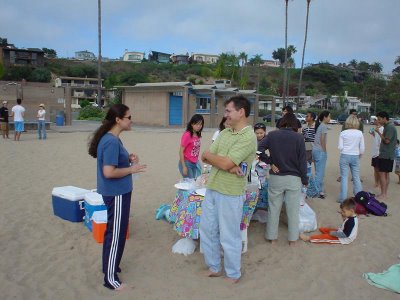
[photo: English speakers standing around talking. Beginning in fall of this year, Korean first and second graders will be able to join these conversations.]
To be fair, there is substantial anecdotal evidence that the nationalists may be partly right. Hand in hand with the advent of text messaging, many Korean youths seem to have lost the ability to spell correctly in Korean, quite a feat for a language with a phonetic alphabet and mostly straightforward rules of spelling. English (along with some Japanese and a few other foreign languages) has infiltrated Korean slang to such a degree that many young people don't know which words are standard and which are casual expressions.
The Ministry is to earmark about 51 trillion won for the skills improvement project over the next five years, including money for recruitment of English speakers as assistant teachers in all middle schools nationwide by 2010 in an effort to enhance English conversation and English teaching skills.
I'm sure that some in the blogosphere will look at the 51 trillion won figure and say that, judging by the English skills of the average Korean, this will be like flushing money down the toilet. Better if they use North Korean superbills to pay for this.
For those who have been in Korea only a year or so, the snapshot of Korea they see now might seem as if it is one where Koreans can't speak English worth a damn. But for those who have been here longer, it is obvious that the number of young Koreans who have lived in Korea all their lives and can actually converse in Korea has increased significantly. This is due to a number of factors, including the massive increase in English-language programming, the expansion of English-teaching institutes, and the Internet, among other things, not just elementary school education.
The Korea Times also reports that the Ministry plans to oblige primary and secondary schools in free economic zones (Inchon, Pusan, Chinhae and Kwangyang) and an international city (Cheju and later, I think, Songdo) to conduct math and science classes in English under the so-called "English Immersion Program," starting from 2008 on a trial basis. Furthermore, students living in Pusan adjacent to Japan may be required to take Japanese, while students living in Inchon near China may learn Chinese. (Personally, I think Japanese would be practical for people in Seoul and Inchon as well.)
There are a few other changes, as well. The current school year system will be scrapped in favor of one where schools begin the academic year in September rather than in March by 2010 to coordinate with foreign educational institutions. Also, the the 6-3-3-4 system (six years for elementary school, three each for middle and high school, and four years for university) may be changed to a a 5-3-4-4 school system.
Of course, the pragmatists still had to include a nod to nationalistic ambitions. Quoting Deputy Education Minister Kim Young-shik:
[photos below: more English speakers talking]
And that means the pragmatists have again won out over the nationalists. The echo chamber known as the Korea-related blogosphere seems stuck in the N-Gear (i.e., relying on the facile analysis that all things in Korea are dictated and guided by blind nationalism), but despite the noise the jingoists like to make (making noise is what they do, after all), cooler and wiser heads typically prevail.
This is another such case. In the early to mid-1990s, Korea was caught up in the argument of whether expanding English education into the elementary school system would erode Korean children's sense of Koreanness. The argument was not whether English education would be more effective if it began in third grade rather than seventh grade (中1); instead, many feared that teaching kids English at an earlier age would erode their Korean language abilities and thus their sense of Koreanness.
The pragmatists (i.e., those who felt that Korea would have a leg up, a la Singapore or Hong Kong, if its students were conversant at what is the world's unofficial language, the Lingua Franca, as it were) eventually won out. The teenagers who enter universities this coming March will be the first crop of students to have been exposed to English in school at the age of eight or nine.
But the pragmatists' plan was never to stop there. The third, fourth, fifth, and sixth graders were just test cases, and they eventually wanted to expand English education to the youngest of elementary students. The nationalists have squawked that this would be even worse, but the pragmatists have won out.

[photo: English speakers standing around talking. Beginning in fall of this year, Korean first and second graders will be able to join these conversations.]
To be fair, there is substantial anecdotal evidence that the nationalists may be partly right. Hand in hand with the advent of text messaging, many Korean youths seem to have lost the ability to spell correctly in Korean, quite a feat for a language with a phonetic alphabet and mostly straightforward rules of spelling. English (along with some Japanese and a few other foreign languages) has infiltrated Korean slang to such a degree that many young people don't know which words are standard and which are casual expressions.
The Ministry is to earmark about 51 trillion won for the skills improvement project over the next five years, including money for recruitment of English speakers as assistant teachers in all middle schools nationwide by 2010 in an effort to enhance English conversation and English teaching skills.
I'm sure that some in the blogosphere will look at the 51 trillion won figure and say that, judging by the English skills of the average Korean, this will be like flushing money down the toilet. Better if they use North Korean superbills to pay for this.
For those who have been in Korea only a year or so, the snapshot of Korea they see now might seem as if it is one where Koreans can't speak English worth a damn. But for those who have been here longer, it is obvious that the number of young Koreans who have lived in Korea all their lives and can actually converse in Korea has increased significantly. This is due to a number of factors, including the massive increase in English-language programming, the expansion of English-teaching institutes, and the Internet, among other things, not just elementary school education.
The Korea Times also reports that the Ministry plans to oblige primary and secondary schools in free economic zones (Inchon, Pusan, Chinhae and Kwangyang) and an international city (Cheju and later, I think, Songdo) to conduct math and science classes in English under the so-called "English Immersion Program," starting from 2008 on a trial basis. Furthermore, students living in Pusan adjacent to Japan may be required to take Japanese, while students living in Inchon near China may learn Chinese. (Personally, I think Japanese would be practical for people in Seoul and Inchon as well.)
There are a few other changes, as well. The current school year system will be scrapped in favor of one where schools begin the academic year in September rather than in March by 2010 to coordinate with foreign educational institutions. Also, the the 6-3-3-4 system (six years for elementary school, three each for middle and high school, and four years for university) may be changed to a a 5-3-4-4 school system.
Of course, the pragmatists still had to include a nod to nationalistic ambitions. Quoting Deputy Education Minister Kim Young-shik:
By 2010, we will help ten local universities join the world’s top 200 universities and national competitiveness rank within the top-ten in international competitiveness.That may not be such a bad thing. As we all know, patriotic drives to rise in the rankings have long been the engine of Korean achievement.
[photos below: more English speakers talking]


Tuesday, January 10, 2006
Hwang's 2004 study also "falsified"
Marmot will probably have the run-down on this later, but I want to get it out while I'm still in front of my computer: Seoul National University nine-person council has declared that the data in embattled cloning scientist Hwang Woo-suk's 2004 study was also forged.
In the 2004 paper, which first brought Dr. Hwang international acclaim, Hwang claimed to have cloned a human embryo and extracted stem cells from it.
There's one ray of hope for Hwang: the panel also said Hwang's alleged stem-cell technology lacked practicality but that Snuppy, the world's first cloned dog, has been proven to be genuine. Snoopy, however, is still a cartoon.
Meanwhile, Kimbob links an article showing that Dr. Schatten's and Dr. Hwang's respective teams are seeking patents for this "failed" cloning technology. I find it interesting that these "discredited" scientists seem to think that there is value in their "failed" work. It did make me wonder if there really isn't something going that hasn't yet come to light.
This is not over yet.
In the 2004 paper, which first brought Dr. Hwang international acclaim, Hwang claimed to have cloned a human embryo and extracted stem cells from it.
There's one ray of hope for Hwang: the panel also said Hwang's alleged stem-cell technology lacked practicality but that Snuppy, the world's first cloned dog, has been proven to be genuine. Snoopy, however, is still a cartoon.
Meanwhile, Kimbob links an article showing that Dr. Schatten's and Dr. Hwang's respective teams are seeking patents for this "failed" cloning technology. I find it interesting that these "discredited" scientists seem to think that there is value in their "failed" work. It did make me wonder if there really isn't something going that hasn't yet come to light.
This is not over yet.
The Korean monisphere
On and above the surface of our planet, we've got a stratosphere, mesosphere, troposphere, biosphere, chemosphere, aerosphere, exosphere, thermosphere, hydrosphere, and an ionosphere.
I submit that there is also a monisphere, and it is especially concentrated above the Republic of Korea.
While so many people spend their time in salaried positions or in freelance work trying to make enough won to pay the rent, buy alcohol, or purchase the latest all-in-one cell phone-PDA-MP3 player-portable TV-Breathalyzer, there are some people who, with little or no work on their own part, have access to an insane amount of money that is just out of the reach of most Korean citizens (and international residents).
Evidence can be seen down here on the Earth's surface, in places like Shinsegae Department Store in Myŏngdong, where this past weekend I saw a television for sale that costs more than I paid for my apartment.
Granted my apartment is twenty-five years old, not a big financial draw in Korea where so many people eschew anything that's not new, new, new. Granted, also, that the television, an 80-inch-diagonal monstrosity, is almost as big as my apartment.
But how on God's green Earth did a television get to be more expensive than a place to live? I'm not talking about wimpy little chŏnsei [전세] deposit money; I'm talking about the actual purchase price of my place. Only people with plentiful access to the monisphere could even imagine paying that much for a TV, yet Shinsegae has it right out there on display, expecting someone(s) to buy it.
I don't have a picture to post yet, but I'll get one of the 80-inch Samsung PAVV PB device being sold for 150,000,000 won [一億五千萬元]. It does have a nice, crisp picture (you can see all the skin imperfections the actors and actresses were probably hoping to conceal), but given the choice, I'd rather have a roof over my head.
I submit that there is also a monisphere, and it is especially concentrated above the Republic of Korea.
While so many people spend their time in salaried positions or in freelance work trying to make enough won to pay the rent, buy alcohol, or purchase the latest all-in-one cell phone-PDA-MP3 player-portable TV-Breathalyzer, there are some people who, with little or no work on their own part, have access to an insane amount of money that is just out of the reach of most Korean citizens (and international residents).
Evidence can be seen down here on the Earth's surface, in places like Shinsegae Department Store in Myŏngdong, where this past weekend I saw a television for sale that costs more than I paid for my apartment.
Granted my apartment is twenty-five years old, not a big financial draw in Korea where so many people eschew anything that's not new, new, new. Granted, also, that the television, an 80-inch-diagonal monstrosity, is almost as big as my apartment.
But how on God's green Earth did a television get to be more expensive than a place to live? I'm not talking about wimpy little chŏnsei [전세] deposit money; I'm talking about the actual purchase price of my place. Only people with plentiful access to the monisphere could even imagine paying that much for a TV, yet Shinsegae has it right out there on display, expecting someone(s) to buy it.
I don't have a picture to post yet, but I'll get one of the 80-inch Samsung PAVV PB device being sold for 150,000,000 won [一億五千萬元]. It does have a nice, crisp picture (you can see all the skin imperfections the actors and actresses were probably hoping to conceal), but given the choice, I'd rather have a roof over my head.
Thursday, January 5, 2006
Koizumi blames Beijing and Seoul for bad relations
Norimitsu Onishi of The New York Times, reports that Prime Minister Junichiro Koizumi "squarely blamed China and South Korea today for worsening relations with Japan, accusing them of interference in Japan's domestic matters":
South Korean foreign minister, Ban Ki Moon, responded by saying that Japan's leaders needed a "better understanding of history" and should earn the "trust and respect of other countries."
Although I don't put much stock in surveys like this as anything more than a barometer of volatile feelings last week, the NYT piece talks about deteriorating attitudes toward Chinese and Koreans:
In a nationally broadcast news conference marking the start of the new year, Mr. Koizumi defended his annual visits to the Yasukuni Shrine, the memorial to Japan's war dead, although the visits have frozen Japan's diplomatic relations with its neighbors. The leaders of China and South Korea have refused to meet Mr. Koizumi in protest over the visits to the shrine, which also honors top-ranked war criminals and is considered a symbol of Japanese militarism throughout Asia.For a number of reasons, it's naïve at best (and deceptively calculating at worst) to suggest that paying homage at a place that enshrines the architects and the executors of policies that led to the countless deaths of Chinese and Koreans is NOT within the diplomatic sphere of those countries. Ditto with government-approved textbooks that in the past may have downplayed those actions.
"I can't understand why foreign governments would intervene in a spiritual matter and try to turn it into a diplomatic problem," Mr. Koizumi said, adding that he visited the shrine to pray for peace.
"I've never once closed the door to negotiations with China and South Korea," he added.
South Korean foreign minister, Ban Ki Moon, responded by saying that Japan's leaders needed a "better understanding of history" and should earn the "trust and respect of other countries."
Although I don't put much stock in surveys like this as anything more than a barometer of volatile feelings last week, the NYT piece talks about deteriorating attitudes toward Chinese and Koreans:
According to a Japanese government survey released at the end of last year, only 32.4 percent of Japanese said they had "friendly feelings" toward China. The figure, down 5.2 percentage points from the previous year, was a record low.I don't agree that Yasukuni Shrine visits are as cut-and-dry as Koizumi would have us believe. And certainly in Japan there are many that agree with me. I will finish this post with some questions about Yasukuni I had asked in another forum, and which I had planned to include as a prelude to a post on the shrine, which I visited during my most recent visit to Tōkyō, last fall.
Japanese public opinion also grew less favorable toward South Korea, with 51.1 percent expressing positive sentiments, down 5.6 percentage points from the previous year. Japan's positive feelings toward Korea had increased annually in the previous four years, reflecting improving bilateral ties that took a turn for the worse last year over Yasukuni and other issues.
Since the Yasukuni-14 did not die during war (a couple died of natural causes), how is it that they were justified in being enshrined there? Is anybody who fought in war to be enshrined there, even if they died [later, after the war] from lung cancer, getting hit by a bus, or just old age?There's a little more to read at the original comment, but I'd prefer people provide their answers here on this blog.
Are all executed “war criminals” enshrined there, or is it just these fourteen? Is Hong, a Korean executed after the war for his role in Japanese POW camps, also enshrined there?
If it is natural that these fourteen were to be enshrined there, why did they wait over three decades to enshrine them there? It would seem that their post-war, non-wartime deaths did not necessitate their enshrinement. Was this a deliberate political act, not a religious one?
Tuesday, January 3, 2006
Anti-Japanese sentiment affects car sales in Korea
In what is clearly a further sign of just how much Koreans loathe Japan with every fiber of their being, Lexus has overtaken BMW as the most widely purchased automobile import in Korea.
To the untrained observer, the surge in popularity of Toyota's luxury line might seem like many Korean consumers actually favor Japanese goods, but socio-cultural experts and old Korean hands can attest that the increase in sales masks a cleverly hidden and subtle form of duplicity on the part of the average Korean.
The fact is, they seek to buy Japanese cars so that they can drive them out in Seoul traffic and park them in Seoul parking lots where it is virtually guaranteed they will be scratched up. This passive aggressive form of animosity and enmity can also be seen in moviegoers who buy tickets to Japanese movies just so they can fall asleep during them, or club-goers who deliberately dance badly to J-pop (or sing really sucky karaoke).
It is reported that even those whose expensive Lexus somehow fail to be scratched up by other cars, motorcycles, and trucks edging by secretly harbor fantasies about cutting off their little pinkies while inside the vehicle and getting blood all over the high-grade leather interior.
The future of Japan-Korea relations indeed looks grim.
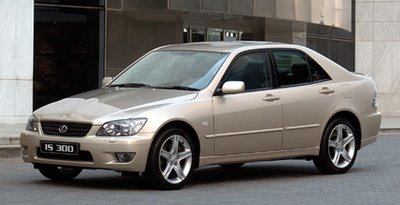
[photo: A somewhat older model IS 300. You, too, can do your patriotic part against Japan in President Roh Moohyun's "diplomatic war" by purchasing this overpriced monstrosity and having your infant child or drunken co-workers throw up all over the backseat.]
To the untrained observer, the surge in popularity of Toyota's luxury line might seem like many Korean consumers actually favor Japanese goods, but socio-cultural experts and old Korean hands can attest that the increase in sales masks a cleverly hidden and subtle form of duplicity on the part of the average Korean.
The fact is, they seek to buy Japanese cars so that they can drive them out in Seoul traffic and park them in Seoul parking lots where it is virtually guaranteed they will be scratched up. This passive aggressive form of animosity and enmity can also be seen in moviegoers who buy tickets to Japanese movies just so they can fall asleep during them, or club-goers who deliberately dance badly to J-pop (or sing really sucky karaoke).
It is reported that even those whose expensive Lexus somehow fail to be scratched up by other cars, motorcycles, and trucks edging by secretly harbor fantasies about cutting off their little pinkies while inside the vehicle and getting blood all over the high-grade leather interior.
The future of Japan-Korea relations indeed looks grim.
.jpg)
[photo: A somewhat older model IS 300. You, too, can do your patriotic part against Japan in President Roh Moohyun's "diplomatic war" by purchasing this overpriced monstrosity and having your infant child or drunken co-workers throw up all over the backseat.]
Korean automakers hit five-million mark
Apparently it's easier to clone cars than people. AP reports that worldwide vehicle sales for South Korea's five automakers (Hyundai, Kia, GM Daewoo, Ssangyong, and Renault Samsung) rose to 5.22 million vehicles last year.
This is a 15.6 percent increase over the 4.52 million in 2004 (both figures include sales of vehicles manufactured at overseas plants).
This is on the strength of increasing exports (which rose 19.1 percent to 4.09 million vehicles) and somewhat strong growth of domestic sales (which rose a modest 4.3 percent to 1.13 million, the first year-on-year gain in three years).
The domestic recovery comes after consumer buying went down sharply after rollbacks in Korea's formerly free-wheeling credit industry. Experts expect strong numbers this year, too.
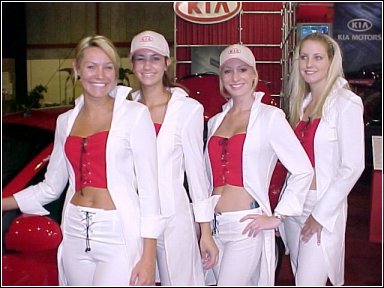
[photo: Though young women at auto shows, like these four in South Africa, no doubt helped boost sales of Korean vehicles worldwide, they don't actually come with the car.]
Hyundai sales were up 11 percent to 2.53 million vehicles. Kia, now a Hyundai affiliate, was up 13.9 percent to 1.27 vehicles. GM Daewoo, the South Korean unit of General Motors, was up a whopping 28.6 percent to rival Kia with sales of 1.16 million vehicles.
Small-fries Ssangyong and Samsung had numbers so low they don't warrant space on my blog. Follow the link for their numbers.
This is a 15.6 percent increase over the 4.52 million in 2004 (both figures include sales of vehicles manufactured at overseas plants).
This is on the strength of increasing exports (which rose 19.1 percent to 4.09 million vehicles) and somewhat strong growth of domestic sales (which rose a modest 4.3 percent to 1.13 million, the first year-on-year gain in three years).
The domestic recovery comes after consumer buying went down sharply after rollbacks in Korea's formerly free-wheeling credit industry. Experts expect strong numbers this year, too.

[photo: Though young women at auto shows, like these four in South Africa, no doubt helped boost sales of Korean vehicles worldwide, they don't actually come with the car.]
Hyundai sales were up 11 percent to 2.53 million vehicles. Kia, now a Hyundai affiliate, was up 13.9 percent to 1.27 vehicles. GM Daewoo, the South Korean unit of General Motors, was up a whopping 28.6 percent to rival Kia with sales of 1.16 million vehicles.
Small-fries Ssangyong and Samsung had numbers so low they don't warrant space on my blog. Follow the link for their numbers.
Happy New Unification Minister!
 President Roh Moohyun announced on Monday that 48-year-old Lee Jong-seok [at left], a top official at the National Security Council that oversees South Korea's foreign and security policies, will succeed Chung Dong-young as unification minister.
 Chung, a preening, self-promoting former TV news anchor whose smug look when he talks about North Korea makes even pacifists want to choke him, has quit in order to shore up the ruling Uri Party's plummeting popularity ahead of elections in May and prepare for his own run for the presidency at the end of next year [Kushibo shudders].
The AP report describes Lee as "a respected expert on the North" who is "considered an architect of Roh's policy on the communist neighbor." He is "reform-minded" and supports engagement with North Korea, but "critics accuse him of being pro-Pyongyang." That's putting it diplomatically.
Via the Chongwadae (Blue House) website, senior presidential secretary for personnel affairs Kim Wan-key had this to say about Lee:
Lee is an expert on North Korea.... He has played an important role in embodying the government's philosophy in foreign and security affairs.Yeah, that's what makes me nervous. Which part of the government's "philosophy" is he responsible for? Reducing the number of North Koreans who can make it to South Korea? Declaring a "diplomatic war" on Tokyo to pander for support from jingoists with no sense of what's in South Korea's interests? Allowing relations with Washington to deteriorate?
Last week Marmot had mentioned Lee as a possible successor to Comrade Chung. What he wrote about Lee embodies what is wrong with so many of Roh's choices, but he also offers some positive thoughts:
Actually, seeing Lee become Unification Minister might not be as disastrous as it would initially seem. Lots of negative things could be said about Lee, the supposed head of the Cheong Wa Dae Taliban faction, but the former Sejong Institute scholar is a legitimate North Korea expert. In his current position as deputy NSC chief, he's handicapped by the fact that the only thing he really knows about is North Korea. As Unification Minister, the narrow nature of his area of expertise could be less of a problem.I don't know if that really makes me feel better, but at least it offers some hope.
We don't need another ideologue [coincidentally, pronounced a lot like idiot log]; the Roh administration has had too many people that are so far to the left you can't see them because of the curvature of the Earth.
What we need is a pragmatist who sees and is willing to address how North Korea itself creates problems for South Korean security, Seoul's own "Sunshine Policy," and healthy ROK-US relations.
Monday, January 2, 2006
This blog unviewable in China
Coming Anarchy reports that blogspot.com (among a number of other services) is not viewable in China.
Is this my fault? Did I piss them off with this, this, this, this, or even this?
Or was it free speech in general that got them nervous?
Or maybe it was this:

[I would amend this map to include at least a strip along North Korea as Occupied Korea , and maybe next to that Occupied Manchuria, but I'm not married to the idea.]
Is this my fault? Did I piss them off with this, this, this, this, or even this?
Or was it free speech in general that got them nervous?
Or maybe it was this:
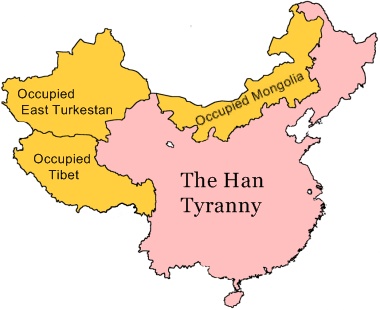
[I would amend this map to include at least a strip along North Korea as Occupied Korea , and maybe next to that Occupied Manchuria, but I'm not married to the idea.]
Sunday, January 1, 2006
새해 큰福 누리세요! Happy New Year!
새해 福 많이 많이 받에세요. Happy New Year, one and all!
Usually at this time of year, I am visiting my family in Orange County, California, and we have driven up to Las Vegas, Nevada to visit my komo and her family (growing up, we were like one giant extended family). But this year, due to an excessive amount of work, I simply could not get away.
The last time I found myself in Seoul at New Year's was several years ago. My ex-fiancée had called me up out of the blue and asked me to be with her at midnight. The fireworks from Namsan, viewable from the terrace of the house I lived in then, was enough of a spark to rekindle our tumultuous on-again, off-again romance (what I've heard referred to a "lightbulb romance") for another few months.
I had dinner with the family of someone close who was also very tired, so when I then found myself alone again around 10:30 p.m., I decided to take advantage of being in Seoul and do what I had long thought about doing: going to Chonggak Station [Jonggak] and joining the sea of people there as they light off fireworks and then listen to the ancient bell at Poshin-gak Belfry [Bosingak].
People told me I was crazy, that it would be wall to wall people packed like sardines. But I figured I'd try anyway. After all, I live on the southern edge of what is considered "downtown Seoul," so I wouldn't have to worry about taking a taxi or public transportation (whose hours were extended for New Year's Eve) and if it got too crowded, I could always just turn back.
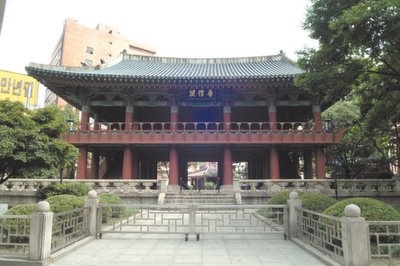
[photo: Poshingak Belfry by day, with a lot fewer people than on New Year's Eve.]
I passed Namdaemun Gate and there weren't that many people. By the time I got to City Hall Plaza, more people were milling around and admiring all the lights. I arrived at Ch´ŏnggye Plaza, at the "head" of the refurbished Ch´ŏnggyechŏn Stream [Jeonggyecheon], where there were a lot of people lighting off a lot of firecrackers and other incendiary devices, but it wasn't the morning-rush-hour-in-Sadang-Station that I was expecting.
Hundreds of people were lighting what looked like giant Pixie sticks which fired off streams of mini-fireworks in succession. Riot-control buses were blocking off most of the entrance to the area around Poshin-gak, but they had left an opening where people could stream in. It was then 11:53 p.m., so I decided to see if I could get in there. Even if I couldn't, if I could just hear the bell, I'd have been satisfied.
People were milling around and taking pictures with all form of camera phone and digital camera. Lots of families, lots of couples. And an awful lot of international residents and visitors. I could hear a lot of people speaking Japanese to each other. Just as midnight came there was a disjointed non-unison chorus of "Five, four, three, two, one!" (yes, in English; since New Year's is all about the future, and English is Korea's future, this seemed appropriate.).
When midnight came, it seemed everyone started firing off those mini-fireworks. The sky was filled with the sound of cracking boomettes and what I imagined a barrage of North Korean artillery would look like if Pyongyang ever made good on their frequent threat to "rain fire down on Seoul."
Over the cracking sounds and the cheering, I finally heard the low droning of the bell being rung. I don't know how many times it rang. I'm guessing it wasn't 2,006. Or 4,339 for that matter.
For those of you still stuck in 2005, here's some news from the future.
1. So far, the average temperature this year is much colder than the average temperature last year.
2. Hurricanes and typhoons are so far non-existent this year, apparently some kind of record.
3. I haven't changed my underwear all year.
My New Year's resolutions:
1. Clean up my damn apartment (especially the little room) so I can rent it out when I go to the States for school in September.
2. Finish everything I was supposed to do last year.
Anyway, here's wishing a wonderful Tangun Year 4339 to you! May it be even better than Tangun Year 4338!
Usually at this time of year, I am visiting my family in Orange County, California, and we have driven up to Las Vegas, Nevada to visit my komo and her family (growing up, we were like one giant extended family). But this year, due to an excessive amount of work, I simply could not get away.
The last time I found myself in Seoul at New Year's was several years ago. My ex-fiancée had called me up out of the blue and asked me to be with her at midnight. The fireworks from Namsan, viewable from the terrace of the house I lived in then, was enough of a spark to rekindle our tumultuous on-again, off-again romance (what I've heard referred to a "lightbulb romance") for another few months.
I had dinner with the family of someone close who was also very tired, so when I then found myself alone again around 10:30 p.m., I decided to take advantage of being in Seoul and do what I had long thought about doing: going to Chonggak Station [Jonggak] and joining the sea of people there as they light off fireworks and then listen to the ancient bell at Poshin-gak Belfry [Bosingak].
People told me I was crazy, that it would be wall to wall people packed like sardines. But I figured I'd try anyway. After all, I live on the southern edge of what is considered "downtown Seoul," so I wouldn't have to worry about taking a taxi or public transportation (whose hours were extended for New Year's Eve) and if it got too crowded, I could always just turn back.

[photo: Poshingak Belfry by day, with a lot fewer people than on New Year's Eve.]
I passed Namdaemun Gate and there weren't that many people. By the time I got to City Hall Plaza, more people were milling around and admiring all the lights. I arrived at Ch´ŏnggye Plaza, at the "head" of the refurbished Ch´ŏnggyechŏn Stream [Jeonggyecheon], where there were a lot of people lighting off a lot of firecrackers and other incendiary devices, but it wasn't the morning-rush-hour-in-Sadang-Station that I was expecting.
Hundreds of people were lighting what looked like giant Pixie sticks which fired off streams of mini-fireworks in succession. Riot-control buses were blocking off most of the entrance to the area around Poshin-gak, but they had left an opening where people could stream in. It was then 11:53 p.m., so I decided to see if I could get in there. Even if I couldn't, if I could just hear the bell, I'd have been satisfied.
People were milling around and taking pictures with all form of camera phone and digital camera. Lots of families, lots of couples. And an awful lot of international residents and visitors. I could hear a lot of people speaking Japanese to each other. Just as midnight came there was a disjointed non-unison chorus of "Five, four, three, two, one!" (yes, in English; since New Year's is all about the future, and English is Korea's future, this seemed appropriate.).
When midnight came, it seemed everyone started firing off those mini-fireworks. The sky was filled with the sound of cracking boomettes and what I imagined a barrage of North Korean artillery would look like if Pyongyang ever made good on their frequent threat to "rain fire down on Seoul."
Over the cracking sounds and the cheering, I finally heard the low droning of the bell being rung. I don't know how many times it rang. I'm guessing it wasn't 2,006. Or 4,339 for that matter.
For those of you still stuck in 2005, here's some news from the future.
1. So far, the average temperature this year is much colder than the average temperature last year.
2. Hurricanes and typhoons are so far non-existent this year, apparently some kind of record.
3. I haven't changed my underwear all year.
My New Year's resolutions:
1. Clean up my damn apartment (especially the little room) so I can rent it out when I go to the States for school in September.
2. Finish everything I was supposed to do last year.
Anyway, here's wishing a wonderful Tangun Year 4339 to you! May it be even better than Tangun Year 4338!
Run amok?
Nomad posted a couple stories about a group of USFK personnel in Uijongbu who robbed a taxi driver and then locked him in the trunk of his car. Last week they admitted what they had done, and we're waiting to see how the case will be handled.
A commenter named justpassingthru through claims that this same group of people has beaten down a bar owner and his wife, but they were still running around. Nomad himself is incredulous about the claim:
It is this kind of thing that, when reported, feeds the common Korean public perception (well, mostly misperception as far as I'm aware) that too many USFK personnel have for too long run amok without fear of real punishment by a military organization that lets things slide when Korean nationals are victims of such crime by USFK personnel.*
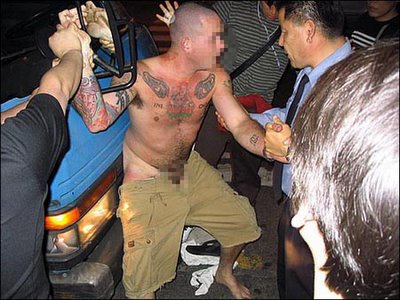 This, plus the taxi jumpers and the alleged stabber in Shinchon who managed to make a spectacle on camera (GI Korea suggests the half-naked guy [seen above in what GI Korea describes as a staged photo] with the yakuza-esque tattoos who was willingly breaking regulations against being in an off-limits area "was probably a good kid just out having a good time with his friends"), are a composite image that, sadly, can eclipse the many good deeds of thousands of law-abiding, hard-working USFK personnel.
*A proper refutation of this perception would address how USFK personnel crime is taken seriously by USFK, not point out, correctly or not, that the Korean judicial system does not take seriously crimes committed by Korean nationals against USFK personnel.
A commenter named justpassingthru through claims that this same group of people has beaten down a bar owner and his wife, but they were still running around. Nomad himself is incredulous about the claim:
So you're saying that's correct? The same guys previously beat up a bar owner and his wife? I'm having a hard time believing they did that and were still walking around free.If it is true (and I will retract some of this if it turns out it isn't), then I have something to say about this. [Before I begin, I want to make clear that I'm saying this from a personally held point-of-view that USFK is mostly well-behaved and that the chinbo "progressives" who want to push USFK off the peninsula to remove what they believe is the primary obstacle to peaceful unification seek to blow any incident out of proportion.]
It is this kind of thing that, when reported, feeds the common Korean public perception (well, mostly misperception as far as I'm aware) that too many USFK personnel have for too long run amok without fear of real punishment by a military organization that lets things slide when Korean nationals are victims of such crime by USFK personnel.*
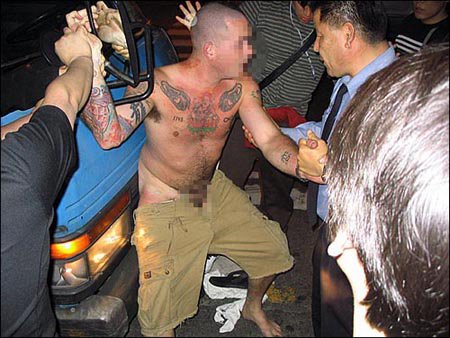 This, plus the taxi jumpers and the alleged stabber in Shinchon who managed to make a spectacle on camera (GI Korea suggests the half-naked guy [seen above in what GI Korea describes as a staged photo] with the yakuza-esque tattoos who was willingly breaking regulations against being in an off-limits area "was probably a good kid just out having a good time with his friends"), are a composite image that, sadly, can eclipse the many good deeds of thousands of law-abiding, hard-working USFK personnel.
*A proper refutation of this perception would address how USFK personnel crime is taken seriously by USFK, not point out, correctly or not, that the Korean judicial system does not take seriously crimes committed by Korean nationals against USFK personnel.
Subscribe to:
Posts (Atom)