For anyone interested in Korean history, this archive deserves your attention long enough to get to the punchline.
Copy from Admiral Nimitz' press conference at Pearl Harbor clacked monotonously on one of the Associated Press's San Francisco teletypes. Suddenly a side item from Pearl Harbor set another teletype going. Bureau Manager Harold Turnblad whistled in surprise as he read: "Powerful Allied naval forces have attacked a portion of the Japanese fleet lying at anchor near the entrance to Fusan Harbor on the southeast coast of Korea . . . 26 of approximately 80 ships . . . were set afire . . . more than 70 Japanese vessels, including warships and transports, were . . . sunk."
Turnblad got off a bulletin over the A.P. domestic wire. Then the Honolulu teletype bucked and started again with the last line of the attack story, quoting Admiral Nimitz: "This communiqué, incidentally, is dated late June, 1592." Turnblad's whistle died. He fired a stop order after his bulletin, soon enough to catch the newspapers, but too late to prevent a broadcast over some San Francisco stations.
Later the red-faced A.P. explained to press and radio editors: "The Honolulu dispatch . . . gave no indication that Nimitz was jesting until transmission of the text of his simulated communique had been completed. The bulletin was killed . . . the moment the San Francisco cable desk discovered the Admiral was . . . quoting medieval history."
Ah, yes. The unstoppable Admiral Yi Sunshin of Kŏbuksŏn [geobukseon] ironclad Turtle Boat fame.
Tuesday, December 13, 2005


Racial unrest in Australia

I was alerted to this story on the Daum website, which had a link to an SBS news program: White versus Middle Eastern racial violence in Australia.
I don't know enough about what has happened (is happening?) in Australia to know who is acting in the wrong here, but it is this kind of news story that leads many Koreans (and their Japanese neighbors) to feel that ethnic/racial diversity is an invitation to disaster.
Of course, one could just as easily argue that knee-jerk opposition to diversity is the real culprit.
Wikipedia? Whackypedia!
If you find yourself bored, go onto Wikipedia's site and edit the biography of prominent individuals in your hometown. Just be prepared to apologize for it.
December 10, 1965 archives: Confucius' Outcasts
Though this archived story is forty years old this week, I think it underscores a lot of the images that linger even today. For Korea's baby boomer generation, which includes the parents of many young people today, humiliating stories like Annie Park's are a dominant image when they think about issues such as the US military, mixed-race dating and marriage, prostitution, and even adoption. Images that heavily erode the overwhelming positives that the US military has brought to South Korea. Of course, none of that justifies xenophobia or maltreatment of young children or even opposition to "international marriage" today (or then), but old attitudes die hard.
At six, she followed her Korean mother to a ramshackle bar and discovered that her mother was for sale to U.S. servicemen. On the way home, alone, the little girl had an even more traumatic experience: a man lured her into an alley and assaulted her. At eight, she learned why classmates jeered "half-caste!" at her: her father had been a white G.I. At 16, she was a full-fledged prostitute working among American soldiers who liked her slim Occidental legs and ample breasts.
Now, at 19, after six abortions and uncounted liaisons with every variety of G.I., Annie Park is the most-talked-about girl in South Korea. With the help of a ghostwriter, she has published a bestselling autobiography that at last forces Koreans to think about something they would rather forget—the problem of illegitimate half-castes.
There are an estimated 20,000 half-caste children in Korea; 500 to 600 more are born each year. Sadly, even in their homeland, they are displaced persons from birth. Under the Confucian concept of tightly knit families, Korea's half-castes are considered outcasts. And the mixed-blood children remind many Koreans of the shame of widespread prostitution and of the subservient role Koreans have often had to play to the bigger and richer G.I.'s.
My Forsaken Star has been serialized in newspapers. Work began last week on a movie based on the book, and a television series is planned. But Koreans seem to savor the book more for its lurid details of commercial love than for the insights it gives into the plight of half-castes.
Some U.S. welfare groups have actually come to grips with the half-caste problem. In the past ten years, 5,670 mixed-blood children have been adopted by families in the U.S. through such groups as the Holt Adoption Program, the National Catholic Welfare Conference and the Child Placement Service. But the vast majority of these children are the offspring of white G.I.s. Finding foster parents for Negro-fathered children is much harder. With that in mind, the Pearl S. Buck Foundation began operating in Korea just last month. Its initial hopes are modest: to provide funds directly to mothers of Negro-Korean children so that the little lost half-castes will have at least some chance of growing up with enough food to eat in homes of their own.
At six, she followed her Korean mother to a ramshackle bar and discovered that her mother was for sale to U.S. servicemen. On the way home, alone, the little girl had an even more traumatic experience: a man lured her into an alley and assaulted her. At eight, she learned why classmates jeered "half-caste!" at her: her father had been a white G.I. At 16, she was a full-fledged prostitute working among American soldiers who liked her slim Occidental legs and ample breasts.
Now, at 19, after six abortions and uncounted liaisons with every variety of G.I., Annie Park is the most-talked-about girl in South Korea. With the help of a ghostwriter, she has published a bestselling autobiography that at last forces Koreans to think about something they would rather forget—the problem of illegitimate half-castes.
There are an estimated 20,000 half-caste children in Korea; 500 to 600 more are born each year. Sadly, even in their homeland, they are displaced persons from birth. Under the Confucian concept of tightly knit families, Korea's half-castes are considered outcasts. And the mixed-blood children remind many Koreans of the shame of widespread prostitution and of the subservient role Koreans have often had to play to the bigger and richer G.I.'s.
My Forsaken Star has been serialized in newspapers. Work began last week on a movie based on the book, and a television series is planned. But Koreans seem to savor the book more for its lurid details of commercial love than for the insights it gives into the plight of half-castes.
Some U.S. welfare groups have actually come to grips with the half-caste problem. In the past ten years, 5,670 mixed-blood children have been adopted by families in the U.S. through such groups as the Holt Adoption Program, the National Catholic Welfare Conference and the Child Placement Service. But the vast majority of these children are the offspring of white G.I.s. Finding foster parents for Negro-fathered children is much harder. With that in mind, the Pearl S. Buck Foundation began operating in Korea just last month. Its initial hopes are modest: to provide funds directly to mothers of Negro-Korean children so that the little lost half-castes will have at least some chance of growing up with enough food to eat in homes of their own.
Monday, December 12, 2005
March 12, 1945 archives
Excerpted from "No Easy Road"
Hosts and Guests.
On behalf of Russia, Britain and China, the U.S. invited 39 other "United Nations" to San Francisco on April 24. Still huffed by its cavalier treatment at Yalta and after, France agreed to attend the Conference but not to sponsor it.
The list of guests showed that, at best, Europe's representation will be weak. All of its Governments are provisional or exiled. Only Norway will represent Scandinavia. Last week's invitations skipped Poland entirely. It will be represented at San Francisco only if the compromise Government agreed on at Yalta is formed in time.
Invitations went last week to three countries—Turkey, Egypt, Saudi Arabia—which scurried under the wire by March 1, the deadline for war declarations set at Yalta. Syria and Lebanon also beat the deadline, but were not invited (they are still juridically French mandates). Korea's Provisional Government in Chungking tried to get a place by declaring war on Japan, but did not yet rate membership in the United Nations.
Hosts and Guests.
On behalf of Russia, Britain and China, the U.S. invited 39 other "United Nations" to San Francisco on April 24. Still huffed by its cavalier treatment at Yalta and after, France agreed to attend the Conference but not to sponsor it.
The list of guests showed that, at best, Europe's representation will be weak. All of its Governments are provisional or exiled. Only Norway will represent Scandinavia. Last week's invitations skipped Poland entirely. It will be represented at San Francisco only if the compromise Government agreed on at Yalta is formed in time.
Invitations went last week to three countries—Turkey, Egypt, Saudi Arabia—which scurried under the wire by March 1, the deadline for war declarations set at Yalta. Syria and Lebanon also beat the deadline, but were not invited (they are still juridically French mandates). Korea's Provisional Government in Chungking tried to get a place by declaring war on Japan, but did not yet rate membership in the United Nations.
May 21, 1945 archives
Excerpted from "The God-Emperor"
Crucial Question.
Clearly, the Japanese mind does not want a change. Rumors of peace bids by Tokyo have been flooding Allied capitals. One, emanating last week from London, reported the Suzuki Government willing to disgorge all Japanese conquests except Korea; in return, there must be no Allied occupation of the main Japanese islands, and presumably no interference with the Shinto system.
The rumors found no public echo in Japan. Radio Tokyo, as defiant as ever, took full responsibility for starting the war in the East, pledged a battle alone "to smash the enemy, to avenge fallen Germany." An emergency Cabinet meeting drafted an emergency statement: the collapse of the Nazi Reich "will not bring the slightest change" in Japan's determination to fight to the finish. Emperor Hirohito gave the statement his divine approval.
But though the will of the Shinto mind was strong for a finish fight, time and inevitable history were stronger still. Ancient Egypt, said Elie Faure, died of her desire for immortality. In the 20th Century world, two of whose greatest powers were leagued in overwhelming military force against him, the crucial question facing Hirohito, as the divine symbol of an immortal dynasty, was: how long can an anachronism last?
Crucial Question.
Clearly, the Japanese mind does not want a change. Rumors of peace bids by Tokyo have been flooding Allied capitals. One, emanating last week from London, reported the Suzuki Government willing to disgorge all Japanese conquests except Korea; in return, there must be no Allied occupation of the main Japanese islands, and presumably no interference with the Shinto system.
The rumors found no public echo in Japan. Radio Tokyo, as defiant as ever, took full responsibility for starting the war in the East, pledged a battle alone "to smash the enemy, to avenge fallen Germany." An emergency Cabinet meeting drafted an emergency statement: the collapse of the Nazi Reich "will not bring the slightest change" in Japan's determination to fight to the finish. Emperor Hirohito gave the statement his divine approval.
But though the will of the Shinto mind was strong for a finish fight, time and inevitable history were stronger still. Ancient Egypt, said Elie Faure, died of her desire for immortality. In the 20th Century world, two of whose greatest powers were leagued in overwhelming military force against him, the crucial question facing Hirohito, as the divine symbol of an immortal dynasty, was: how long can an anachronism last?
Sunday, December 11, 2005
July 30, 1945 archives: Top Secret
Premier T. V. Soong was back in Chungking last week. But what he and Generalissimo Joseph Stalin had talked about in Moscow was a top secret.
One version of the Soong-Stalin talks came from a French source. Primarily, the Chinese Premier had sought Russian support for China's fight against Japan and a Russian pledge not to recognize the Chinese Communist regime. Stalin indicated that he would give the pledge on three conditions : 1) China must be democratized through a coalition government worked out between Chungking and Yenan; 2) China must agree to special Russian rights in Sinkiang, Outer Mongolia and China's northern provinces; 3) China must agree to Korea's independence.
T. V. replied that China was ready to negotiate over "special regions." He implied that Russia could have back her pre-1937 railway rights in Manchuria. He suggested a condominium for Outer Mongolia (over which Chungking claims sovereignty). But its Soviet-dominated government must sign a mutual assistance pact with Chungking similar to the one it had signed with Moscow. He conceded that Korea should be independent. But T.V. could not agree to special political status for Russia in Sinkiang, which would jeopardize China's sovereign rights. Nor could he assent to naval or air bases for Russia in Manchuria. As to China's democratization, Chungking had long striven for it and for an understanding with Yenan. The Russians felt that a durable accord between Moscow and Chungking must be preceded by peace between Generalissimo Chiang's Government and the Chinese Communists. T.V., it was decided, would report back to Chungking, return to Moscow next month.
One version of the Soong-Stalin talks came from a French source. Primarily, the Chinese Premier had sought Russian support for China's fight against Japan and a Russian pledge not to recognize the Chinese Communist regime. Stalin indicated that he would give the pledge on three conditions : 1) China must be democratized through a coalition government worked out between Chungking and Yenan; 2) China must agree to special Russian rights in Sinkiang, Outer Mongolia and China's northern provinces; 3) China must agree to Korea's independence.
T. V. replied that China was ready to negotiate over "special regions." He implied that Russia could have back her pre-1937 railway rights in Manchuria. He suggested a condominium for Outer Mongolia (over which Chungking claims sovereignty). But its Soviet-dominated government must sign a mutual assistance pact with Chungking similar to the one it had signed with Moscow. He conceded that Korea should be independent. But T.V. could not agree to special political status for Russia in Sinkiang, which would jeopardize China's sovereign rights. Nor could he assent to naval or air bases for Russia in Manchuria. As to China's democratization, Chungking had long striven for it and for an understanding with Yenan. The Russians felt that a durable accord between Moscow and Chungking must be preceded by peace between Generalissimo Chiang's Government and the Chinese Communists. T.V., it was decided, would report back to Chungking, return to Moscow next month.
A corpse
I was driving home, about half an hour ago when I came upon a scene that may haunt my thoughts for a while. Along Hangang-no Boulevard, just north of Shinyongsan Station, the traffic began to slow down and I noticed about four men standing in the road, directing traffic around something. I assumed the obstacle was one or two cars involved in a fender bender, something I've encountered frequently on Seoul roads.
But as I slowly approached, it was obvious there was no car. There was a person lying in the road, motionless. Instinct had me reaching for my cell phone to call 119, Korea's emergency number, but I quickly saw that there were already people around this person handling this: surely one of them would have called for an ambulance.
But it became very apparent that it was too late for that. The body faced downward, into the pavement, and the head was in a pool of blood. The four men were not attempting to revive the man, whose suit jacket was bunched up around the upper torso, which was another clue to the obvious.
Other than a medical cadaver, it was the first time I had seen a dead body in person. More than the blood or the fact that the man was dead, it was the method of dying that had me so rattled and disturbed. The likely salaryman was lying in the middle of a major thoroughfare, meaning that, unless he was actually thrown from some vehicle (doubtful, since there was no damaged vehicle around), he had been jaywalking.
Jaywalking among sober people is not unusual, but given the time of day (around midnight) and the location (a wide boulevard with plenty of cars and buses in both directions), it is more probable (though not certain) that the victim was inebriated. Too much soju and/or beer impairs the judgement enough that jaywalking across eight lanes of traffic seems doable.
Unfortunately, this happens all too often in parts of the city, especially around "entertainment" areas. As a driver, one of my darkest fears is the possibility that I might plow into a drunk jaywalker. Another related fear is that some child will run out in front of my car and I won't be able to stop.
In fact, I have had a few near misses, as have other people I know. One might be driving down a highway, scanning normally for headlights, traffic signals, and lines painted on the road, when suddenly a person is standing where a person shouldn't be. Sometimes it is too late to brake or swerve out of the way.
This man almost certainly left behind loved ones who will miss him. Maybe a wife and children who will grow up fatherless, maybe even penniless. My sadness for their loss gives way to anger that someone would so fucking foolishly -- and selfishly -- drink themselves into such a stupor that stepping into traffic doesn't set off alarm bells in their head or in the head of those with them. The effects of stupidity rarely stop with the stupid themselves.
But as I slowly approached, it was obvious there was no car. There was a person lying in the road, motionless. Instinct had me reaching for my cell phone to call 119, Korea's emergency number, but I quickly saw that there were already people around this person handling this: surely one of them would have called for an ambulance.
But it became very apparent that it was too late for that. The body faced downward, into the pavement, and the head was in a pool of blood. The four men were not attempting to revive the man, whose suit jacket was bunched up around the upper torso, which was another clue to the obvious.
Other than a medical cadaver, it was the first time I had seen a dead body in person. More than the blood or the fact that the man was dead, it was the method of dying that had me so rattled and disturbed. The likely salaryman was lying in the middle of a major thoroughfare, meaning that, unless he was actually thrown from some vehicle (doubtful, since there was no damaged vehicle around), he had been jaywalking.
Jaywalking among sober people is not unusual, but given the time of day (around midnight) and the location (a wide boulevard with plenty of cars and buses in both directions), it is more probable (though not certain) that the victim was inebriated. Too much soju and/or beer impairs the judgement enough that jaywalking across eight lanes of traffic seems doable.
Unfortunately, this happens all too often in parts of the city, especially around "entertainment" areas. As a driver, one of my darkest fears is the possibility that I might plow into a drunk jaywalker. Another related fear is that some child will run out in front of my car and I won't be able to stop.
In fact, I have had a few near misses, as have other people I know. One might be driving down a highway, scanning normally for headlights, traffic signals, and lines painted on the road, when suddenly a person is standing where a person shouldn't be. Sometimes it is too late to brake or swerve out of the way.
This man almost certainly left behind loved ones who will miss him. Maybe a wife and children who will grow up fatherless, maybe even penniless. My sadness for their loss gives way to anger that someone would so fucking foolishly -- and selfishly -- drink themselves into such a stupor that stepping into traffic doesn't set off alarm bells in their head or in the head of those with them. The effects of stupidity rarely stop with the stupid themselves.
Saturday, December 10, 2005
It's the last supper for them, that's for sure.
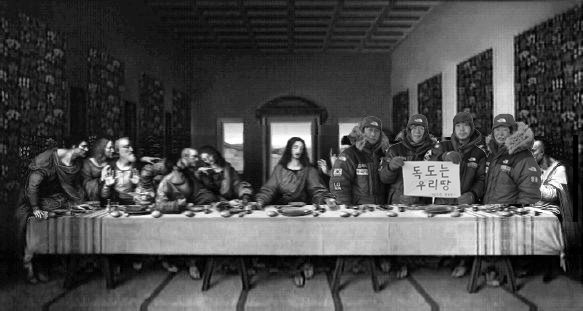
Contemporary accounts say the behavior of the oddly-dressed visitors was rather inappropriate.
[more on these gentlemen can be found here]
August 24, 1942 archives: Straight to the armpit
Kilsoo K. Haan, U.S. representative of both the admittedly revolutionary Korean National Front Federation and the Sino-Korean Peoples' League, is Korea's most vocal Washington spokesman. He is short and 42; he wears rimless spectacles and is given to loud, figured ties. He is often heard, seldom heeded. But last week Kilsoo Haan came into his own.
Papers throughout the U.S. featured his "secret report" that a young Korean patriot had shot and slightly wounded Japanese Premier Hideki Tojo on June 17. The would-be assassin's second shot went wild, but seriously wounded onetime Premier Koki Hirota. As Tojo was carried to the hospital with a wound "under the left armpit," the patriot, whose name was Park Soowon, was shot full of holes by Japanese police, who in the process brought down the Japanese ace, Major Yuzo Fujita, and two Japanese photographers. Tokyo police succeeded in rounding up go-odd members of a Korean terrorist group that has been operating in Yokohama, Tokyo and Osaka, but, said Kilsoo Haan, "their number is legion, and they will continue to operate."
Although his scoop had yet to be confirmed, Kilsoo Haan was serenely confident that it would be. As evidence of its plausibility, he drew up a list of Korean acts of terrorism. The list was more notable for length than for accuracy. Most impressive of the checkable acts was the 1932 bombing of a reviewing stand in Shanghai after a parade in honor of Japan's Emperor: General Yoshinori Shirakawa lost his life, Minister to China Mamoru Shigemitsu his leg and Admiral Kichisaburo Nomura his right eye. Author of that bombing was one In Hokichi. As for most other Korean terrorists, their aim was no better than Park Soowon's.
Papers throughout the U.S. featured his "secret report" that a young Korean patriot had shot and slightly wounded Japanese Premier Hideki Tojo on June 17. The would-be assassin's second shot went wild, but seriously wounded onetime Premier Koki Hirota. As Tojo was carried to the hospital with a wound "under the left armpit," the patriot, whose name was Park Soowon, was shot full of holes by Japanese police, who in the process brought down the Japanese ace, Major Yuzo Fujita, and two Japanese photographers. Tokyo police succeeded in rounding up go-odd members of a Korean terrorist group that has been operating in Yokohama, Tokyo and Osaka, but, said Kilsoo Haan, "their number is legion, and they will continue to operate."
Although his scoop had yet to be confirmed, Kilsoo Haan was serenely confident that it would be. As evidence of its plausibility, he drew up a list of Korean acts of terrorism. The list was more notable for length than for accuracy. Most impressive of the checkable acts was the 1932 bombing of a reviewing stand in Shanghai after a parade in honor of Japan's Emperor: General Yoshinori Shirakawa lost his life, Minister to China Mamoru Shigemitsu his leg and Admiral Kichisaburo Nomura his right eye. Author of that bombing was one In Hokichi. As for most other Korean terrorists, their aim was no better than Park Soowon's.
May 26, 1941 archives: Luke 6:42
Damn Christians trying to let moral development get in the way of unbridled capitalism!
If the U.S. wants a good and lasting peace after the war, perhaps the U.S. should look to its own policies before it starts preaching to other powers.
That is the assumption on which the Federal Council of Churches' distinguished Committee to Study the Bases of a Just and Durable Peace this week began lining up the organized support of U.S. Protestantism for a revolutionary move. They did not go so far as to suggest that the U.S. should follow the Golden Rule. They did, however, propose that Congress set up a Federal agency to study the economic harm that might be done to other countries by any proposed change in U.S. foreign trade, tariff, immigration or monetary policy.
In other words, the Committee did not suggest that the U.S. abridge its right to pass laws which might throw thousands of people out of work elsewhere (as the Smoot-Hawley Tariff did). What they urged was that before such laws can be passed, Congress should be legally bound to ascertain what their effect abroad would be, so that it could legislate with its eyes open.
While Congress is establishing this agency here, the President would be requested to invite other nations to take parallel action.
"A sovereignty system which accords the right to use economic power irresponsibly has become an anachronism no longer consistent with peace," the Committee declared. "What one nation does with regard to its raw materials, markets, immigration, or money may vitally affect millions elsewhere."
If the U.S. wants a good and lasting peace after the war, perhaps the U.S. should look to its own policies before it starts preaching to other powers.
That is the assumption on which the Federal Council of Churches' distinguished Committee to Study the Bases of a Just and Durable Peace this week began lining up the organized support of U.S. Protestantism for a revolutionary move. They did not go so far as to suggest that the U.S. should follow the Golden Rule. They did, however, propose that Congress set up a Federal agency to study the economic harm that might be done to other countries by any proposed change in U.S. foreign trade, tariff, immigration or monetary policy.
In other words, the Committee did not suggest that the U.S. abridge its right to pass laws which might throw thousands of people out of work elsewhere (as the Smoot-Hawley Tariff did). What they urged was that before such laws can be passed, Congress should be legally bound to ascertain what their effect abroad would be, so that it could legislate with its eyes open.
While Congress is establishing this agency here, the President would be requested to invite other nations to take parallel action.
"A sovereignty system which accords the right to use economic power irresponsibly has become an anachronism no longer consistent with peace," the Committee declared. "What one nation does with regard to its raw materials, markets, immigration, or money may vitally affect millions elsewhere."
May 26, 1941 archives: Persecution
Sentenced to ten months in jail were two Presbyterian missionaries in Korea, Dr. De Witt S. Lowe and the Rev. E. Otto DeCamp. The charge: removing Shinto god shrines from the homes of their servants.
Sent to a German prison was the Most Rev. Joseph Philippe, Roman Catholic Bishop of Luxembourg. His flock learned the news from Cardinal Kinsley over the British radio.
To vindicate the story of Jonah and the whale, Chicago's Pharmacology Professor Eugene Maximilian Karl Ceiling crawled through the gullet of a dead cetacean to prove it could be done. "It was a pretty slimy trip," he said last week, "but there was plenty of room."
Sent to a German prison was the Most Rev. Joseph Philippe, Roman Catholic Bishop of Luxembourg. His flock learned the news from Cardinal Kinsley over the British radio.
To vindicate the story of Jonah and the whale, Chicago's Pharmacology Professor Eugene Maximilian Karl Ceiling crawled through the gullet of a dead cetacean to prove it could be done. "It was a pretty slimy trip," he said last week, "but there was plenty of room."
March 13, 1944 archives: Missionaries to Korea
In Brooklyn (at the Lafayette Avenue Presbyterian Church) last week a 53-year-old missionary and his 25-year-old twin sons were together ordained to the Presbyterian ministry. They were Dr. Horace H. Underwood (of the typewriter Underwoods), who was repatriated two years ago from Korea, and his sons, James and John, graduates of Princeton Theological Seminary. Dr. Underwood has had no theological training. His 32 years' work as a veteran missionary in Korea kept him "too busy to be ordained." But he has a Ph.D. from New York University, and Presbyterian usage permits the ordination of men with such qualifications upon two-thirds vote of the local presbytery.
The Underwoods, all born in Korea, chose an appropriate day for their triple ordination: the 25th anniversary of the day when 33 Korean patriots (15 of them Christians) drew up the Korean declaration of independence and brought down upon themselves the wrath of the Japanese.
First to Go In.
The first Underwood in Korea (while it was still the Hermit Kingdom) was Grandfather Horace Grant Underwood, who went there as Korea's first Protestant missionary in 1885. Though Seoul was swarming with cholera (Koreans call it "the rat in the stomach disease") old Dr. Underwood used to stride about unscathed in his black buttoned-up coat and white tie. He was extremely proud of the fact that he was the only ordained Calvinist in the city. Later he married a medical missionary, Lillias Horton, who became physician to Korea's Queen Min. Soon the Underwoods and the royal family, who were harassed by Russian and Japanese intrigues, were on very friendly terms.
Last week Grandfather Underwood's son recalled his Korean childhood. Queen Min used to dandle him on her royal knee. When the palace burned down the royal family moved next door to the Underwoods. When King Ik Song feared assassination, he sent for Grandfather Underwood and two other missionaries. They sat up all night guarding His Majesty with loaded revolvers.
Pearl Harbor Casualty.
After his education in the U.S., young Underwood returned to Korea to teach at Chosen Christian College, founded by his father. In 1934 he became the College's president, held the job until the Japanese ousted him the day after Pearl Harbor.
Teaching quick-witted Koreans was pleasant until the Japanese seized Manchuria (1931). Then the Japs dictated what should be taught, constantly suspected "dangerous thoughts." When one faculty member preached a chapel sermon on the exodus of the Israelites, the Japanese arrested him, charged him with preaching against them by parables. At last Dr. Underwood did not even dare visit Korean homes. Whenever he did, the Japanese police carted off his hosts to jail.
Evidence of Things Seen.
Dr. Underwood agrees that Christianizing Korea has been a slow task. Of the country's 23,000,000 people only some 500,000 are Christians. Koreans seem indifferent to religion. Buddhism has died out. Some educated people have embraced Confucianism, which Dr. Underwood considers "hardly a religion." Most Koreans are ancestor-worshipers.
But if the Christian missionaries have not brought the Koreans faith, Dr. Underwood claims that they have brought them education and a sense of national pride. Koreans were almost completely illiterate when the missionaries came. Korean Christians are now 90% literate, other Koreans 40%. The missionaries found literate Koreans using Chinese characters. They translated parts of the Bible into Korean characters, gradually taught Koreans to read their own tongue. Dr. Underwood also believes that Presbyterianism has shown the Korean people how democracy works.
One thing Dr. Underwood misses is his Korean hunting trips. In the winter he and his twin sons used to go into the wilds, hunt tigers and wild boars. Another Underwood hobby: early Korean naval history. In last month's Yachting Dr. Underwood has an article on a 16th Century naval battle when the Japanese attempted a Pearl Harbor on the Korean port of Fusan. The Koreans destroyed half the 500 Japanese ships.
Dr. Underwood is now working on missionary problems at Manhattan's Presbyterian Church headquarters, will return to Korea after the war. Of the two sons ordained with him, James will soon become a U.S. naval chaplain, John plans to return to Korea with his father.
The Underwoods, all born in Korea, chose an appropriate day for their triple ordination: the 25th anniversary of the day when 33 Korean patriots (15 of them Christians) drew up the Korean declaration of independence and brought down upon themselves the wrath of the Japanese.
First to Go In.
The first Underwood in Korea (while it was still the Hermit Kingdom) was Grandfather Horace Grant Underwood, who went there as Korea's first Protestant missionary in 1885. Though Seoul was swarming with cholera (Koreans call it "the rat in the stomach disease") old Dr. Underwood used to stride about unscathed in his black buttoned-up coat and white tie. He was extremely proud of the fact that he was the only ordained Calvinist in the city. Later he married a medical missionary, Lillias Horton, who became physician to Korea's Queen Min. Soon the Underwoods and the royal family, who were harassed by Russian and Japanese intrigues, were on very friendly terms.
Last week Grandfather Underwood's son recalled his Korean childhood. Queen Min used to dandle him on her royal knee. When the palace burned down the royal family moved next door to the Underwoods. When King Ik Song feared assassination, he sent for Grandfather Underwood and two other missionaries. They sat up all night guarding His Majesty with loaded revolvers.
Pearl Harbor Casualty.
After his education in the U.S., young Underwood returned to Korea to teach at Chosen Christian College, founded by his father. In 1934 he became the College's president, held the job until the Japanese ousted him the day after Pearl Harbor.
Teaching quick-witted Koreans was pleasant until the Japanese seized Manchuria (1931). Then the Japs dictated what should be taught, constantly suspected "dangerous thoughts." When one faculty member preached a chapel sermon on the exodus of the Israelites, the Japanese arrested him, charged him with preaching against them by parables. At last Dr. Underwood did not even dare visit Korean homes. Whenever he did, the Japanese police carted off his hosts to jail.
Evidence of Things Seen.
Dr. Underwood agrees that Christianizing Korea has been a slow task. Of the country's 23,000,000 people only some 500,000 are Christians. Koreans seem indifferent to religion. Buddhism has died out. Some educated people have embraced Confucianism, which Dr. Underwood considers "hardly a religion." Most Koreans are ancestor-worshipers.
But if the Christian missionaries have not brought the Koreans faith, Dr. Underwood claims that they have brought them education and a sense of national pride. Koreans were almost completely illiterate when the missionaries came. Korean Christians are now 90% literate, other Koreans 40%. The missionaries found literate Koreans using Chinese characters. They translated parts of the Bible into Korean characters, gradually taught Koreans to read their own tongue. Dr. Underwood also believes that Presbyterianism has shown the Korean people how democracy works.
One thing Dr. Underwood misses is his Korean hunting trips. In the winter he and his twin sons used to go into the wilds, hunt tigers and wild boars. Another Underwood hobby: early Korean naval history. In last month's Yachting Dr. Underwood has an article on a 16th Century naval battle when the Japanese attempted a Pearl Harbor on the Korean port of Fusan. The Koreans destroyed half the 500 Japanese ships.
Dr. Underwood is now working on missionary problems at Manhattan's Presbyterian Church headquarters, will return to Korea after the war. Of the two sons ordained with him, James will soon become a U.S. naval chaplain, John plans to return to Korea with his father.
Subscribe to:
Posts (Atom)