Monday, January 2, 2006

This blog unviewable in China

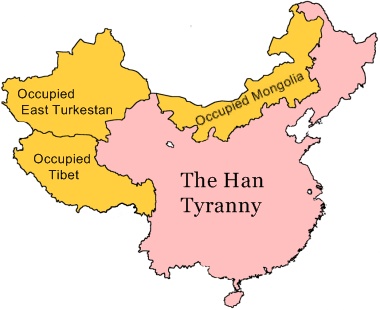
Coming Anarchy reports that blogspot.com (among a number of other services) is not viewable in China.

Is this my fault? Did I piss them off with
this, this, this, this, or even this?

Or was it free speech in general that got them nervous?

Or maybe it was
this:


[I would amend this map to include at least a strip along North Korea as Occupied Korea , and maybe next to that Occupied Manchuria, but I'm not married to the idea.]

Sunday, January 1, 2006

새해 큰福 누리세요! Happy New Year!

새해 福 많이 많이 받에세요. Happy New Year, one and all!

Usually at this time of year, I am visiting my family in Orange County, California, and we have driven up to Las Vegas, Nevada to visit my komo and her family (growing up, we were like one giant extended family). But this year, due to an excessive amount of work, I simply could not get away.

The last time I found myself in Seoul at New Year's was several years ago. My ex-fiancée had called me up out of the blue and asked me to be with her at midnight. The fireworks from Namsan, viewable from the terrace of the house I lived in then, was enough of a spark to rekindle our tumultuous on-again, off-again romance (what I've heard referred to a "lightbulb romance") for another few months.

I had dinner with the family of someone close who was also very tired, so when I then found myself alone again around 10:30 p.m., I decided to take advantage of being in Seoul and do what I had long thought about doing: going to Chonggak Station [Jonggak] and joining the sea of people there as they light off fireworks and then listen to the ancient bell at Poshin-gak Belfry [Bosingak].

People told me I was crazy, that it would be wall to wall people packed like sardines. But I figured I'd try anyway. After all, I live on the southern edge of what is considered "downtown Seoul," so I wouldn't have to worry about taking a taxi or public transportation (whose hours were extended for New Year's Eve) and if it got too crowded, I could always just turn back.
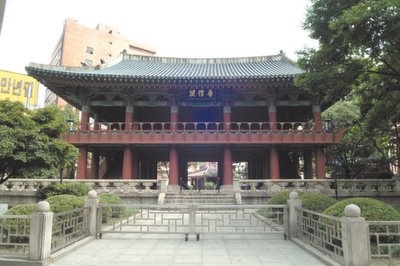


[photo: Poshingak Belfry by day, with a lot fewer people than on New Year's Eve.]

I passed Namdaemun Gate and there weren't that many people. By the time I got to City Hall Plaza, more people were milling around and admiring all the lights. I arrived at Ch´ŏnggye Plaza, at the "head" of the refurbished Ch´ŏnggyechŏn Stream [Jeonggyecheon], where there were a lot of people lighting off a lot of firecrackers and other incendiary devices, but it wasn't the morning-rush-hour-in-Sadang-Station that I was expecting.

Hundreds of people were lighting what looked like giant Pixie sticks which fired off streams of mini-fireworks in succession. Riot-control buses were blocking off most of the entrance to the area around Poshin-gak, but they had left an opening where people could stream in. It was then 11:53 p.m., so I decided to see if I could get in there. Even if I couldn't, if I could just hear the bell, I'd have been satisfied.

People were milling around and taking pictures with all form of camera phone and digital camera. Lots of families, lots of couples. And an awful lot of international residents and visitors. I could hear a lot of people speaking Japanese to each other. Just as midnight came there was a disjointed non-unison chorus of "Five, four, three, two, one!" (yes, in English; since New Year's is all about the future, and English is Korea's future, this seemed appropriate.).

When midnight came, it seemed everyone started firing off those mini-fireworks. The sky was filled with the sound of cracking boomettes and what I imagined a barrage of North Korean artillery would look like if Pyongyang ever made good on their frequent threat to "rain fire down on Seoul."

Over the cracking sounds and the cheering, I finally heard the low droning of the bell being rung. I don't know how many times it rang. I'm guessing it wasn't 2,006. Or 4,339 for that matter.

For those of you still stuck in 2005, here's some news from the future.
1. So far, the average temperature this year is much colder than the average temperature last year.
2. Hurricanes and typhoons are so far non-existent this year, apparently some kind of record.
3. I haven't changed my underwear all year.

My New Year's resolutions:
1. Clean up my damn apartment (especially the little room) so I can rent it out when I go to the States for school in September.
2. Finish everything I was supposed to do last year.

Anyway, here's wishing a wonderful Tangun Year 4339 to you! May it be even better than Tangun Year 4338!
Run amok?

Nomad posted a couple stories about a group of USFK personnel in Uijongbu who robbed a taxi driver and then locked him in the trunk of his car. Last week they admitted what they had done, and we're waiting to see how the case will be handled.

A commenter named justpassingthru through claims that this same group of people has beaten down a bar owner and his wife, but they were still running around. Nomad himself is incredulous about the claim:
So you're saying that's correct? The same guys previously beat up a bar owner and his wife? I'm having a hard time believing they did that and were still walking around free.
If it is true (and I will retract some of this if it turns out it isn't), then I have something to say about this. [Before I begin, I want to make clear that I'm saying this from a personally held point-of-view that USFK is mostly well-behaved and that the chinbo "progressives" who want to push USFK off the peninsula to remove what they believe is the primary obstacle to peaceful unification seek to blow any incident out of proportion.]

It is this kind of thing that, when reported, feeds the common Korean public perception (well, mostly misperception as far as I'm aware) that too many USFK personnel have for too long run amok without fear of real punishment by a military organization that lets things slide when Korean nationals are victims of such crime by USFK personnel.*

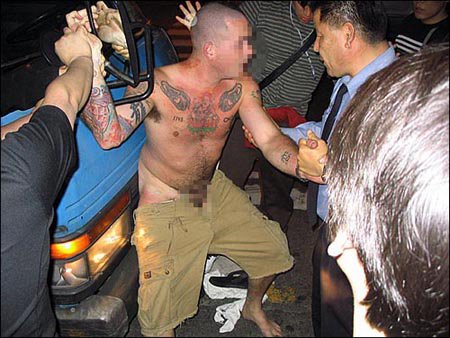
This, plus the taxi jumpers and the alleged stabber in Shinchon who managed to make a spectacle on camera (GI Korea suggests the half-naked guy [seen above in what GI Korea describes as a staged photo] with the yakuza-esque tattoos who was willingly breaking regulations against being in an off-limits area "was probably a good kid just out having a good time with his friends"), are a composite image that, sadly, can eclipse the many good deeds of thousands of law-abiding, hard-working USFK personnel.


*A proper refutation of this perception would address how USFK personnel crime is taken seriously by USFK, not point out, correctly or not, that the Korean judicial system does not take seriously crimes committed by Korean nationals against USFK personnel.

Saturday, December 31, 2005

Korea's productivity gone south

[photo: A happy worker is a busy worker. I like The cut of your jib, Kushibo. Let the fools have their tartar sauce.]

Lost Nomad links to the annual news that South Korean workers work too long (30 percent more than Americans), trashing their marriages and forcing kids to grow up barely seeing their absentee fathers (and increasingly, absentee mothers). And despite that, productivity still isn't' all that high. Go figure!

Some skeptics 
of the much-touted "Korean work ethic" (like Daehan Miguk in the Lost Nomad's comments section) rightfully state that "time spent at work in South Korea does not equal productivity." This is especially true in neo-Confucian, top-down hierarchical organizations where people are supposed to stay at work until the boss leaves. Their actual work is probably long finished (or it's not, but they're too mentally exhausted to do any more of it), so the remainder of the time (usually well after 6 p.m. has come and gone) is spent talking with co-workers, surfing the Internet, or talking on the phone with others.

Of course, there are other companies, such as my primary employer, where there really is way too much work for employees, and people are staying until 10 p.m. or midnight, or coming in on Sundays and holidays, because that's the only way to get all the work done.

So you have one type of company where people are supposed to look busy but could probably leave at 5 p.m. and it would make no difference in productivity, and then you have ones where even if they stay until 10 p.m., they're still not getting all their work done. I'm guessing the proportion is somewhere around 50-50.


For years, Korean companies have resisted going from a six-day workweek (until a couple years ago, when banks and then government agencies adopted a five-day workweek, virtually all Korean organizations required workers to come in for a half-day, usually finishing around noon or 1 p.m., on Saturday). The primary reason was that they feared productivity would go down (a secondary reason was that Korean employees got too many holidays, including Arbor Day and Constitution Day).

Converting to the five-day workweek will be a boost in productivity, not just in per-hour prodctivity, but in overall productivity. Too little gets done in the three or fours of work on Saturday to justify dragging people in. Cutting the workweek some 10% with the elimination of Saturday work schedules would probably mean little or no corresponding drop in how much each employee gets done, thus there is no loss to the companies (most service-sector businesses, except retail, simply don't have anyone come in on Saturday to fill in for the Monday-to-Friday employees).

Furthermore, that sixth "half day" comes with an opportunity cost: it's one less day for workers to rejuvenate themselves so that they can be more productive, creative, and happy Monday through Friday. In other words, reducing the workweek from six days to five can actually boost productivity.

More importantly, freeing up the sixth day for leisure will eventually translate into a boost to the economy in the form of greater economic activity. Employees with only one day off per week are often too exhausted to do anything on Sunday except stay home and watch TV. If they had two days off every weekend, then they would be more likely to take trips around the country and just go out on Saturday and Sunday. A boon to the tourism (which now is heavily seasonal) and entertainment industries, and perhaps retail as well.


A two-day weekend, as opposed to a one-day weekend, means the development of a more widespread part-time workforce, especially in the retail sector and parts of the service sector, which can be beneficial to families with a need for a little extra income, as well as for the economy as a whole.

Ironic that taking a day off would lead to greater economic output, huh?

There is resistance to the five-day workweek, though, and not just from companies for whom cutting work hours means hiring weekend employees (and those companies who just hold fast to the facile notion that more work means more production). This resistance partly comes from the fact that there are probably more than a few people who are deathly afraid of spending more time with their estranged family.


I kid you not. There are many absentee fathers and absentee husbands who have found themselves married to someone with whom they have little in common and therefore feel uncomfortable and awkward spending too much time with. Their kids have become strangers and their kids' problems are something they just don't want to know about.

It's no wonder that such families anesthetize themselves by watching cable (this is the real reason OCN is Korea's #1 channel) or videos: sitting in a room watching TV together gives the comfortable illusion of being together even if no real interaction is achieved.

Friday, December 30, 2005

Random randomness

From the December 4, 1944 archives, I randomly discovered the news "milestone" describing the death of Sadakichi Hartmann, a "Japanese-German" playwright who is, apparently, actually Korean-German (seen at left in an 1899 photo).

These little random incidents of randomness are often just as interesting for where they take me as are the news bits (like Japanese imperial oppression of Christians in Korea and Japan or what was happening to Korea under Japanese rule).

Died. Sadakichi Hartmann, eightyish, dramatist, artist, philosopher and mop-haired onetime "King of Greenwich Village"; in St. Petersburg, Fla. Born in Nagasaki, Japan, son of a Korean woman and a German munitions worker, he married three times, begat 15 children, named one set after jewels, another set for flowers, was the boon companion of artistic greats, from Walt Whitman to John Barrymore.


I vaguely remember hearing of this man, who was quite prominent in his day. In this brief bio, which mentions nothing of any reputed Korean background, his problems as a former Japanese citizen in a country at war with Japan are described:
World War II imposed its horrors on the old man when the FBI started inquiring into his Japanese-German background, despite the fact that he had been a citizen since 1894. After they were interviewed by FBI agents, many of the Hollywood crowd quickly dropped Hartmann and invitations to parties ceased. Only Gene Fowler continued to show interest in the old man. In numerous embittered letters, Hartmann pleaded with high government officials not to intern him, arguing that there could be nothing more American than to have written the first modern History of American Art. The harassment never completely ceased, and sheriff's deputies again and again received reports from townspeople that Hartmann made periodic climbs to the top of Mt. San Jacinto to signal Japanese planes with a lantern.
World War II-era hysteria against Japanese-Americans (and more than a few ethnic Koreans considered "Japanese") never ceases to amaze me.

September 24, 1945 archives

Excerpted from "The New Pictures"

First Yank Into Tokyo (RKO-Radio) might well be subtitled First Atomic Bomb Thriller Out of Hollywood. It was originally a stock B potboiler about a vague "superbomb," just ready to be picked off the RKO assembly line when news of the atomic bomb was announced. By snipping in a quick scene in a Washington office and pasting on the newsreel clip of the first practice explosion in New Mexico, RKO beats everyone else to the neighborhood houses.

The First Yank is Major Steve Ross (Tom Neal), an Army pilot who was raised in Japan and speaks the language without a trace of an accent. He is therefore drafted by Washington to rescue an American scientist (Marc Cramer) from a Jap prison camp. The captive scientist appears to be the only man who knows the whole formula for completing the atom bomb. The Major forthwith undergoes some heavy-handed plastic surgery to give him buck teeth, slant eyes and a puffy face which make him look less like a Jap than like a man with a chronic hangover. In the tick of a time fuse he is being smuggled into Japan by the Korean underground as Sergeant Tomo Takashima, a returning war hero. He gets a job in a prison hospital, where he finds his nuclear scientist. By a streak of dazzling luck he also finds that the hospital's head nurse is his old girl, Abby (Barbara Hale), an Army nurse who was captured on Bataan.

From this point on, it is high-octane cops & robbers, ending with a slam-bang fist fight and a breakneck chase as the Major, Abby and the scientist dash for the water's edge and a waiting British submarine. In a simple-minded way, it is good, fast fun.

November 17, 1941: Japan's Jailees

The Japanese have held three fundamentalist Presbyterian missionaries incommunicado in Manchukuo since Oct. 22. Protests by the U.S. State Department have failed even to elicit the charge against the missionaries. Four days after the arrest at Harbin, the Japanese hustled the trio—Dr. and Mrs. Roy M. Byram, the Rev. Bruce Hunt—500 miles south to Antung, on the Korean border. Probable reason: to make them testify at the trial of the Korean Christians arrested for refusing to take part in State Shinto rites. Secondary reason: to frighten remaining U.S. missionaries out of Manchukuo.

September 21, 1942 archives: Ki's son Ken

One Japanese who has good reason to loathe Japan's ruling militarists is handsome Ken Inukai, 53, four times a Diet member. In 1932 a group of young officers murdered his 77-year-old father, Premier Ki Inukai, potent Seiyukai Party leader, whose wily political opportunism brought him the nickname "The Old Fox."

It was among the most revolting of the many assassinations by which the militarists worked for power against Japan's financial and political oligarchy. The murderers broke into the Premier's official residence toward the end of a bland spring afternoon, found him at ease with his daughter-in-law, her two children and a family friend. Two officers slammed bearded, aging little Ki Inukai against a wall while others raised their pistols. "Please don't shoot," he begged. "Maybe we can settle this." Two bullets drilled his head.

Last week the world heard reports that the Premier's son Ken had been trying to do as he had been done by. The unconfirmed reports came from the Korean underground by way of Kilsoo K. Haan, Washington agent of the Sino-Korean People's League. They said that Ken Inukai was in a Japanese jail charged with aiding the attempted assassination (TIME, Aug. 24) of Premier General Hideki Tojo and onetime (1936-37) Premier Koki Hirota, a leader of the sinister militaristic Black Dragon Society. Ken Inukai was also charged with aiding Eurldan, a Korean terrorist group. The charge was that he had helped Eurldan to derail an express 100 miles from Tokyo, thereby badly injuring Navy Minister Admiral Shigetaro Shimada and Captain Fritz Wiedemann, onetime German Consul General in San Francisco.

March 12, 1945 archives: Erosion in Japan

Religion: Erosion in Japan

A question that has worried mission-minded churchmen since Pearl Harbor was partially answered last week. Had the roots of Christianity been planted deep enough in Japan to withstand the erosion of war? Probably not—according to a 28-year-old Korean theological student, who had been drafted into the Japanese Army from Tokyo's Nippon Theological College, later escaped and made his way to Chungking.

He told a Religious News Service correspondent that Christianity in Japan is much weaker today than it was in 1941; of the 350,000 native Japanese who were Christians before the war, about 100,000 are still church members. One who has stood firm, said the Korean, is the famed Japanese Christian leader, Dr. Toyohiko Kagawa (TIME, Sept. 30, 1940). Though it was widely rumored that he supported the government's warmongering, Kagawa actually was thrown in jail nearly two years ago for his open opposition to the war.

December 3, 1923 archives: A serious accusation

More on the 1923 Great Earthquake in the Kanto Plain. This one directly deals with the issue of Koreans being killed and the role the police took. Certainly some right-wing apologists would love to suggest that the police were just trying to protect the Korean residents, but contemporary reports like this suggest otherwise.

Dr. Floyd Williams Tomkins, President of the Friends of Korea in America and a leading clergyman of Philadelphia, filed a protest with U. S. Secretary of State Charles Evans Hughes, against Japanese inhumanity in killing Koreans in Japan during the earthquake.

The charges made by Dr. Tomkins were based upon written evidence, supplied by a Captain Hedstrom, U. S. citizen and assistant dock superintendent at Yokohama, which is backed up by other American observers. The virtual indictment says "that the official order went out to kill as many Koreans as possible that on Sunday, Sept. 2, 1923, 250 Koreans were bound hand and foot, in groups of five, placed in an old junk, covered with oil, burned alive"; that soldiers, ordered to shoot eight Koreans, apparently enjoyed the horror of a party of Americans, who were forced to witness the preparations for the executions, and "instead of shooting the Koreans they bayonetted them"; that hundreds of Koreans were massacred and "thousands interned with insufficient supplies."

The report then goes on to say that the territorial integrity and independence of Korea* was guaranteed in 1882 by 14 nations, among them Japan, who followed " the example of the U. S." "The U. S. agreed that if Korea should be unjustly or oppressively dealt with it would exert its 'good offices.' Yet we find Korea absorbed by the very power which guaranteed its independence, and a people once proud to call themselves Korean citizens now reduced to 'people without a country,' with no one to speak in their behalf."

The Japanese Embassy at Washington stated that fighting " between Koreans and Japanese, and between Japanese and Socialists and Anarchists," did take place at the time of the great quake. The number of Japanese and Koreans killed was placed between 200 and 300. It was denied that 250 Koreans were burned in oil. The Koreans, said an Embassy official, were interned for their own protection and "2,700 free railway tickets were provided for such Koreans as desired to go to their homes outside the earthquake zone."

* On Aug. 22, 1910, Korea was formally annexed to Japan and the name changed to Chosen. By an Imperial Rescript of 1919, Chosen became an integral part of the Japanese Empire, and the equality of Koreans with Japanese was declared.

Thursday, December 29, 2005

Always Hwang, never right.

[photo: Tai and Snuppy. Though they remain at the center of a controversy that has torn apart the scientific community and done serious harm to Korea's national reputation, it's clear these dogs don't understand a damn thing about it.]

Marmot, who has been a great source of info throughout the Hwang scandal, is reporting that the remaining cells of Dr. Hwang Woo-suk have been found by Seoul National University (SNU) to not match their donors. In other words, they also are fake. The May 2005 study that appeared in Science was a complete sham.

Sperwer quickly responds that, as Porky the Pig says, be-be-be-be-be-be, That's all, folks! Hwang is through.

But me, I just don't know. I've seen the Fall of the Berlin Wall bring promises of world peace and the end of history, Bush's 2004 election bringing "a mandate," Bill Clinton and the Democrats' congressional beating in 1994 bring the end of his presidency, etc., etc.

In other words, until someone is in the grave, I am cautious about counting them out permanently. Dr. Hwang still has some things on his side.

Spcifically, the 2004 study has yet to be disproven, though it certain deserves copious amounts of supsicion.

And Snuppy,
apparently, may still be legit.

So if 2004 was legit and so was Snuppy, or even just Snuppy, Hwang's shady ethics are countered by actual success in difficult cloning tasks.

What would that mean? His academic career is over, over, over, over. Over easy, overies, 오버, overblown, over.

But if he has really accomplished those past successes, I think some corp, may Evil GloboCorp Consolidated, Ltd., is going to snatch him up, pay him millions (of dollars, not those fruity, worth-nothing won), and have him develop patentable processes for them.

And that, of course, muddies the ethical debate about cloning even further.

Meanwhile, Korea is NOT off the hook in terms of cleaning up its own scientific house. The lessons still need to be learned and solutions that stick need to be sought. The nation's credibility is at stake.

September 17, 1923 archives: In the Wake of the Quake

Discussions elsewhere had me looking through the archives for information on the Great Earthquake of 1923, also known as the Kanto Earthquake. Around 100,000 people in Japan died in this horrible tragedy.

But the carnage was compounded by the deaths of apparently thousands of Koreans in mob violence after rumors spread that ethnic Koreans living in Japan had poisoned the water supply (perhaps causing the earthquake) and were trying to overthrow the government.

Check in the "damage" section below to see what this contemporary news piece had to say about that.

News from Japan was extremely contradictory and the most reliable information can be taken as only approximately correct.

Gratitude.


"COOLIDGE, WHITE

HOUSE, WASHINGTON. DEEPLY TOUCHED BY YOUR PROFOUND SYMPATHY AND KINDEST OFFER IN OUR APPALLING CALAMITY. I BEG YOU TO ACCEPT MY HEARTFELT GRATITUDE TO YOU AND THE AMERICAN PEOPLE.

(Signed) "YOSHIHITO,

"EMPEROR OF JAPAN."


President Coolidge's telegram of sympathy was the first to reach Japan after the disaster.

Mark Sullivan, dean of Washington newspaper correspondents, said that Japan's needs is America's opportunity—to show her friendship and end misunderstanding. This is the sentiment of the Government, unsentimental " Big Business " and the warm-hearted American public.

Damage. Yokohama is completely razed by quake, tidal wave and a flood of burning oil from exploding tanks. Tokyo is half in ashes. Yokosuka is terribly, injured; with many naval vessels lost. Forty-five thousand square miles in Eastern Japan are devastated; 500 to 600 miles of railroad are damaged; 14 big towns damaged; 15,000 Koreans, accused of looting and rioting, added to Tokyo's loss and were interned by the troops sent to restore order.

First estimates of loss were $5,000,000,000—five times the cost of the Russo-Japanese War, but later insurance figures put the property loss in the neighborhood of $1,000,000,000.

Damage to Foreigners. " Final " reports placed foreign dead at 200, but only 73 were verified—70 at Yokohama and three at Hakone. Reports from Tokyo varied widely and no reliable figure could be given. Max D. Kirjasoff, U. S. Consul, was killed, Dutch Consul killed. U. S. Ambassador Woods and family, Italian Ambassador G. de Martini, French Consul Claudet reported safe. British Consul lost his hand. Total British dead are estimated at 30.

Statistics. The earthquake is established as the "greatest disaster the world has ever known." The Japanese earthquake of 1891 killed 10,000 people; that of 1896 20,000. The Lisbon earthquake of November, 1755, the greatest in history up to the time of the present disaster, killed 40,000 people; earthquake, tidal wave, fire caused $100,000,000 damage—a huge toll of lives and enormous damage for those days. The recent Japanese earthquake affected about 45,000 square miles on the east coast, killed about 200,000 people, injured about 300,000 to 500,000, and made homeless about 2,500,000 persons. Damage to property caused by the quake, fire, tidal wave, was estimated at $1,000,000,000. Temperature of 150 degrees F. was recorded in the vicinity of Tokyo. Tokyo's flames were visible 200 miles away. The Osaka Asahi reported Tokyo dead at 150,000; Yokohama, 100,000; 60,000 at the Yokosuka naval base. Cholera was reported but not confirmed at Tokyo and Yokohama. Cables were not damaged. Work started in clearing up the devastated areas and in erecting temporary shelters.

Notables Dead. The following members of the Japanese Royal Family and aristocracy were reported killed: Princess Hiro Kan-In, daughter of Prince Kan-In; Prince Moromosa, Prince Tadeshige Shimazu, formerly of the great house of Satsuma; Dowager Princess Yoshiko, Dowager Princess Yamashina; Prince Hirotada Kalacho, Prince and Princess Yamashina. Marshal Prince Kan-In, Minister of Education Keijiro Okano, Minister of Justice Hiranuma were all reported missing.

Crown Prince Hirohito postponed his wedding with Princess Nayako Kuni, scheduled for this Fall. The new date is uncertain.

Silk. It was at first expected that the earthquake would disrupt the silk market and cause "sky-high " prices. Despite heavy damage to silk stocks in Japan, the areas of production escaped destruction, and there is still a large quantity of stock on hand. Meanwhile China and Italy can supply emergency demands. Prices are likely to advance. But not violently.

Shipping. Marine insurance losses were estimated between 25 and 50 million dollars. The Japanese liner Taiyo Maru sent S. O. S. calls, but was subsequently reported safe. The C. P. R. liners Empress of Canada and Empress of Australia arrived respectively at Yokohama and Kobe, with only minor damages. There appears to have been no loss of life on the high seas.

Finance. The gold reserve of the Bank of Japan (Tokyo), valued at $100,000,000, was saved. The total gold reserve of Japan is placed at $1,000,000,000, the bulk of which is in the U. S. and Great Britain. U. S. Secretary of the Treasury Andrew W. Mellon announced that Japan can easily obtain a reconstruction loan. It is thought likely that $100,000,000 will be asked. A 30-day moratorium was declared by the Japanese Government.

Relief. Twenty-two U. S. warships, under the command of Rear Admiral Anderson, were rushed to the scenes of the disaster. Three destroyer divisions at Port Arthur, Tientsin, Chin-Wang-Tao were also sent to Japan at once and arrived on the East coast soon after the quake had subsided. Transports loaded with supplies were dispatched from Manila. Sixty ships were rushed from the U. S. A. with supplies and relief workers. Italy, France, Britain and other nations assisted the Japanese people in the stricken land.

U. S. Ambassador Woods called for tinned meat, condensed milk, flour, underclothing, galvanized iron, dimensioned timber to provide food and shelter for the refugees. Large consignments of these materials were shipped; more will follow. U. S. architects offered their services " in any capacity" to the Japan Government.

Almost every nation in the world helped Japan. King George gave $2,250; the Lord Mayor of London's fund was reported at more than $300,000. France and Italy and many other nations raised funds. Hong Kong and the Dutch East Indies made a money drive. The Soviet Government sent large supplies of provisions.

The Japanese Government voted $265,000,000 for general relief and reconstruction. Kobe raised $17,500,000 in ten minutes. The Mikado gave $5,000,000 from his private funds. Tokyo reported hunger lines two miles long. (There was a small ball of rice for each refugee.)

Sunday, December 25, 2005

Buon Natale! Merry Christmas!

Merry Christmas! 메리 크리스마스!
And a belated happy Hanukkah!


Here's wishing you and yours a joyous holiday season. And for those of us in Seoul, enjoy the semi-white Christmas.

And last, but not least, for the US military personnel who find themselves thousands of miles away from loved ones while serving in the Middle East, Afghanistan, Korea, Okinawa, mainland Japan, Europe, out at sea, or anywhere else in the world, here's a heart-felt word of thanks this holiday season for your sacrifice and your courage.

For you, a small tribute in the form of a Korean Christmas past:


From this
website of Paul Noll:
After we left Taejon we went to Taegu and camped there for a while. On Christmas day we had a Christmas feast with Turkey, dressing, sweet potatoes, pumpkin pie, mashed potatoes, green beans, nuts, cake, celery, cranberry sauce, eggnog, milk, coffee, and other things I have forgotten about.

Tears come to my eyes as I write and think about that wonderful Christmas and the effort the army went to, to make it feel a little bit more like home. The officers served the dinner.

My team had a Christmas tree about 7 inches high and we sang songs and thought of Christmases long ago home with our families.

We wondered about our families and how they might be worrying about us here. We wrote home often but mail was hard to get and send. I did get one package from my brother Mark. It was, so help me, a box of handkerchiefs. I kidded him about that when I got home.

Some of the group got packages of cookies, cheeses or salami. Whenever anyone got something it was always gratefully shared with others in the team. We grew to trust and depend on each other very much. This was one of the few times we spent as a company together. Soon after my team went off to set up a station.
God bless you all!