... you can answer yes. (At least a few million.)
Actually, if one had a secure cave, I think it would be quite cool to live in one. Literally.
...
Pearls of witticism from 'Bo the Blogger: Kushibo's Korea blog... Kushibo-e Kibun... Now with Less kimchi, more nunchi. Random thoughts and commentary (and indiscernibly opaque humor) about selected social, political, economic, and health-related issues of the day affecting "foreans," Koreans, Korea and East Asia, along with the US, especially Hawaii, Orange County and the rest of California, plus anything else that is deemed worthy of discussion. Forza Corea!
Showing posts with label China. Show all posts
Thursday, March 22, 2012
Tuesday, November 22, 2011
Going all the Weiwei (possibly NSFW)
Kushibo wishes he had minions who would get naked and/or pay millions of dollars in (bogus) fines if I asked them to. Instead, Kushibo can barely squeeze a latte out of anyone.
But if you're Ai Weiwei, your supporters will strip and then take pictures of themselves to show their support. Then they'll post them online. This is enough to get them slapped with investigation for pornography by Chinese authorities.
There are more photos here, but be warned: most are men. Be also warned that someone thought it would be funny to throw in a picture of the Dear Leader and see if anyone noticed. (Or is Kim Jong-il secretly a supporter of decadent Chinese nudity?)
(Oh, and this post would come with a full-blown, bold-faced "NSFW!" warning, but I don't know where you work; this kinda thing may be ay-okay in your office place.)
UPDATE:
D'oh! I forgot to include anything on why Mr Ai Weiwei is a famous artist in the first place. I've seen his work here and there, but my most profound "encounter" with his work was viewing this 14-minute documentary on the production of his presentation of a 100 million (?) fake sunflower seeds (all ceramic and each hand painted) at The Tate in London (which is where my camera got stolen in 2007).
I also forgot to mention one of my original points in writing this: It smells of the tribulations of Professor Ma Kwangsoo (마광수), the Yonsei University professor who was imprisoned in 1995 when authorities deemed his novel Happy Sara to be obscene and pornographic, the same accusations thrown at Ai Weiwei.
South Korea was still sloughing off the vestiges of dictatorial rule, and it would be a while before the authorities realized they end up creating heroes out of their ideological foes when they treat them this way. It may be a while before the communists in Beijing realize how ham-fisted such heavy-handed tactics can be.
...
But if you're Ai Weiwei, your supporters will strip and then take pictures of themselves to show their support. Then they'll post them online. This is enough to get them slapped with investigation for pornography by Chinese authorities.
There are more photos here, but be warned: most are men. Be also warned that someone thought it would be funny to throw in a picture of the Dear Leader and see if anyone noticed. (Or is Kim Jong-il secretly a supporter of decadent Chinese nudity?)
(Oh, and this post would come with a full-blown, bold-faced "NSFW!" warning, but I don't know where you work; this kinda thing may be ay-okay in your office place.)
UPDATE:
D'oh! I forgot to include anything on why Mr Ai Weiwei is a famous artist in the first place. I've seen his work here and there, but my most profound "encounter" with his work was viewing this 14-minute documentary on the production of his presentation of a 100 million (?) fake sunflower seeds (all ceramic and each hand painted) at The Tate in London (which is where my camera got stolen in 2007).
I also forgot to mention one of my original points in writing this: It smells of the tribulations of Professor Ma Kwangsoo (마광수), the Yonsei University professor who was imprisoned in 1995 when authorities deemed his novel Happy Sara to be obscene and pornographic, the same accusations thrown at Ai Weiwei.
South Korea was still sloughing off the vestiges of dictatorial rule, and it would be a while before the authorities realized they end up creating heroes out of their ideological foes when they treat them this way. It may be a while before the communists in Beijing realize how ham-fisted such heavy-handed tactics can be.
...
Monday, August 23, 2010
NPR on China's economic and military rise, and how it might affect US and her allies
This was from Weekend Edition, which points out things of obvious interest to Korea watchers or Japan observers:
"The Chinese have a great track record in demanding to be treated as a great power and a mixed record in acting like one," says David Finkelstein, a former defense attache in Beijing.Of course, China's recent attempts at maritime land grabs are setting up the region for more tension:
The new Pentagon report, "Military and Security Developments Involving the People's Republic of China," suggests China wants to establish itself as a dominant regional power before claiming a larger global role. The Chinese military, according to the Pentagon, is pursuing "anti access and area denial strategies" in its corner of the world with respect to potential rivals like Japan, South Korea and the United States. In part, this means being prepared to keep U.S. and other foreign military forces as far from Chinese waters as possible.
"One of the missions that have been given to the Chinese Navy and the Chinese air force has been to extend China's defensive perimeter out to sea, eastward," says Finkelstein, now at the Center for Naval Analyses. "So they're developing operational capabilities that can make it difficult for forces outside the region to operate with impunity inside China's coastal strategic areas."
"They do intend to become very dominant in the region," says Cornell's Prasad, formerly the top China specialist at the International Monetary Fund. "They see economic, political and military issues as all intertwined in terms of trying to obtain their longer-term objectives."All the more reason to expect (or at least not be surprised) all hell to eventually break loose if the Pax Americana were to end.
International law normally recognizes a country's territorial domain only over seawaters within 12 miles of its shores, but China is claiming dominion out to 300 miles. Other Asian countries, with U.S. support, are now pushing back, as was evidenced at a meeting last month of the Association of Southeast Asian Nations in Hanoi. But China has not retreated, with Chinese leaders even asserting their domination of the Yellow Sea, between China and the Korean Peninsula.
"Beijing's statements about their sovereignty in the Yellow Sea as well as their sovereignty in the southern part of the China Sea reflect a new, even more expanded view [of their sovereignty claims]," says James Mulvenon of the Defense Group consultancy. He notes that the United States has repeatedly challenged China's claims, most recently in the speech given by Secretary of State Hillary Clinton at the ASEAN meeting in Hanoi.
![]() |
| In a spectacular fireworks display east of Shanghai, China's elite show what it will look like when they finally blow up Japan and the United States. |
Wednesday, August 18, 2010
Fighter plane flown by possible North Korean defector crashes in China
The BBC is reporting on what might be a highly unusual method of defection: A North Korean fighter pilot trying to make his way to Russia has apparently crashed in Manchuria's Liaoning Province:
Although China can be tight-lipped when it comes to news media, we can probably expect more straightforward reporting on this than if the plane had crashed on the North Korean side of the Yalu River. It will be interesting to see who was on board. Was it just one person? How high-ranking was the pilot and/or passengers? Is this a harbinger of things to come?
For that matter, how did it crash? Are North Korean jets so shoddily maintained at this point that they can barely get out of the country? Did the Chinese themselves shoot it down? Or the North Koreans?
A North Korean aircraft, which may be a fighter jet, has crashed in China near the country's shared border, say Chinese and South Korean reports.Here's the Yonhap story, for which the above photo was taken.
It is believed the pilot, who was killed, may have been trying to defect to Russia, according to unnamed intelligence sources cited by Yonhap.
The crash happened on Tuesday afternoon in Fushun county, Liaoning province.
Defections are common but an attempt by plane is highly unusual and would be a source of embarrassment for Pyongyang.
Although China can be tight-lipped when it comes to news media, we can probably expect more straightforward reporting on this than if the plane had crashed on the North Korean side of the Yalu River. It will be interesting to see who was on board. Was it just one person? How high-ranking was the pilot and/or passengers? Is this a harbinger of things to come?
For that matter, how did it crash? Are North Korean jets so shoddily maintained at this point that they can barely get out of the country? Did the Chinese themselves shoot it down? Or the North Koreans?
Wednesday, April 7, 2010
Good news from China
I thought I'd cut into all the negative stories about cartoonist, sunken naval ships, etc., etc., with a heart-warming story with a (mostly) happy ending. It's about the rescue of a group of Chinese miners that had been trapped deep below the surface of Shanxi Province for eight days and eight nights:
For once, it was good news that came from the depths of a Chinese coal mine as 115 workers were rescued Monday after eight days and eight nights trapped deep inside a mine in Shanxi province.I'm happy that those 115 are alive, and my prayers go out to those who remain. And I'm tickled that Chinese officials are talking about "miracles."
The extraordinary rescue turned into a round-the-clock reality show with state-run TV broadcasting live footage of the rescue workers carrying out the miners to a cheering audience. Rescue crews were still hoping as of Monday night to bring out 38 more miners.
Although the miners had their faces wrapped with towels to protect their eyes after so many days in darkness, their elation was evident. Even lying flat on his back, one clapped and gave a high-five to a rescue worker who had carried his stretcher.
"They were in high spirits,'' Chen Yongsheng, the chief rescue worker, told Chinese television.
The miners had been trapped since March 28; that's when, according to one survivor, a tidal wave of water came rushing into the mine they were constructing in Wangjialing, about 400 miles southwest of Beijing.
During the construction process, the workers hit an abandoned mine shaft filled with enough water to fill more than 50 Olympic-size swimming pools.
"I am really amazed that the miners held on in the mine shaft for eight days and eight nights,'' Luo Lin, head of the State Administration for Work Safety, told Chinese television. "For them to survive after such a long time, it's really a miracle.''
Wednesday, February 11, 2009
ChiComs control the Universe
The K-blogs are abuzz over the tragedy of four deaths during festivities over the Taeborŭm holiday [or Daeboreum; 대보름, 大보름], a traditional holiday marking the propitious first full moon of the new year (on the lunar calendar).


BBC News has an excellent video clip on the tragedy in Ch'angnyŏng-gun County [Changnyeong-gun, 창녕군/昌寧郡], near Taegu. As the BBC News clip explains, many had gathered to watch this traditional event, which is dying out in South Korea.

BBC reported some 15,000 people had gathered at this one at Mt Hwawangsan [화왕산/火旺山], a mountain whose name, ironically, can be translated as "fire prosper mountain" or "fire increase mountain" (click on each hantcha character to see the Wiktionary explanation).
Historically, burning the grass around farms or the straw placed on top of it has been a way to control pests, by killing bugs as eggs or larvae. It has since morphed into ceremonial ritual. Organizers were not prepared for a shift in winds, people panicked and ran, and as often happens when a lot of people flee in a hurry, some fall or get trampled, with disastrous results.
This is truly tragic and my heart goes out to the victims and their families. We may also see an end to this particular ritual in the coming years, in favor of less deadly traditions. Sadly, this stampede is not a lonely occurrence, as we have seen other incidents where too-large crowds come with deadly results.

The odd thing I found about news surrounding this tragedy is that it became the replacement filler when the Chinese authorities removed a news story about the recent destruction by fire of a new 44-story Beijing landmark, that was part of the Olympic construction boom, the soon-to-open Mandarin Hotel.
Although the building was not yet occupied, one firefighter was killed when the building was gutted. Investigators are saying the inferno was sparked by burning embers from a celebratory fireworks display set off from the nearby building, the odd shaped structure at left in the picture below (the gutted Mandarin Hotel is at right).
That building is home to CCTV, the state broadcaster whose Lantern Festival fireworks display is being held responsible and who now are the target of the nation's ire. Elsewhere in China, fifteen people were killed in Fujian Province when fireworks were set off in a bar.

Authorities were embarrassed, which is probably why the pictures were removed. From the above linked NYT article:
But residents of the city who came to see the smoking shell of architect Rem Koolhaas’s Mandarin Oriental Hotel had a harder time day finding images of the fire on the Internet in China, on television or in the city’s newspapers.Marmot's Hole regular commenter Linkd (one of my favorites there) had a few choice words to say about the switcheroo:
There were no pictures on the front page of The Beijing News. On Tuesday morning, the home page of Xinhua, the official news agency, featured a photo from another tragedy: a stampede in South Korea that left four people dead. Throughout the day, CCTV’s brief bulletins about the blaze omitted footage of the burning tower. By evening, the newscast skipped the story entirely.
Even before the flames had been extinguished early Tuesday, pictures of the burning hotel had been removed from most of the main Internet portals serving China. In the afternoon, the story had been largely buried, but by the evening, news of the fire was accessible via the Xinhua and CCTV Web sites.
The Chinese are very superstitious people, Elgin. This fire so close to the New Year, in such an iconic Beijing building, is a bad omen for the rest of the year. The ChiCommPty is already worried enough about unrest from increasing unemployment and closing factories. In a fatherly way, it’s trying to protect its flock from getting themselves all worried about nothing. (more precisely, from thinking that the omen points toward mishandling of the nation’s affairs by the CCP)Okay, so the ChiComs are worried about unrest and public disorder—and possible revolution—but why replace it with a story on a much smaller tragedy in Korea? Sure, there's that Lantern Festival/Taeborŭm angle, but this is part of a disturbing trend where South Korea has become a whipping boy for nationalism in the People's Republic of China.
While looking into the stampede-for-inferno substitution, I found something else a bit odd. In a UPI story on the Korean fire and stampede, the news agency being quoted was not Yonhap, but China's official mouthpiece, Xinhua:
Local police said two people were missing Tuesday after at least four people died when a crowd stampeded during a grass-burning ceremony in South Korea.The report by Xinhua is probably all correct—at least in this case—but it is a bit unsettling that a government-controlled official mouthpiece from an authoritarian government known for manipulating news to shape its political agenda, including the dissemination of news that would affect the image of its geographic neighbors, would be used as an authoritative source for events unrelated to it outside its borders (and in all fairness, I could say something almost as harsh about some South Korean news agencies).
Police said the incident occurred Monday on a field on Mount Hwangwang in Changyeong, southeast of Seoul, during a traditional ritual of burning of pampas grass, the Chinese news agency Xinhua reported. A breeze expanded the fire, forcing about 15,000 participants to flee.
Kim Yeon-sun, an official of the Changyeong municipal government, told Xinhua two people were missing as of Tuesday. At least 60 people were injured.
The Changnyeong municipal government conducts the burning the pampas grass ceremony every three years to mark the first full moon of the lunar new year on the Mount Hwangwang, Xinhua said.
Make no mistake: Beijing tries hard to control the news that reaches Chinese eyeballs. That means removing or downplaying stories of Chinese tragedies and, sometimes, playing up or even distorting events that happen in rival nations, including Japan and now South Korea.
And that's why it's hard for Chinese to see stories like this one in the New York Times [The Discovery Channel's "TreeHugger" website carries the same story]. It seems that last year's devastating earthquake in Sichuan Province, in which some 80,000 lives were lost, may have been triggered by a massive dam built nearby on a major fault line.

From the NYT article:
Nearly nine months after a devastating earthquake in Sichuan Province, China, left 80,000 people dead or missing, a growing number of American and Chinese scientists are suggesting that the calamity was triggered by a four-year-old reservoir built close to the earthquake’s geological fault line.Sichuan residents were already angry at officials for what was perceived as corruption and criminal indifference to the lives of regular people in the area, exemplified by many government offices remaining standing while schools full of children collapsed like pancakes.
A Columbia University scientist who studied the quake has said that it may have been triggered by the weight of 320 million tons of water in the Zipingpu Reservoir less than a mile from a well-known major fault. His conclusions, presented to the American Geophysical Union in December, coincide with a new finding by Chinese geophysicists that the dam caused significant seismic changes before the earthquake.
The connection between the dam and the earthquake is not yet a slam dunk:
Scientists emphasize that the link between the dam and the failure of the fault has not been conclusively proved, and that even if the dam acted as a trigger, it would only have hastened a quake that would have occurred at some point.Having grown up in earthquake country, I know what it's like to wait for "the Big One," but seismic inevitability does not mean it's about to happen. The earthquake that may have been triggered might otherwise have occurred decades in the future—when the people presumably would have been ready with better construction.
Oh, dear God, if it turned out that the earthquake may have been triggered by a massive dam built irresponsibly over a fault line, this could be the spark of unrest that could be a body blow to the Chinese Communist Party (CCP), and perhaps they know it.
Nonetheless, any suggestion that a government project played a role in one of the biggest natural disasters in recent Chinese history is likely to be politically explosive.Public safety and order are the linchpins of the CCP's raison d'être. The last thing they need is people thinking that their poor planning represents a careless disregard for the the lives of small children. Chinese history is often steered in a different direction by angry peasants, and they are likely to throw more than just shoes at the Premier.
The issue of government accountability and responsiveness has boiled over in China in the past year. The grieving parents of thousands of schoolchildren killed in the disaster have already made the 7.9-magnitude earthquake a political issue, charging that children died needlessly in unsafe school buildings approved by negligent or corrupt officials.

Expect more finger-pointing eastward, in the direction of Korea and Japan.
Wednesday, May 31, 2006
Three-armed baby proof that efficient keyboard usage is driving human evolution
We all knew this was going to happen sooner or later.
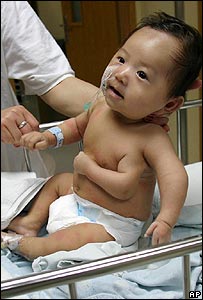
A baby named Jie-Jie was born at a small local hospital in China's Anhui Province, armed with, well...three arms. All of them functional to some degree.
Clearly this is a sign of human evolution and the 144-hour Creationists* need to just shut the fuck up right now. This mutated baby will grow up being able to type out his blog and sip his Starbucks... simultaneously! How genetically developed is that?! It's like when the first giraffe had a long neck or the first elephant developed a trunk long enough to scratch its private regions.
In true egalitarian, communist fashion, doctors at a medical center in Shanghai are plotting how to take one of these arms away from the infant. In all seriousness, I say let him keep them all — he's not a freak, he's the future: an ergonomic infant.
Besides, the poor kid is missing one kidney, so shouldn't the extra arm be left intact to make up for his renal deficiencies? Won't someone think of the children?
If Jie-Jie could talk, I'm sure he'd be saying:
UPDATE:
Doctors did in fact go and remove one of Jie-Jie's two left arms. He is in stable condition and doctors expect a full recovery. They removed the arm closes to his chest, the one which could have been used to hide contraband.
SITEMETER UPDATE:
Thanks to Space Nakji's foray into discussion of gender re-assignment gone awry, someone linked to this post while searching for (and how could I make this up) ambiguous genitalia island. Just what this person was looking for, I have no idea. Dare I say I hope he/she found it?
*That's people who believe in a literal six-day creation. I myself am a hexa-eon creationist, which is pretty much the same as a theological evolutionist, and we kick ass.
A baby named Jie-Jie was born at a small local hospital in China's Anhui Province, armed with, well...three arms. All of them functional to some degree.Clearly this is a sign of human evolution and the 144-hour Creationists* need to just shut the fuck up right now. This mutated baby will grow up being able to type out his blog and sip his Starbucks... simultaneously! How genetically developed is that?! It's like when the first giraffe had a long neck or the first elephant developed a trunk long enough to scratch its private regions.
In true egalitarian, communist fashion, doctors at a medical center in Shanghai are plotting how to take one of these arms away from the infant. In all seriousness, I say let him keep them all — he's not a freak, he's the future: an ergonomic infant.
Besides, the poor kid is missing one kidney, so shouldn't the extra arm be left intact to make up for his renal deficiencies? Won't someone think of the children?
If Jie-Jie could talk, I'm sure he'd be saying:
What the hell is wrong with you people? I've got an extra arm...think of how many things I'll be able to do that others can't, from sports to cheating at poker to clerical duties to intimate activities with my wife and/or girlfriend. Leave my arm the fuck alone! Oh, and why did you give me a name that sounds like I'm a fucking panda?! Were you high or something? I should take my third arm and go Cultural Revolution on your asses!Yes, I'm certain that's the way babies would talk if they could speak.
UPDATE:
Doctors did in fact go and remove one of Jie-Jie's two left arms. He is in stable condition and doctors expect a full recovery. They removed the arm closes to his chest, the one which could have been used to hide contraband.
SITEMETER UPDATE:
Thanks to Space Nakji's foray into discussion of gender re-assignment gone awry, someone linked to this post while searching for (and how could I make this up) ambiguous genitalia island. Just what this person was looking for, I have no idea. Dare I say I hope he/she found it?
*That's people who believe in a literal six-day creation. I myself am a hexa-eon creationist, which is pretty much the same as a theological evolutionist, and we kick ass.
Subscribe to:
Posts (Atom)


