Well, other than the GIs with the full arm tattoos at the bar we went to this evening, it's this plastic surgery advert I've seen in the subway and on buses.
This is just extreme. Moreover, it's a blatant message that if you don't live up to some impossible ideal, you're kinda sorta worthless (or at least worth less) if you don't fork over millions and millions of won and mutilate your face.
...
Pearls of witticism from 'Bo the Blogger: Kushibo's Korea blog... Kushibo-e Kibun... Now with Less kimchi, more nunchi. Random thoughts and commentary (and indiscernibly opaque humor) about selected social, political, economic, and health-related issues of the day affecting "foreans," Koreans, Korea and East Asia, along with the US, especially Hawaii, Orange County and the rest of California, plus anything else that is deemed worthy of discussion. Forza Corea!
Showing posts with label plastic surgery. Show all posts
Saturday, July 14, 2012
Friday, November 4, 2011
Hub of plastic surgery, still
![]() |
| If they're going to keep recycling this meme, then I'm going to keep recycling this graphic. |
It's becoming a cliché: writing about how plastic surgery in Korea is itself a cliché. But there it is, yet again, in the mainstream American media.
From the New York Times:
For Ms. Chang, 25, a makeup artist, the 2.3 million won, or about $2,000, eye job is just the finishing touch in a program several months long to remake her face. In the previous two months, Ms. Chang had not only had her teeth rearranged, but her jaw bones cut and repositioned, for 22 million won.How common does something have to be for it to be "a favorite"? Fifty percent? A mere ten percent? Two percent and rising? I wonder seriously what proportion of under-30 women in South Korea are rearranging their upper and lower
“You must endure pain to be beautiful,” she said, adding that an eye job is so routine these days “it’s not even considered surgery.”
Cosmetic surgery has long been widespread in South Korea. But until recently, it was something to keep quiet about. No longer.
And as society has become more open about the practice, surgeries have become increasingly extreme. Double-jaw surgery — which was originally developed to repair facial deformities, and involves cutting and rearranging the upper and lower jaws — has become a favorite procedure for South Korean women who are no longer satisfied with mere nose jobs or with paring down cheekbones to achieve a smoother facial line.
And no, the proper calculus would not simply take the population of the twenty-somethings and divide by the number of procedures performed (or vice-versa). That would skew the actual proportion by adding in all the Japanese who come to South Korea to get it done more cheaply and all the Chinese and other East Asians who come to South Korea to get it done more expertly. Hub of plastic surgery indeed.
And I do wonder how many people are going more extreme. Or is this one of those things, like tongue-snipping, where it gets talked about more than it actually gets done?
As the article actually suggests, eyelid surgery is so routine as to hardly be considered "major." In fact, I have on numerous occasions (see here, here, here, here, and here) likened it to getting braces in the United States (which costs even more, alters one's appearance, and often requires invasive surgery in the form of teeth removal). But the other forms of surgery are extreme enough that the typical squeamish Generation-Y Korean female is going to think twice, then thrice about this and usually decide no. The costs-more-than-a-car price tag helps.
UPDATE:
D'oh! I forgot to add my admitted overgeneralization (from my infamous CSI post) about Korean-born women who get breast enlargement surgery:
You see from other parts of the show that the young Korean mother (murder victim #2) is sort of hot. Thin—maybe too thin for someone who has had a kid—and crazy nutso. But hot. Though she's lying on her back, you can see her breasts are still standing at attention, which is nearly a sure bet that they're mercenaries. The moral of this episode is simple: never trust a Korean-born woman who gets a boob job. They're nuts. I'm not kidding. Certifiable. If you don't like 'em small and natural, move along, brother. Move along.Yeah, I'm sure there are some exceptions to the rule, but my point in adding that was to distinguish South Koreans' acceptance (as of now) for minor plastic surgery (eyelid surgery or slight changes to the nose, chin, or jaw) from that for breast "enhancement."
...
Saturday, August 13, 2011
UPDATED: Korea-obsessed British university student gets surgery to become Merong Girl (메롱걸)
ORIGINAL POST:
One of those popular urban legends about South Korea is that kids in English-obsessed South Korea are getting their tongues snipped (a procedure called lingual frenectomy) in order to pronounce English more accurately. I call it an urban legend because, while there certainly are people who have gotten the surgery done, it has reached the point where there are more stories about this supposedly popular Korean procedure in English-language media than there are people who have actually done it. I think.
Now the British media has brought us a twist on this story. It seems one university student in England is obsessed with Korean culture and learning Korean (see all those Korea books she's carrying), and (wait for it...) she has had a similar tongue-lengthening surgery in order to speak Korean better.
From the UK's Daily Mail:
Anyway, while in Korea I imagine a lot of anglophones would scratch their head and say, "What the...?!" for the same reasons we might do the same about six-year-olds with English-obsessed Korean mothers having the surgery (if you have a tiger mom, expect to get mauled a bit), back in the United Kingdom people are hemming and hawing about this surgical procedure having been covered by the national health insurance scheme. Apparently this Nottingham native is some sort of modern-day medical Robin Hood: stealing from the rich National Health Service and giving it to her poor, unable-to-pronounce ㄹ self.
Okay. But me? I smell a carefully crafted ploy by a young, smart, and reasonably attractive young lady to launch a career in Korea's public sphere: she's cute (never hurts with any job), speaks Korean pretty well (a plus for doing anything other than English teaching), has considerable interest in Korean culture (an ego massager for a large portion of the Korean masses), and has the kind of figure many Korean men like in Caucasian women (that's a euphemistic way of saying she has a good-sized chest while falling within the range of thin to nothing larger that chubby-cute). And I like her glasses.
So in conclusion: Get in touch with me, Rhiannon Brooksbank-Jones, and I'll make you a star.
Seriously. And I've already christened you 메롱걸* (the only alternative is 혀녀). That's what we call 서비스.
* To understand what is 메롱 (merong), see the picture below:
UPDATE:
This story has also become a post at The Marmot's Hole. Human rights lawyer Ben Wagner, who is highly skilled at finding bigotry where no one else does, has revealed that Merong Girl is promoting racist viewpoints:
One of those popular urban legends about South Korea is that kids in English-obsessed South Korea are getting their tongues snipped (a procedure called lingual frenectomy) in order to pronounce English more accurately. I call it an urban legend because, while there certainly are people who have gotten the surgery done, it has reached the point where there are more stories about this supposedly popular Korean procedure in English-language media than there are people who have actually done it. I think.
Now the British media has brought us a twist on this story. It seems one university student in England is obsessed with Korean culture and learning Korean (see all those Korea books she's carrying), and (wait for it...) she has had a similar tongue-lengthening surgery in order to speak Korean better.
From the UK's Daily Mail:
Student Rhiannon Brooksbank-Jones dreams of living and working in South Korea once she finishes university, even though she has never visited the country.Poor lingual frenulum, you're hated on two continents.
But while taking language lessons, the 19-year-old found that she couldn't pronounce certain crucial sounds in the Korean alphabet.
Her dentist suggested it may be because she was born with a slightly shorter than average tongue, caused by having an unusually thick lingual frenulum - the flap of skin that joins the underside of the tongue to the floor of the mouth.
After discussing the matter with her parents and language tutor, Rhiannon decided to undergo an operation to correct the condition, despite the fact it has never caused her any problems in speaking English.
She underwent a lingual frenectomy, which involves making an incision in the flap of skin. As a result, Rhiannon's tongue is now about 1cm longer, and she can say words that were impossible before.
Rhiannon, of Beeston, Nottingham, said: 'I'd been learning Korean for about two years, and my speaking level is now high, but I was really struggling with particular sounds.
'It became apparent after a little while that I was having trouble with the Korean letter 'L', which is very frequent and comes from a slightly higher place in the mouth than the English 'L', and that my tongue was too short.
'My pronunciation was very 'foreign', but now I can speak with a native Korean accent. The surgical procedure was my only option. It's not like you can stretch your tongue otherwise. I just decided enough was enough.
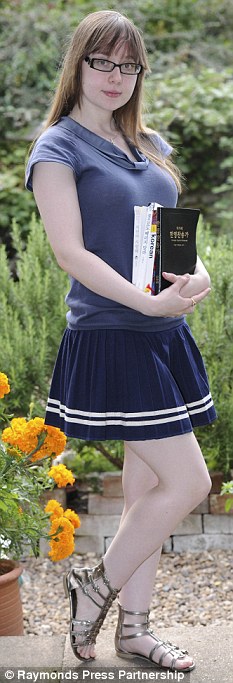
Anyway, while in Korea I imagine a lot of anglophones would scratch their head and say, "What the...?!" for the same reasons we might do the same about six-year-olds with English-obsessed Korean mothers having the surgery (if you have a tiger mom, expect to get mauled a bit), back in the United Kingdom people are hemming and hawing about this surgical procedure having been covered by the national health insurance scheme. Apparently this Nottingham native is some sort of modern-day medical Robin Hood: stealing from the rich National Health Service and giving it to her poor, unable-to-pronounce ㄹ self.
Okay. But me? I smell a carefully crafted ploy by a young, smart, and reasonably attractive young lady to launch a career in Korea's public sphere: she's cute (never hurts with any job), speaks Korean pretty well (a plus for doing anything other than English teaching), has considerable interest in Korean culture (an ego massager for a large portion of the Korean masses), and has the kind of figure many Korean men like in Caucasian women (that's a euphemistic way of saying she has a good-sized chest while falling within the range of thin to nothing larger that chubby-cute). And I like her glasses.
So in conclusion: Get in touch with me, Rhiannon Brooksbank-Jones, and I'll make you a star.
Seriously. And I've already christened you 메롱걸* (the only alternative is 혀녀). That's what we call 서비스.
* To understand what is 메롱 (merong), see the picture below:
![]() |
| above: South Korea's most famous English teacher |
UPDATE:
This story has also become a post at The Marmot's Hole. Human rights lawyer Ben Wagner, who is highly skilled at finding bigotry where no one else does, has revealed that Merong Girl is promoting racist viewpoints:
All the best in to Rhiannon in her Korean language studies, but I wish she hadn’t chosen to perpetuate to the myth that race is somehow tied one’s ability to speak a language with native fluency. Ironically it’s an allegedly short “Korean tongue” which supposedly makes it difficult to produce the English L/R sounds, the Brit’s “short” tongue should have made her a natural if any of these nonsensical theories had any scientific basis.Thank goodness for Mr Wagner, or else I wouldn't have realized Ms Brooksbank-Jones was perpetuating race-based myths. Here I thought that the reason for the surgery was that her tongue (i.e., not the tongue of most White people in England) was "shorter than average" and that she (i.e., not most White people in England) had "an unusually thick lingual frenulum." Now I realize she's some sort of White Inferiorist. I may have to rethink launching her career.
Saturday, November 20, 2010
South Korea = nation of plastic surgery!
Yep, Reuters is carrying on the meme (meme #77) with an article about how prevalent plastic surgery is in South Korea:
But more to the point, just how many of these nose jobs are actually performed, by these chop shops in the article that are offering the special deals (and that may or may not be characteristic of plastic surgery outfits throughout the country)? The article doesn't say, but instead leaves us with the impression that it's somewhat common.
And that, kiddies, is my point. The eyelid surgery is commonplace, much more than other forms of plastic surgery. And while it does have the "plastic surgery" label slapped on it, it's a relatively minor procedure and it is (for better or worse) normative. A lot like, wait for it... getting braces in America, which is also done primarily for cosmetic purposes, costs thousands of dollars, and frequently requires invasive oral surgery (it did in my case).
But explaining that would make the whole thing seem, well, less shocking... less weird. And we couldn't have that.
With grueling university entrance exams finally behind them, exhausted South Korean students are now choosing their reward — plastic surgery.Call it the Koreanization of Western journalism, but there are a few bits of irresponsible reportage in this article. For starters, who is saying "Westernising" such that it's in quotes. Oh, it's "scare quotes" so we can pretend someone said it some time ago, and even though we don't analyze it, it seems to be full of truthiness, so let's run with it.
A number of plastic surgery hospitals have taken advantage of a recent trend by some parents to reward their children for years of hard study with plastic surgery, offering substantial discounts for eye and nose operations.
Popular surgeries include "Westernising" the nose to give it an upward tilt and double-eyelid surgery to make eyes look bigger, which is especially popular with young women.
"We already had a long reservation list with names of students even before they took the test," the manager of one hospital told the JoongAng Daily.
At that hospital, the two surgeries -- one for the eyes and one for the nose -- would normally go for 3.7 million won ($3,273) if done separately. The special package, though, offers a discount of 900,000 won for those having both.
Another hospital took a different tack, aiming at the students' long-suffering mothers, who offer food and support through the hard years of study and worry along with their offspring until the dreaded tests are past.
"If a student has two plastic surgeries for eyes and nose at the same time, we will provide a free Botox shot for the mother's wrinkles," it said in an advertisement on its website, the JoongAng Daily said.
But more to the point, just how many of these nose jobs are actually performed, by these chop shops in the article that are offering the special deals (and that may or may not be characteristic of plastic surgery outfits throughout the country)? The article doesn't say, but instead leaves us with the impression that it's somewhat common.
And that, kiddies, is my point. The eyelid surgery is commonplace, much more than other forms of plastic surgery. And while it does have the "plastic surgery" label slapped on it, it's a relatively minor procedure and it is (for better or worse) normative. A lot like, wait for it... getting braces in America, which is also done primarily for cosmetic purposes, costs thousands of dollars, and frequently requires invasive oral surgery (it did in my case).
But explaining that would make the whole thing seem, well, less shocking... less weird. And we couldn't have that.
Subscribe to:
Posts (Atom)


