Showing posts with label eating dog. Show all posts

Thursday, July 5, 2012

In what version of reality would it ever be a good idea for Korea to propose the resumption of "scientific whaling"?

Dear Angry Reader: Yes, I know this is a picture of a protest against Japan and not South Korea, but that is part of the point if you will read past this shock-value photo of an anti-whaling demonstration. 

Despite the success of K-pop and the rest of the Korean wave, the warm-and-fuzzy image of South Korea the world now seems to have is still a bit tenuous.

And when the rest of the world sometimes confuses you with neighbors like China (which is bad), North Korea (very, very bad), Japan (mixed bag), or yourself in the past (potentially bad), we're talking tower-of-Jenga-blocks tenuousness.

And it is against that backdrop that I would like whichever Republic of Korea officials are responsible for South Korean proposals at the International Whaling Commission to please reconsider their proposal to resume so-called "scientific hunting" of minke whales.

See, when the BBC is reporting on you being a part of this loathed practice, that's a very bad sign:
South Korea is proposing to hunt whales under regulations permitting scientific research whaling, echoing the programmes of its neighbour, Japan.

Hunting would take place near the Korean coast on minke whales. How many would be caught is unclear.

The South Korean delegation to the International Whaling Commission (IWC) said the research was needed "for the proper assessment of whale stocks".

Many governments at the IWC meeting condemned the Korean announcement.

There are several different stocks, or groups, of minke whales in the region, and one of the them, the so-called J-stock, is severely depleted.

Given that fact, "we believe that scientific whaling on this stock borders on the reckless," New Zealand's delegation head, Gerard van Bohemen said.

But Joon-Suk Kang, the head of the South Korean delegation, said the programme was necessary to answer questions about minke whale stocks that non-lethal research had been unable to solve.
Questions they want to answer: Which minke whale stock is most delicious?

Korea's IWC proposal:
"It's a cookbook!"
Look, I get that down in Ulsan there is a history of whaling supposedly eight thousand years old, but even the froggiest of officials in the deepest of wells must realize that our buddies next door in Japan are hated around the world by many people because they keep trying to pursue "scientific" whaling where the carcasses of these giant sea mammals legally end up on dinner plates because it would be a shame for them to go to waste.

Why, oh why, would you want to drag Korea into that miasma of piss-poor international relations?

Let me put it another way, ROK officials at the IWC. Japan's obstinacy has been on display lately as diplomats and not just right-wing nut jobs try to pressure the United States to remove local memorials to the Comfort Women (brutalized World War II-era sex slaves, for those of you living in a wifi-less cave). Japan's unpleasant combination of boneheadedness and pigheadedness on that issue is exactly how much of the world sees Japan's intransigence on "scientific" whaling (it doesn't help that they kill dolphins in documentaries), and you would basically paint South Korea with the same blood-soaked brush.

Let me put it yet another way: If countries like Great Britain were willing to lead a boycott of the 1988 Seoul Olympiad over consumption of dog meat, do you think South Korea will be able to dodge threats of a similar boycott of the 2018 Pyongchang Winter Olympics? (One of the problems of hosting major international events is that it means your cojones are hanging right out in the open.)

Don't think for a minute that I am the only one who's thought of that. Ditto with campaigns against Hyundai, Kia, Samsung, and LG.

You can't win, ROK. If you strike me down, I shall become
more powerful than you could possibly imagine.

Ultimately you have to ask: Is it worth it? Is reviving or preserving the whaling industry in Ulsan worth the scathing bad press, tarnished national reputation, and potential economic losses that will likely be incurred from this proposal?

Sorry, even though I don't like other countries pushing South Korea around (and I see no small amount of hypocrisy that so many critics of whaling come from the US and the UK which hunted several species nearly to extinction), I have to say no on this one.

See, whaling conjures up notions around the world of brutal murder of not just sentient but highly intelligent creatures and thus it stinks of being morally wrong. And that means adding them to the list of such creatures your country kills for food is indelibly bad for the national image (as well as stinking of being morally wrong).


...

Friday, April 20, 2012

And NONE of them are Korean...

Clockwise, from bottom:
Mitt Romney, Mrs Romney,
Rick Santorum, the American
electorate, Ron Paul.
If I were to write a serious version of the hit 1990s NBC comedy Third Rock From the Sun, the character of Dick Solomon, the intelligent alien leader who is hopelessly clueless about normal life on Earth, would seem a lot like Mitt Romney.

Outwardly he seems like a normal human being, but if you talk with him just a little bit you can see he's not one of us: his awkward use of descriptive sentences when he doesn't know common words is an indicator that he's a visitor to the world of the common man and isn't familiar with the familiar, while he boasts of engaging in things that most people would find kinda sorta appalling.

Like transporting your dog in a small kennel strapped to the top of the car and insisting that Mitt's mutt loved it. Or expressing glee about firing people. Or bragging of how many personal vehicles one has. You've no doubt heard this list.

The dog thing really seemed cringeworthy (that word does not trigger the spellcheck!) to a lot of people, making them wonder if he's kinda sorta lacking compassion for humans or canines.

The story has legs. Months later, people are still talking about it, and that has prompted the Romney campaign to react by making President Obama seem like an even worse offender in the eyes of people who bought Marley & Me on DVD.

And what could that be? President Barack Hussein Obama, the guy with the funny name whose father was from a strange country and who grew up in a different strange country and attended a madrassa, has eaten dog:
The Romney campaign signaled Tuesday night that they are not about to cede any ground when it comes to a candidate’s odd past with man’s best friend.

And the Obama campaign shot back, with a spokesman suggesting the Romney team was attacking a child, since the Obama act in question took place when he was a kid.

The Daily Caller noted that in President Obama’s best-selling memoir, “Dreams from My Father: A Story of Race and Inheritance,” the president recalls being fed dog meat as a young boy in Indonesia with his stepfather, Lolo Soetoro.

“With Lolo, I learned how to eat small green chill peppers raw with dinner (plenty of rice), and, away from the dinner table, I was introduced to dog meat (tough), snake meat (tougher), and roasted grasshopper (crunchy),” the president wrote. “Like many Indonesians, Lolo followed a brand of Islam that could make room for the remnants of more ancient animist and Hindu faiths. He explained that a man took on the powers of whatever he ate: One day soon, he promised, he would bring home a piece of tiger meat for us to share.”

After his mother married Soetoro, Obama lived in Indonesia from 1967 until 1971, from roughly the age of 6 through 10.

The discovery that the president had eaten dog meat prompted wise-cracks on twitter (hashtag — #ObamaDogRecipes) and this tweet from Romney strategist Eric Fehrstrom, who re-tweeted Axelrod’s original message with a different take on the picture of the president and Bo.

“@EricFehrn: In hindsight, a chilling photo,” he wrote.

Obama campaign spokesman Ben LaBolt tweeted in response: “@BenLaBolt What’s the next attack @EricFerhn and the RNC will surface on a 6-10 year old?”

Democrats and supporters of the president’s forcefully took to twitter Tuesday night and Wednesday morning to challenge the notion that Obama as a boy eating food given to him by his stepfather could be compared to actions Romney took as an adult. Republicans pushed back, saying that the dog-eating tale underlines how any discussion of dogs at a time of massive unemployment, with troops in harm’s way, is silly.
I have to agree with the Democratic operatives that there is something ridiculous about comparing Romney's own deliberate acts as an adult to those of a kid being fed something over which he had no control. I mean, one was thirty-seven and the other was seven.

[source]

This reminds me of George W. Bush's felony drunk driving conviction, which he tried to brush off as a "youthful indiscretion" even though he was older than I was. That's right: our actions as an adult tell us a lot more about our impulses, drives, flaws, and convictions much more than what was thrust upon us as children.

Anyway, I wonder if Obama's elementary school eating experiences will gain any traction. Already some are suggesting that it is proof he's not a real American:
I don't know ANY natural born American boy who would ever eat Spot, even if coerced by his mooslim stepfather. Thanks for the further proof that Barry ain't really an American. Eatin' dogs ain't an American value. Hell, he acts like he's proud he did it! Where's the regret?
That's an argument that would hardly hold up in court (right here is a natural born American from Long Island who loves himself some dog meat — as an adult) but it might hold sway in the ballot box. But I think those who already loathe President B. Hussein Obama are the only ones really expressing outrage at a kid being "introduced to dog meat" in another country. Heck, I might go back to Korea and eat some dog meat on principle! (While wearing my hoodie, if that's still a thing.)

Anyway, if this story does take off, the association of some East Asian country with canine cuisine might shift from Korea to Indonesia. Here's hoping.

This one's a keeper.

UPDATE:
Over at the Marmot's Hole (I'm all about K-blog cross-pollination), there's a discussion on the recent discovery of a Mad Cow case in America, which includes mention of Obama's youthful canophagic proclivities, including this video:


...

Monday, July 4, 2011

A geographically muddled article on Korean dog meat consumption

In the wake of news that a dog meat festival in Seoul was canceled thanks to the efforts of animal rights activists (above), CNN has a Global Post article on the state of dog meat in East Asia. And while the article tries to helpfully present the issue, it underscores one of the major problems in discussing the topic.

Setting aside the merits of eating dog meat or eschewing it (which you can talk about to your heart's content at this go-to Ask a Korean! post or in this Monster Island post), the CNN article is quite a geographically muddled presentation of this highly contentious issue.

A Chinese animal lover consoles a dog after a convoy of trucks carrying some 500 dogs to be sold as meat, were stopped along a highway in Beijing on early April 17, 2011, and the dogs were later rescued to the China Animal Protection Association. There were about 58 million pet dogs in 20 major Chinese cities at the end of 2009 and the figure is rising about 30 percent each year, according to a survey, as pet owners in China spend an estimated two billion USD a year on their animals.

The article is purportedly about South Korea, but the picture of the abused (and finally rescued) dog CNN put up at the top of the page (above this paragraph, with original caption) is in China. Naturally, some casual readers will conflate the dog meat industry in South Korea with the abuse in China depicted in the photograph (I dare say some readers might actually think Korea is a part of China or closely tied with it).

[Please note that I'm not saying abuse of canine livestock does not occur in Korea, as I've pointed it out here and here, but judging from these pictures it appears the abuse may be different: in Korea one major type of abuse are the cramped conditions in which many are transported to market, but in China, judging from the coat of the dogs in the picture, it appears some of these animals are not well tended even when they're being raised.]

And then at the end of the article we are told we can read more on this issue at GlobalPost's Dog Meat Mafia series, which "delves into the seedy world of the booming dog meat industry in Southeast Asia" (italic emphasis mine). Again, it would seem that South Korea's meat industry has something to do with the "seedy world" of the dog meat industry in Southeast Asia. Heck, M*A*S*H itself had its characters (who you may recall were in South Korea) referring to where they were as "Southeast Asia" in early seasons, even though they are thousands of miles apart, so why not casual CNN readers?

And to top it off, a hotlink in the middle of the article abruptly invites readers to "Read North Korean propaganda," as if North Korea is somehow connected to this (indeed, one commenter jumped on the North-South connection to suggest that because Koreans eat people, it's okay to eat Koreans elsewhere). Sadly, this mistaken conflation is nothing new.

The CNN piece was just sloppy journalism. Consumption of dog meat is an emotional issue for many people, both those who are opposed to it and those who defend it. Even though dog meat is consumed in China and a number of other countries throughout Asia, the stilted way it gets discussed in global media has been twisted into a stereotype about Korea that makes it seem like a uniquely Korean issue, and the worst aspects of the industry in other countries are sometimes placed squarely on the shoulders of Korea (and its national image).

And from there it sometimes crosses from an issue of national pride to one that affects people's pocketbook. When you have emotional opponents of dog meat consumption saying they will boycott LG, Samsung, or Hyundai because of the practice, that distortion gets to be a problem, especially if they're still buying Made-in-China (Apple, Dell, just about anything in WalMart, etc.) with hypocritical glee.

Somewhere in China, in cramped dorm rooms from Dalian to Guangzhou, Chinese netizens are starting to hammer out on their keyboards that, "Now the damned Koreans are stealing our dog meat industry!"

Sunday, October 25, 2009

The Guardian on reclassifying dog meat as livestock

Ah, the decades-old issue of Koreans eating dog meat. It's a testy issue because so much of the discussion touches on emotional topics of raising pets, national pride, animal cruelty, and lashing out at entire nations for the actions of a segment of the population.

Eating dog meat is a practice that a sizable segment of the South Korean population (mostly male, but not necessarily most males) engages in on an occasional basis. Some do quite often, most who do it only do it occasionally, and many have done it only once or twice, but never again. Millions more have never done it at all and even find it distasteful. In that sense, I suppose, it's a lot like pot smoking in the US (except for the gender differential).

South Koreans are not the only population where dog meat is not an unusual thing, though for some reason South Korea in particular has been tagged with this practice, especially when it comes to ridiculing the practice or shaming the country. "Mr Kim's coming. Hide the dog" is an old joke in California. In fact, dog-eating Koreans has arguably risen to the level an ethnic slur in the US.

But back to South Korea. The problem isn't just one of international perceptions, but one of local governance, and the two are related. Back in the 1980s, the United Kingdom reportedly considered boycotting the 1988 Summer Olympics in Seoul because of the legality of eating dog meat. The ROK government response was to ban the consumption of canine. On paper, at least, it was illegal.

But of course it continued. That's the case with many things in South Korea, some of which are illegal and tolerated without regulation (e.g., dog meat consumption, abortion), some of which are illegal and tolerated with government intervention (e.g., prostitution).

You can see the difference in public health concerns that emanate from the two different tacks. Prostitution is regulated to a high degree: condom use is widely enforced, underage males are kept out of red-light districts, and women are routinely checked for STDs. On the other hand, abortions are typically performed by people with no specific training for that procedure nor with equipment designed for it. And that brings us to dog meat.

Dog meat producers operate in the shadows, without enforcement of health standards that a legitimate food producer would be subject to. This can lead to animal cruelty, pathogens ingested by consumers, and a host of other problems. Essentially, there are two solutions to that problems: completely eradicate it or legalize and regulate it.

But the problem lies in that attempts to legalize and regulate are shouted down by a growing presence of animal rights groups in South Korea, who are joined by the chorus of usual suspects outside of South Korea who jump at the chance to paint South Koreans as a barbaric people for allowing consumption of dog meat. Scared by the controversy and wary of bad press internationally, policymakers simply maintain the status quo. And thus animal cruelty and questionable production practices are allowed to continue.

I've read of people, particularly in the UK, saying that their countrymen should boycott LG, Samsung, Hyundai, etc., because South Koreans eat dog. As if there's a reasonable connection between corporate Korea and the gastronomical proclivities of some members of the ROK citizenry. This kind of thing has got to stop because it's doing more harm than good. Forget for a moment the hypocrisy of any carnivore who opposes the consumption of dog meat essentially because canines are "man's best friend; this vocal opposition is preventing the very thing that needs to be done to protect the animals that are going to slaughter.

Imagine if abattoirs for cows or pigs had to operate away from the eyes of authorities: how much more dangerous would our meat supply be? It's the same as with dogs. Face facts: It's not going to go away, and it's not really worse than consumption of beef or pork, so let it operate safely and legally in the open.

Anyway, this rant was inspired by a piece I saw in the Guardian, where a Brit (I presume) living in Japan certainly seems to get it:
Following bouts of food poisoning attributed to eating dog meat – whose legal status occupies a sort of no man's territory - the local authority in Seoul has had enough of fudging the legal issues and says it will attempt to bring dogs bred for meat at last under the banner of "livestock".

It is also urging the central government to do the same across the whole country so South Koreans can rest assured that the meat they eat from canines will be safe and, hopefully, humanely reared and slaughtered. Under the current law, dogs are categorised in the same group as donkeys, rabbits, horses and deer, not as livestock such as cattle and chickens.

Apparently lawmakers have been dithering for decades over the move because of pressure from the dog meat business - more regulation will make dog meat more expensive - and from the animal rights activists, some of whom don't want Fido to be eaten in the first place.

South Koreans for the most part want to be left alone so they can enjoy a regular bowl of ''Mong-Mong Tang'' (literally ''woof-woof stew''). Even the president, Lee Myung-bak, is partial to it, and if dog does become classed as livestock and an existing South Korean law that safeguards the humane treatment of animals is enforced I can't see how anyone can complain. Western cooks regularly shish-kebab Bambi and Lambsy - an absolute affront to the mighty lobby for the cute in east Asia.
By "get it" I meant that he seems to understand the importance of regulating the raising of dogs for consumption, but it appears he seems to not know the full reason for all the "dithering for decades" about the issue.

Maybe The Korean can set him straight, especially since the Guardian writer has read what Ask a Korean has to say on the matter. My own views, by the way, in addition to those above, can be found here and here.

UPDATE:
This post is linked to as an op-ed piece at the site for the Korea Animal Rights Activists (KARA).

Sunday, September 6, 2009

LAT on movement against dog meat consumption in Korea

This is yet another example of why it is dumb (not to mention intellectually lazy) to paint all people in some group with the same brush. While there are loads of Koreans who eat dog meat, usually consumed in some sort of soup and especially enjoyed during hot summer months, and there are those who stand by the cruelty with which the canine cuisine is dispatched, they do not represent all Koreans, many of whom eschew dog meat and even protest the very things that get non-Koreans so riled up about this.


With regularity you could set a calendar by, John Glionna of the Los Angeles Times and local reporter Jumin Park have come up with the dog meat story, this one focusing on the protests.
As Lee Won-bok arranged his posters one Saturday at a busy outdoor pedestrian mall, passersby peeked over his shoulder in dismay and horror.

Some covered their eyes. But hundreds also clamored to sign Lee's petition to outlaw a traditional culinary practice here: the eating of dog meat.

Each weekend, the 45-year-old animal rights activist stages a graphic photo display of dogs kept in cages, hanged and butchered, their meat prepared for market. He knows the images are hard to look at. But that's precisely his point, to show the harsh treatment of an animal that many South Koreans now view as companions, not cuisine.

For years, foreign advocates have railed against the practice of butchering dogs and cats. Although Koreans have eaten dogs for centuries, the habit became more prevalent during the privations that followed the Korean War. It eventually spread from the poor and elderly to be adopted by the more affluent as niche cuisine.

Most protests were dismissed as the unwanted opinions of outsiders. But as the country has acquired more trappings of Western culture, the number of pet owners has exploded, and South Koreans are taking the lead in promoting animal rights here.

In recent years, at least nine domestic groups against eating dog have been founded to stage street and online campaigns nationwide.
I think I've made my own thoughts quite clear in the past: I do not support animal cruelty in the consumption of dog meat, consistent with my views on other forms of meat and animal product consumption. But at the same time, those who are opposed to dog meat consumption simply because it is dog meat — man's best friend — are apply a cultural conceit that is quite self-centered, particularly if they eat other forms of meat.

But yeah, I would definitely like to see the cruelty of animals stuck in cramped cages (which I know still happens) and being beaten (to the extent that still happens) ended now.

UPDATE:
While mentioning this post you're now reading, The Mizar Marmot's Hole regular commenter Jing also linked to a National Geographic piece which suggests that the Chinese were the first to domesticate dogs 16,300 years ago... for food! Quoting Jing:
Dogs were first domesticated in China from wolves. This was pretty much scientifically acknowledged. Now they’ve isolated the origin to a particular region south of the Yangtze river where the genetic diversity of canines is largest and dated it to maybe 16000 years ago. The kicker is, drumroll please, the mesolithic Chinese may not have domesticated dogs to be used as companions but probably something much more eminently practical, they were to be eaten! It makes much more sense than the idea of dogs being domesticated so junior could have puppies to play with. The early wolf-dogs would have probably been skinned so that their pelts could be used for clothing and the meat consumed. Waste not want not after all. I suppose this is an amusing rejoinder for anyone who would insist that eating dog is barbaric or uncivilized. To the contrary, the creation of the dog and it’s subsequent journey to the pot demonstrates the essence of civilization via man’s dominance of the natural world.
Nothing says "civilized" like copying the behavior of someone who lived sixteen thousand years ago!

Sunday, April 9, 2006

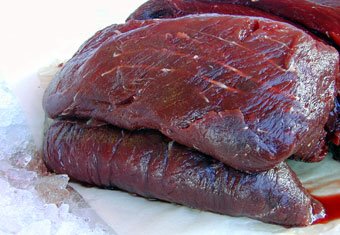
Koraegogi (whale meat)


One thing I forgot to mention in my Haeundae post... while down in Pusan at the Japanese eatery we went to last night, one of the items on the menu was koraegogi, whale meat. 20,000 won (about US$20) for I'm not sure how many pieces.

While I am always tempted to try new things for the sake of trying them (thus my horrific encounter with pŏndegi, or silkworm larvae, when I was a teen), social responsibility takes hold in cases like this and I give it a pass.

While I would love to be able to say I've tried the stuff so that I can include my own perceptions as part of an argument one way or the other, I know that consuming it will be creating demand for more whale meat down the road, even if just in small increments. And given how I feel about the unnecessary and cruel killing of God's intelligent creatures, that would be an inappropriate thing to do. "Trying it" creates demand; and the purveyors of whale meat are trying to jump-start demand by getting people to re-acquire this acquired taste.

I feel similarly about dog meat, a matter where The Marmot and I part company. Unless it can be demonstrated to me that the dogs were not treated cruelly during the time fo their death, transport, or being raised, I will not partake in any kaegogi. This point was underscored for me last month while on Expressway 25, between Kwangju (Gwangju) and Ch'ŏnan (Cheonan).

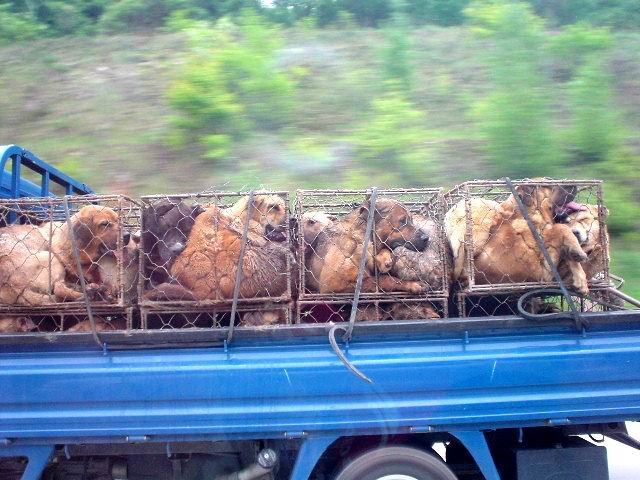
There I saw a typical flat-bed Porter-style small truck, the back filled with cages which were also piled three-high. Each cage was literally stuffed with live dogs, with so little room they could barely move. Many of the more than one hundred dogs had their faces and/or bodies pressed against the metal mesh of the cage they were in.

To make matters worse, these creatures were completely exposed to the elements as they were being whisked along at 120 kph in freezing weather. I only wish I had a working camera nearby so I could have documented this horrific treatment.

This is like the argument against eating veal: if this is what is required to bring the meat of these creatures to the table, then I want no part. And frankly, I think the current consumption of the animals themselves perpetuates such cruelty.


[above photo: The dogs here are in a situation much like I just described, except that there were three tiers of cages, not just two as in this photo. Also, the dogs were a little smaller than these, so most cages appeared to have three dogs in them, not just two.]