Showing posts with label Tohoku earthquake. Show all posts

Sunday, March 11, 2012

9.0 + 1

Today marks the one-year anniversary of the 9.0-magnitude Tōhoku Earthquake, the ensuing tsunami that killed many thousands, and the still ongoing nuclear disaster at Fukushima.

The tragedy has had major repercussions within Japan and elsewhere. The people of Japan — and I know this intimately from having talked with many Japanese since then — are in a funk over the future of their country as they see how many physical structures and political institutions have failed them.

There is a portion of northern Honshū where, within a twelve-mile radius of the Fukushima Daiichi Nuclear Power Plant, no humans will be allowed to live for perhaps the next half century, if then. Yet the belongings of the former residents are still there, visited occasionally by owners who try to retrieve what they can. The land has become home on the range to feral cows no longer tended by the ranchers who'd been raising them.

Many Japanese live in fear that another massive quake will soon hit Tōkyō and bring even worse disaster — and suspect that the government that apparently hid so much embarrassing bad news about Fukushima is withholding the truth about that, too.

Meanwhile, the loss of Fukushima and Japan's apparent decision to gradually shut down its nuclear facilities elsewhere, means greater pressure on the world's energy supplies, a pinch being felt from Korea to Kentucky. On the US West Coast, some claim to have spotted the first wave of toxic garbage that the tsunami ripped from Japanese coastal towns and tossed into the sea.

Officially, there have been 15,850 deaths but there are still 3287 people missing. Some six thousand more were injured. In a country of 128 million, the 1 in 6000 who likely lost their lives were concentrated in a narrow band of communities that are physically, economically, and psychologically devastated. Whole neighborhoods wiped out, families with maybe a single survivor who is now wracked with guilt and despair, family members and friends still wondering about the fate of those who have not yet been accounted for (and probably never will be). Requiescant in pace.

I can't even begin to imagine what this might feel like. The people of northern Honshū, all the people of Japan, still need our help. My link to helping them through the Korean Red Cross is still at right (the one toward the top with the heart). It is still a time to reach out to a neighbor in need.

Seventy-three-year-old Teruko Sato prays at the site where the body of her son Shoichi was found. He died while helping evacuate elderly residents of his village of Kesencho. [source]

...


Sunday, August 21, 2011

Giving the Tohoku and Fukushima disaster-affected people what they need

"M" has alerted me to a Japanese-language website, called Fukkoichiba (literally, "Revival Market"), that aims to directly connect donors to the victims of the Tohoku earthquake and the ensuing tsunami and nuclear disaster.

In short, it works by filling requests from the affected people with donors who will fill those specific needs. You can see the various items — flip-flops, various food items, cooking oil, Pocari Sweat, and even underwear — on the site and then go and buy the stuff. You can then leave your name or a userid that says you bought it.

Unfortunately, the site is only in Japanese right now, although "M," herself a busy student, offered to translate it into English so it could reach a wider audience. For now, though, the couple that set up the site on their spare time are lacking the resources to take it globally.

"M" noted that it's heartbreaking to see the stuff people still lack. Even all these months after the earthquake and the tsunami, these are the basic needs that people still are having difficulty getting. But that aspect of this site is what drew her to it: she remembers previous disasters where so much stuff that was not needed ended up being discarded.

An added feature of this site is a blog full of pictures where many of the grateful recipients show the stuff they received (no, they are not standing around in the aforementioned underwear). Note that many of the people in the pictures are still living in gymnasiums and other places that have been covered into long-term shelters.

"M" felt that added an element of really feeling like you're accomplishing something with your donation, a bit different from sending money to a large organization like the Red Cross, which does extremely important work in an efficient way, but puts donations in a pool, thus preventing you from knowing where your money actually went.

Anyway, if there's anyone around you who can help you muddle through the Japanese on the site, go and see about donating. With the nuclear issue still unresolved and cleanup an on-going process, there's still a lot of need out there.

Sunday, June 5, 2011

Daily Kor for Sunday, June 5, 2011

From story #X, US Defense Secretary meets his Chinese counterpart, General Liang Guanglie, in Singapore. This is not a Korean story per se, but any discussion of the US's deterrence role in East Asia has repercussions for Korea (see here and here).

Since it's summer weather almost everywhere, I guess there's no point in bragging about the beautiful weather on Oahu. Have a great weekend!
  1. ROK Defense Minister Kim Kwanjin vows a far stronger response than in the past to future North Korean attacks, what he termed "proactive deterrence": "I don't think we can be reserved because they are being bolder and bolder" (AP via NPR, Korea Herald)
  2. US Defense Secretary, speaking in Singapore, says US budget woes and war fatigue will not deter US involvement in East Asia (Bloomberg, NYTAP via WaPo, Korea Herald)
    • Gates warns of clashes in oil- and gas-rich South China Sea without a code of conduct (Bloomberg)
  3. In Korea to encourage local Toyota dealers, company president Akio Toyoda says Japanese automaker will return to full capacity by November, after 51 percent dive in South Korean market following devastating Tohoku earthquake, tsunami, and ongoing nuclear crisis (ReutersWSJBloomberg, Korea Herald, Korea Times)
  4. Five North Korean defectors to be allowed to attend American universities under US-sponsored exchange program (Yonhap)
  5. Prosecutors angry over lawmakers' plans to get rid of the investigative unit of the Supreme Prosecutors' Office (Yonhap, Korea Herald, Korea Times)
  6. Trump dazed after being hit in head with cartoon hammer (CNN)

Tuesday, April 26, 2011

LAT on South Korea's renewed annoyance at Japan

I've already covered it in this post, but John Glionna of the Los Angeles Times brings it to a larger audience than I can:
For two decades, the weekly protest has come as sure as the changing seasons: a handful of graying Korean women picketing Tokyo's embassy here, demanding an apology and compensation for being forced into sexual slavery during Japan's World War II-era occupation.

But soon after a magnitude 9 earthquake and tsunami last month killed more than 20,000 people and caused nuclear mayhem in Japan, something changed here. The so-called comfort women felt moved to hold another kind of rally: a vigil for Japanese victims.

"We hate the sin but not the people," said Lee Yong-su, 85. "We hope Japan will stand on its feet soon."

Suddenly, there was a sense that a bitter nationalistic rivalry might be replaced by something the Korean peninsula has rarely felt for its former conqueror: empathy.

South Korea was the first country to send a rescue team to the disaster area. The Korean Red Cross has raised $40 million, one of the largest nongovernment contributions to Japan after the quake. The newspaper Chosun Ilbo, which has often been critical of Japan and its policies, raised $10 million. Even the comfort women chipped in $15,000.

Many compared the moment to the brief window after the 9/11 attacks when many hoped that Democrats and Republicans might finally put aside their differences.

That, of course, didn't happen. And in the case of South Korea and Japan, the rapprochement also appears short-lived.

The two countries seem to have fallen back into old habits — like a couple in an abusive relationship where one has lorded over the other. They've gone to counseling, tried all the couples therapies. And just when one spouse is about to forgive the other, another unforgivable event comes to pass. Once again, signals are misread, and the relationship is back at a dysfunctional impasse.
I would emphasize that the South Korean view of Japan is highly dichotomized: among most SoKos, there is a mental separation between individual Japanese and the Japanese government itself. Despite Tokyo continuing to lay claim to territory they grabbed at the beginning of their brutal four-decade rule over Korea, there is still great sympathy and concern for the people of Japan who have been affected by the Tohoku earthquake, the ensuing tsunami, and the on-going nuclear crisis.

I just wish that both sides would stop doing things to poke the other in the eye, because with China rising and North Korea raving, we need to see more things like this.

Tuesday, April 19, 2011

Like a good neighbor...

Reuters has an article on some South Koreans thinking twice about their financial outpouring of support for Japan after Tokyo pushed its claim to Tokto (Takeshima in Japan) yet again:
At first, Korean pop singer Kim Jang-hoon, dubbed "the angel of donation" for his habit of donating many of his concert proceeds to the poor and campaigns to promote his country, asked his fans to put aside their decades-old animosity toward Japan over Dokdo in the wake of the 9.0 March 11 disaster that has left nearly 28,000 dead or missing.

Many ordinary South Koreans responded generously, and a dozen K-pop stars donated more than $5 million.

But the mood soon darkened after a Japanese education panel authorised the publication of school textbooks that assert Japan's claims to the islets, which act as a stark reminder of Japan's brutal colonial rule over Korea from 1910-1945.

For many, this meant all donations were off.
Yeah, I agree that Tokyo really should have just let it go, at least this once, but I think that when it comes to responses like this...
A Seoul district office that raised about $10,000 for Japanese disaster relief changed its mind and sent most of the funds to a civic group promoting Korea's claims to the islets, which are also a symbol of South Korea standing up to its neighbour.

"I asked myself, why did Japan do this at this tragic moment. We had to discuss what to do next with this fund," said Ra Tae-sung, an official at the office in southwestern Seoul.
... I'd like to point out to whatever ku office that was, that the people in Japan who are suffering and in need of help from South Korea and other countries are entirely different from the right-wing politicians who feel obliged to keep bringing up Tokyo's historically questionable and currently unenforceable claim to the Tokto Islets and the seas surrounding them.

"Nuclear Boy has a stomachache"


This is how the on-going nuclear crisis at Fukushima (aka "Fu¢k You Island") is being explained to kids who have already been rattled by the earthquake and tsunami.

Three Mile Island Boy looks suspiciously like a drunken partygoer with a lampshade on his head. That would explain a lot.

(HT to "M," who first showed me this in Japanese and then alerted me when she found it with English subtitles. She notes that it's a bit of a whitewash, but that the animator-artist was going by what the Japanese government had been revealing at the time.)

Monday, April 4, 2011

Shanghai Disneyland breaks ground this week

Though Hong Kong's Disneyland park is still treading water (my mom and I visited on a rainy summer day in 2009, when they cut ticket prices in half but closed about a third of the attractions), Disney is going ahead with another China-based theme park:
Walt Disney Co. will hold a ground-breaking ceremony Friday in Shanghai for a long-awaited theme park and resort, sources close to the matter said.

The event could mark the end of 16 years of speculation over when Disney would begin building its first theme park in mainland China.

The $3.6 billion project was first discussed in 1995 and would be the company’s fourth theme park and resort outside the United States.

About 1,700 acres have been designated for the park in northeast Shanghai. When completed, it would give Disney a valuable foothold in China’s emerging consumer market.

Chinese state media reported that the initial phase of construction, which includes the theme park and hotels, would be completed in 2014.

The city is extending subway lines to reach the resort.

Disney would reportedly take a 43% equity stake in Shanghai Disneyland while a city-run joint-venture company would own the remaining 57%.
Hmm... where I have I read that controlling less than fifty-one percent is the same as controlling zero percent?

This is part of a new boom in American theme parks located in Asia. Though it hasn't begun any serious construction yet (?), Universal Studios Korea is scheduled to open in Hwasŏng-shi in 2014.

And then there is the venerable Tokyo Disneyland — I've been to both the Disneyland side and Disney Sea — which managed to come out nearly unscathed after the devastating Tohoku earthquake last month, thanks to some clever engineering (I found this post quite interesting, as was all of Japan Probe's coverage of the quake and tsunami).

Rethinking nuclear power in South Korea

The events in northern Japan have led a number of people in the ROK to reconsider whether it is wise to rely so much on nuclear power to meet the country's energy needs:
Following the disasters in Fukushima, the first reaction was for environmentalists to demand that the country’s older reactors be closed down. Then the partisan divide arose, with the opposition criticizing the pro-business, conservative government for over-reliance on nuclear energy, and the government defending itself by saying a growing industrial economy like Korea’s can’t be chintzy about power.

But now the argument is broadening, with people asking more questions about a wider range of issues nuclear and non. How safe are Korea’s reactors compared to those in Japan or other countries? Do Korean consumers and industries use too much power - and is electricity too cheap here? Are investments in nuclear power crowding out alternatives, such as wind and solar energy?

The ultimate fate of the Fukushima Daiichi plant won’t be known for weeks or months. But as in many countries around the world, its travails have started a debate in Korea on nuclear power that is destined to go on for a long time.
With twenty-one nuclear reactors providing 32 percent of the country's electricity, the debate is warranted. Some say South Korea has the world's best nuclear safety record, but until recently Japan was number one or number two as well.

"Wolsong Nuclear Plant is Fukushima #2!"
Frankly, though I think we should never take our eye off constant safety at South Korea's nuclear plants, when it comes to nuclear risks I am more concerned about what's happening in China or even North Korea.

Wednesday, March 30, 2011

Hawaiian economy hurting as Japanese tourists stay home

With the devastating Tohoku earthquake and the ensuing tsunami, even those Japanese from other parts of the country are opting to stay home. And as much as people feel terrible about that tragedy, officials in Hawaii — as well as the general population that works in tourism — are fretting about the blow to the local economy here.

This has highlighted a need to attract tourists from elsewhere, including South Korea (from which flights have recently been expanded).

From the Honolulu Star Advertiser:
Hawaii's tourism industry took hits by the Kobe earthquake in 1995, the swine flu epidemic in 2009 and the Sept. 11 terrorist attacks on the U.S., but this month's disaster could surpass them after a blow that occurred during what continues to be recovery from a worldwide recession. Japanese visitors to Hawaii numbered 1.2 million last year, down by 1 million from 1996.

The Hawaii Tourism Authority expects April will be the peak of the shortfall. It plans to launch a marketing campaign in Japan after helping in the disaster recovery effort.

David Uchiyama, HTA vice president of brand management, told the Star-Advertiser's Allison Schaefers that it will concentrate on new business from North America, Oceania, Korea and China to offset the shortfall in Japan market.

A special marketing program will be aimed at secondary cities such as Portland, Ore., Dallas, San Diego, Sacramento and Phoenix, according to John Monahan, president and chief executive officer of the Hawaii Visitors and Convention Bureau.

Much of the emphasis in marketing has been on Japan, the third-largest tourism source outside the western and eastern U.S., and for good reason. Beyond the sheer numbers of visitors, Japanese tourists spend an average of $274 a day on food, hotels and shopping, while visitors from western mainland states average $146.
Similarly, Japan is hurting from an expected downturn in tourists to their country (which is something South Korea is perhaps setting itself up to take advantage of by easing visa rules to the ROK).

Tuesday, March 22, 2011

Honeymooning with a heavy heart

Takaaki Matsumoto and his wife Chiaki feel very, very bad.

The Honolulu Star-Advertiser is reporting on Japanese tourists who are still coming to Hawaii despite everything that's happened back home in Japan:
Tourists from Japan are still flying in to Hawaii, but some interviewed yesterday brought pangs of guilt with them.

"I feel apologetic," said 31-year-old Osaka resident Yasuo Mitsuhiro, through an interpreter. "But I planned this trip over six months ago, so I decided to come anyway. Right now people are suffering in Japan, and I feel bad coming on a trip like this."

On March 11, Hawaii was hit by seismic sea waves from Japan's devastating magnitude-9.0 earthquake. And now the state anticipates a drops in visitor arrivals just as the industry was starting to show signs of improvement after the recession.

About 1.2 million Japanese travelers accounted for about 17.3 percent of statewide visitor arrivals in 2010. They spend up on average about $270 a day.

However, several traveling agencies and hotels have reported cancellations and decreases in reservations.

The impact of any significant drop in arrivals would be broad. Toru Hama yasu, who heads the Rapid Transit Division, overseeing the city's $5.5 billion rail transit project, said last week that the city is concerned about a drop in general excise tax collections.

He said Japanese travelers can account for up to 5 percent or 6 percent of the general excise tax and that the rail proj ect depends on a surcharge of the tax for funding.

All of the arriving Japanese tourists interviewed yesterday said they had planned their trips months ago. None of them came from areas heavily affected by the quake or tsunami.
One might find that last bit, about how the Tohoku earthquake and ensuing tsunami will adversely affect Hawaii's coffers, a tad distasteful, but we've seen plenty of news stories talking about the adverse effects of Japan's two-pronged tragedy in economic or commercial areas not in Japan (e.g., that iPad shipments may be held up due to a lack of parts from Japan).

I guess that's just it: life goes on for many people, even if all this is there in the back of their mind. I can imagine, though, that they felt a little awkward having a reporter in Oahu ask them point blank if they feel guilty about taking a pleasure trip at a time like this.

I wonder how I would react if I were one of those honeymooners who was about to get married and take off to start my marriage when the quake and tsunami hit. I have a relative who got married on September 11, but one year earlier. I asked if they were considering changing the date on which they celebrated their anniversary. The answer was, no, they thought that day should still have some good associated with it.

American teacher confirmed among the dead in Japan

This news is just one of many tragic tales.

UPDATE:
In a gracious act, Taylor Anderson's family is donating her belongings to victims of the same earthquake and tsunami that took their daughter. Their emotional roller coaster is also heartbreaking:
Taylor Anderson is the first-known American victim of the Japan earthquake and tsunami. The 24-year-old taught English in the seaside town of Ishinomaki.

Four days after the tsunami struck, Anderson's parents were told their daughter had been found alive. Later that day, however, the Andersons were told by the organization Taylor worked for, JET, the Japan Exchange Teaching program, that an error had been made and Taylor's whereabouts were unknown. Taylor's parents were notified of her death on Monday by the U.S. Embassy in Japan.

Officials there say she spent her final moments making sure her young students were safe. But ultimately, she ran out of time to save herself. Her body was found not far from her school.
In this CBS News video, her family speaks out about the death.


Sunday, March 20, 2011

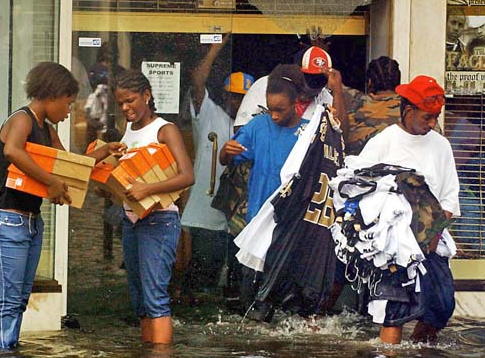
Why aren't Japanese looting?

Over at ROK Drop, GI Korea poses the above question (also asked at CNN and elsewhere), with some concluding that "Japanese are far more developed humans than Koreans will ever be" (it's a K-blog comments section, so what would you expect?).

I've been discussing this very thing with "M" and some other people from Japan or who have lived in Japan, and these are the conclusions we came up with:
  1. Thanks to the graying of Japan, the number of elderly and older people in the affected area is proportionately much higher than in other areas around the world that have been affected by earthquakes and/or major tsunamis.
  2. Just about everything worth looting has been destroyed in the affected area.
  3. Too much shock to loot.
  4. Strict adherence to a family registry has engrained in people the idea that their bad acts, if found out by the authorities, could adversely affect their family members, which seriously lowers the propensity to commit such bad acts long before opportunity arises.
  5. None of the big league sports teams in the Sendai area just won a national championship.
Back at ROK Drop, the discussion diverged into how South Koreans would handle such a disaster. I believe that what would happen is that there would be little or no looting, but there would be a lot of pushing and shoving at some (not all) of the areas offering assistance, as well as a lot of yelling at aid officials.

Back to Japan, some are offering other answers, and I myself would like to submit that the no-looting condition of Japan is not only a goal for other places, but is also an achieved state in many cases. There was little or no looting after 9/11, nor after the major quakes that struck California in 1989 or 1994 (I think).

Honestly, if I lived in this neighborhood and I thought all this merchandise was going to end up being worthless thanks to the flooding, I'd be tempted to loot, too.


Wednesday, March 16, 2011

And the Pat Robertson Disaster Prevention Award goes to...

... Pastor David Yonggi Cho of Yoido Full Gospel Church for wondering aloud if the Tohoku earthquake and ensuing tsunami and nuclear disaster were not a warning from God:
In an interview the newspaper, Cho responded to a request for comments on Japan’s difficulties following its largest earthquake in recorded history by saying, “Japan sees a lot of earthquakes, and I think it is regrettable that there has been such an enormous loss of property and life due to the earthquake.” He went on to say, “Because the Japanese people shun God in terms of their faith and follow idol worship, atheism, and materialism, it makes me wonder if this was not God’s warning to them.”

“I hope that this catastrophe can be turned into a blessing and they take this opportunity to return to the Lord,” he added.
And our runner-up, who will step in and perform Parson Cho's duties if he is unable to serve out his term, is no other than Fox News commentator Glenn Beck:
On his first day back from vacation, Glenn Beck addressed the earthquake in Japan, and said he thinks that it could be a "message [is] being sent" by God.

Speaking on his radio show Monday, Beck said, "I'm not saying God is, you know, causing earthquakes," before quickly adding, "I'm not not saying that either."

He then said that whatever one called God, "there's a message being sent. And that is, 'Hey, you know that stuff we're doing? Not really working out real well. Maybe we should stop doing some of it.' I'm just saying."
No doubt God is listening right now, and well, let's just say I wouldn't stand to close to either of these mooks if I was you. I'm just saying.

The Pat Robertson Award is the namesake of televangelist and former Republican presidential candidate Pat Robertson, who in the aftermath of Hurricane Katrina in 2005 said that New Orleans was struck because God was punishing Americans for their ungodliness.

He managed to win his own award last year for saying something similar after the earthquake that struck Haiti and killed a quarter million people:
Robertson, the host of the "700 Club," blamed the tragedy on something that "happened a long time ago in Haiti, and people might not want to talk about it."

The Haitians "were under the heel of the French. You know, Napoleon III and whatever," Robertson said on his broadcast Wednesday. "And they got together and swore a pact to the devil. They said, 'We will serve you if you will get us free from the French.' True story. And so, the devil said, 'OK, it's a deal.' "
The "700 Club," by the way, gets its name from the combined IQ of its regular viewers. True story.

Tuesday, March 15, 2011

Deep impact from Japan's disaster;
South Korea to divert LNG to Japan

The Los Angeles Times has an analysis of how different sectors will be affected by the massive damage caused by the earthquake, tsunami, and still on-going nuclear disaster that have struck Japan.

Although the impact will be decidedly negative for some, like companies that rely on Japanese goods or parts to do business, corporations that compete with Japanese goods may profit — inadvertently — from Japan's misfortune. Among those are South Korean automakers, though their reliance on Japanese companies' input may make things a bit more of a wash:
Toyota, the world's largest automaker and Japan's biggest company, has halted all production in Japan, including its hybrid Prius vehicle, through Wednesday, representing 45% of its worldwide supply. Automakers Nissan, Mitsubishi, Mazda, Subaru and Suzuki have also temporarily shut down their plants to help conserve electricity.

Honda Motor Co., Japan's fourth-largest company, has shuttered several of its plants, including one in Suzuka, where it produces many of its hybrid vehicles, a painful product to lose as worldwide gasoline prices soar and demand for fuel-efficient vehicles rises. Also, two Toyota plants in the disaster-struck Sendai region produce some of the automaker's more fuel-efficient offerings, including the Yaris subcompact.

Nissan Motor Co. said it lost almost 2,300 vehicles awaiting shipment at an eastern port that were destroyed by the tsunami.

Shares in the Japanese auto sector traded down heavily Monday, with Toyota falling 8% and Nissan down nearly 10% in trading on the Tokyo Stock Exchange.

Although those production setbacks might seem like an opportunity for ambitious foreign competitors such as South Korea's Hyundai, Germany's Volkswagen and a resurgent Ford Motor Co., Rebecca Lindland of IHS Global Insight notes that most Japanese automakers today produce vehicles in the countries where they sell them. According to Honda, for example, 80% of the vehicles it sells in the U.S. are built here.

Moreover, Lindland said, disruptions at Japan's automotive suppliers could hurt brands from all over the world. That's because carmakers depend on complex global supply chains, and even Chevrolets built in Michigan use Japanese components.

"Nobody works in isolation these days," Lindland said. "All it takes is one missing part. If you're missing something as simple as the cup holder, you aren't selling that car."
There's always something unpleasant about looking at bottom lines while we're still looking for survivors in the rubble (!), but these kinds of business stories affect us whether we like it or not.

I guess, though, that a better economic news story to focus on would be South Korea's decision to divert some of its supply of energy-producing liquefied natural gas (LNG) to Japan to help meet its electricity needs in the wake of the disaster:
South Korea will redirect some of its liquefied natural gas imports to Japan to help its disaster-hit neighbour manage a severe energy shortage, a Seoul official said Monday.

"We will redirect parts of LNG (liquefied natural gas) imports from third countries through late March to April to Japan," an official at Knowledge Economy Ministry told AFP.

Japanese electricity operators on Saturday asked for Seoul's help with its gas supply, predicting it will take more than a month for Tokyo to offset shortages caused by damage to key nuclear power plants, the official said.

Negotiations with exporting countries are underway but it is unclear how much gas will be diverted to Japan, the world's top LNG buyer.

"We will provide as much as we can without disrupting our own domestic needs," she said, adding Tokyo will later return the gas under the LNG swap deal with Seoul.

South Korea, the world's second-largest buyer of LNG, has secured nearly 98 per cent of its estimated needs this year through mid-and long-term contracts, the ministry said.
Y'know, I'd say that it's okay for Seoul to disrupt South Korea's energy needs at least a little, all things considered.

Anyway, I'm proud to see that South Koreans are doing so much to help out Japan. Despite historical grievances and some political disputes that bubble to the surface from time to time (cough! — right-wing historical amnesia — cough! — Tokto and Yasukuni — cough!) the two countries are actually closer than most people realize, socially, economically, politically, etc. And much friendlier, too.

And were the tables turned and it were South Korea suffering from such a horrific disaster, I have no doubt in my mind that the Japanese government and the Japanese people would be stepping up in a very big way to make sure their South Korean neighbors made it through.