Sunday, January 29, 2006

Happy Tan'gi 4339!

새해 복 많이 받에세요!

Happy Lunar New Year, everyone! Yeah, Sŏllal (설날) is here. It seems like "Western" New Year was just a few weeks ago.

I did nothing special. I will probably eat ddŏkkuk (rice cake soup) later today. Do some bows (sebae), ask why they don't give me any money (sebaetton).

May it's the Japanese influence in me, but every year I have a strong urge to use the new year as a time to thoroughly clean my apartment. Sure, this is done in Korea as well, but I feel it almost as a ritual. Of course it will take me probably the entire month of February to really get it done, as you will plainly see...
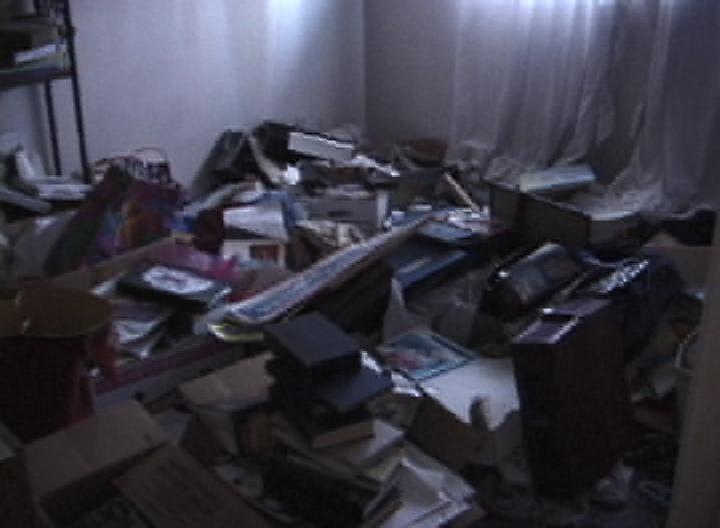


The above picture is not my apartment; it's one of the rooms in the house next door to my parents in upper-middle class Orange County, which was taken over by half a dozen crank addicts when the boyfriend of the wayward granddaughter of our darling old neighbor turned the garage into a meth lab.

I include this photo (from my camcorder, hence the poor quality) only to offer a comparison with my "breakfast nook" (below), which has suffered from neglect since I used the room as a staging area for clearing out another room. Really, could you tell the difference between the two? God forbid I ever am reported missing by some relative I had not spoken with for a while, because the police would come in here and automatically suspect foul play (not that they would care).


If you're a fan of "Friends" like I am and you've seen every episode, you will know that the secret shame of the usually immaculate Monica is her "Monica's closet": a secret small room filled floor to ceiling and wall to wall with junk that she needs to organize in some way. Below is my "Kushibo's closet."


I'm a person who likes to be neat and clean, but that's not always the way it works. For five years I had lived in a big old house, just me and my Halmŏni, and because of its size and number of rooms, I never had to take the time to reduce the amount of junk I own. When the landlady's evil daughter forced her mother to sell the charming, nearly seventy-year-old home so that it could be knocked down and made into a cookie-cutter villa, my Halmŏni and I were forced to move into the small apartment I managed to buy in the same neighborhood she had lived in since she escaped the North in 1947.

But the amount of space available was about one-third that of the old house, and despite my best efforts, I still couldn't pare down my stuff in time for the move so that everything would fit nicely into this small place. I need to work on this—sell some of it, give some of it to the Salvation Army, throw some of it away, put some of it in storage—so that I can actually have the little computer room I want and need.

So now you know how I'll spend my new year. I have an added incentive, besides Tan'gi year 4339 being upon us: I am likely going to the States to continue my doctoral studies this fall, and I have to rent out this place so I can afford San Francisco, Orange County, or Honolulu: a fully furnished apartment with a washer/dryer can maybe get me a million won a month, but a fully furnished apartment with all my junk might get me half that.

Anyway, happy new year. Eat your ddŏkkuk, get a year older, and demand respect from your juniors.

Thursday, January 26, 2006

South Korean court rules against US producers of Agent Orange

The Seoul High Court has ordered two U.S. manufacturers of the defoliant Agent Orange, Dow Chemical and Monsanto Company, to pay $62 million in medical compensation to South Korean veterans of the Vietnam War and their families.
It is acknowledged ... the defendants failed to ensure safety as the defoliants manufactured by the defendants had higher levels of dioxins than standard.
Many people aren't aware of this, but ROK soldiers made up the largest foreign contingent of U.S. allies fighting in Vietnam, contributing some 320,000 troops. Officially, 5,077 South Korean soldiers were killed and 10,962 were wounded.

As the MS-NBC article notes, South Koreans, Vietnamese, and many U.S. veterans blame a variety of illnesses on exposure to Agent Orange, including miscarriages, birth defects, cancers, and nervous disorders. Officially, Agent Orange made up 55% of the 19 million gallons of herbicide dropped on Vietnam between 1962 and 1971 to destroy jungle cover for communist troops.

Norimitsu Onishi on the Dear Leader's trip to China

Norimitsu Onishi, New York Times reporter and suspected (by his critics) stealth Japan-bashing zainichi, has an article on North Korean leader Kim Jong-il's recent tour of socialism with Chinese characteristics.

Onishi likened the trip to Chinese leader and retired Ninja turtle Deng Xiaoping's 1992 "southern tour," after which he "gave his nation...the nod for a full-throttled drive toward capitalism." The article provides a reasonable overview of past attempts by Pyongyang to reform. For "Where's Waldo?" type fun, try to find the hidden anti-Japanese message skillfully hidden in his words (I'm being sarcastic).

Screen quota to be reduced?

I'm going to have more on this as news comes in, but South Korea's Finance Ministry said today that it will reduce the screen quota, removing a key element of friction with the United States ahead of expected free trade talks.

Under the current system, local theaters are mandated to screen South Korean movies for 146 days a year to protect the local film industry. (It should be noted that the screen quota is not just about protection against "Hollywood," but also films from France, the rest of Europe, Hong Kong, and more recently, Japan.)

When there was first talk about removing the quota, Korean filmmakers and performers voiced strong opposition. Some read the writing on the wall and knew that the way to survive, without a captive audience, would be by improving the quality of movies. It appears that many of them have succeeded. Among a lot of people, there is a consensus that the screen quota is no longer needed.

UPDATE:
The screen quota is to be cut by half, to a total of 73 days, beginning July 1. According to the article, "authorities expressed confidence that South Korean movies can withstand more competition from Hollywood, pointing out that the market share for domestic films has grown to nearly 60 percent last year from 50 percent in 2001." The updated article (which gives a good overview of the issue), says Washington welcomed the move.

SECOND UPDATE:
To help movie producers cope with the reduction in the screen quota, the government announced plans to set up a fund worth 400 billion won (about US$400 million), but Korean filmmakers are reportedly calling the countermeasure "flawed and unsatisfactory."

Under the plan, the government will extend direct financial support worth 200 billion won and raise another 200 billion won by using the 5 percent fee it charges for each movie ticket sold.

One of my criticisms of the screen quota was that it mostly assisted big-budget films, not the artsy-fartsy films that can easily be overwhelmed by the competition. Answering that, the proposed fund will be used to help local filmmakers produce more art-house films, independent movies and documentaries. The fund will also be used to increase the number of theaters specializing in such non-mainstream films to 100 from the current dozen.

Culture Minister Chung Dong-chea notes that it was a 150 billion won fund from the Kim Daejung administration that helped the Korean film industry make the strides that we see today.

THIRD UPDATE:
Haisan, a person who I had met long ago but didn't know then that he was Haisan, wrote an interesting piece at the Blog Formerly Known as Marmot's Hole addressing myths of the screen quota. A good read that makes me confident I've been (mostly) feeling the right way on this issue. Just one thing I want to emphasize: the "resurgence" in Korean media is not due to the screen quota, but a change in business (quality and marketing) due to the threat of the screen quota disappearing.

Saturday, January 21, 2006

Los Angeles Times on improving strained Washington-Seoul ties

I should have fisked this last week, but the Los Angeles Times has an interesting overview of the strained relationship between Seoul and Washington ahead of this week's visit by ROK representatives to meet with US Secretary of State Condaleeza Rice in the US capital.

"Peaceful democracies" a myth?

Writing in the Los Angeles Times, Mark Helprin of the Claremont Institute takes aim at President Bush's common claim that "democracies are peaceful countries." An interesting read about how "democracies" can be a threat to their neighbors as much as authoritarian governments, although I would say the point about the value of democracies is being missed: they allow the citizens within them to live the way they deem fit (within certain parameters, of course). But then again, it might not be so much that Helprin himself misses the point as that he doesn't address that point because it's not part of Bush's "self-evident truth."

Anger is vinegar

I've updated this post from June with a long overdue follow-up and an editorial that is lengthier than the original post itself (Kushibo is not known for brevity).

Incidentally, in the comments section following the Gord post on which mine is based, someone links to my Corea-versus-Korea post. To this day, that now-famous post (it's linked in Wikipedia and places that use Wikipedia materials) still gets dozens of hits each week originating from Gord's comments section. In fact, on some days it makes up 20 to 25% of my blog's total hits.

And one last thing about this picture: what really bugs me about it is that the "Korea" figure is stepping on Kyushu, which is one of my two favorite places in Japan. Think of the tsunami that would cause in Pusan!

Korea news briefs (January 21, 2006)

Koizumi wants to make everything all better
Japanese Prime Minister Junichiro Koizum says Japan will push ahead with wide-ranging government changes and try to improve its relations with China and South Korea.

Welcome to the 21st century!
South Korea is going to accelerate its move toward adopting the Linux computer operating system to replace Microsoft Windows in the public sector--not Windows XP but Windows 98. Six government agencies held a meeting to craft measures in response to Microsoft's recent decision to stop issuing security patches for Windows 98 starting in July.

Korea teams up with Japan and China
South Korea's Haansoft Inc. (makers of the widely used Hangul Word Processor, or HWP) says it will set up a three-way joint venture this year with major Chinese and Japanese Linux OS vendors to develop more advanced Linux-based programs and step up their presence in the open-source software market.

Seoul and Washington jointly call for Pyongyang to return to talks
The United States and South Korea call for North Korea to return to talks aimed at ending its nuclear weapons drive as China makes a new push to break the impasse over the three-year-old crisis.

US official calls for Macau to deal with North Korea issue
Daniel Glaser, the deputy assistant Treasury secretary for terrorist financing and financial crimes, calls for Macau to clamp down on money laundering after a bank in the autonomous Chinese territory was accused of acting as a front for North Korean funds.

South Korea widens probe into Hwang fiasco
South Korean prosecutors who earlier searched disgraced stem cell scientist Dr. Hwang Woo-suk's home say they were barring more of his collaborators from leaving the country and raiding homes. Meanwhile,
Seoul National University says it is moving to punish Hwang and six other professors over faked research.

Community standards

Jodi recently wrote that she has over 1000 hits a day (quite healthy if she does say so herself), and she did so not long after I mentioned that I had 100. Naturally, since the world does revolve around me, and therefore everything that happens in the world happens because it is somehow related to me, I can't help but assume that she's just rubbing my nose in it.

Sure,
Asia Pages gets such high numbers because "Asia" pages gets listed when people google Asian mail-order brides or porn. I get googled when people are looking for obscure Japanese fabric or they've misspelled an even more obscure Japanese martial art.

One would think that with my witty banter and laser-like insight I could get tens of thousands of hits a day, but it's only an intellectual few that appreciate my pithy proclamations. What I need is a "
girl Friday" kind of thing [UPDATE after Lost Nomad closed down: like this], but without being so overtly pandering to the number of hits that my ruse is too obvious.

I mean, if I really am going to include gratuitous pictures of sexy women, it's got to look non-gratuitous (like
here—I thought the woman with dark hair was kinda cute).

And that means I guess I could get away with showing things like these pictures below, because, by golly, they're in the
Chosun Ilbo of all places.


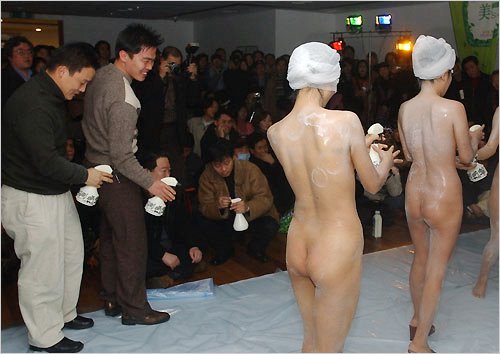
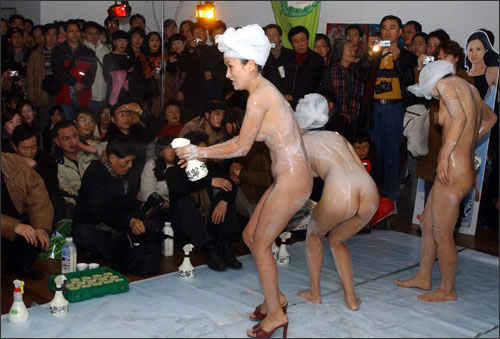
These women, professional nude models, were part of a staged "nude yoghurt fight" designed to advertise a new product for a domestic dairy. The Seoul appellate court ruled Friday that their "performance" was "obscene" because it had no artistic merit and... Ah, who the hell cares?! It's bare butts and pixelated nipples!


Okay, here's my serious take on this (what would
Kushibo-e Kibun be without a serious take?): Isn't it ironic that the nude models (one of them named Park) and the dairy (abbreviated S... Saeil? Sasteur? Senmark? Sonsei? Oh, what could it be?) can be fined for an obscene display, but a mainstream newspaper can post pictures of said obscene display and it's all okay? What's the difference between the closed "performance" and the open-to-the-public newspaper? Maybe Bush knows the answer.

Anyway, lest anyone think I've thrown my standards out the window, no, I am not shirking my social responsibility (children might be reading this blog—won't someone think of the children?!) by claiming "community standards" with whatever I post here from now on. I just have a
new standard: If it can show up in the Chosun Ilbo, that bastion of conservative Korean political values, it's fair game at Kushibo-e Kibun. And you're all feeling my kibun now.

This is wonderful! I don't even have to include a "not safe for work" warning because—hey!—it's in the
Chosun Ilbo! Your boss comes by and says, "Whiskey Tango Foxtrot! What the foxtrot are you looking at?!" but you can turn to him or her and say, "Pictures from the Chosun Ilbo, sir or ma'am."

If your same- or different-gendered co-worker comes by and says that she or he is offended that you have these pictures up for all who crane their necks to view your monitor to see, then you can tell her or him to go sue the
Chosun Ilbo. If the spouse, girlfriend/boyfriend, or animated Real Doll gets offended, you can just say, "Honey, I'm reading commentary about the Chosun Ilbo."

Community standards, baby! How can you
not love this?

Um, Mom, if you're reading this... er, um... I'm trying to make a bold statement about how so-called "community standards" is a totally bogus cop-out which excuses people to post trash like this.

Okay, everyone, my mom's gone now. Just wait and watch those
sitemeter.com numbers at the bottom just shoot through the roof.

Oh, crap, I forgot the most important thing, the
google bait: nude Koreans in Asia doing nude and naked performance, splattered in milky products of some kind. That's right, they're nude Koreans. Or maybe nude Japanese. Maybe these nude Koreans or nude Japanese (naked sexy Asians of some kind) want to have sex with you. Check out their Korean asses and non-uncensored nipples!

[
in Kushibo's best Mr. Burns voice] Ex~cellent!

Friday, January 20, 2006

Ashcroft, Korea, Boeing, and Israel

On the first anniversary of Bush's second inauguration, what better time to talk about the post-White House activities of a Bush all-star, former Attorney General John Ashcroft. After leaving Washington--well, not really leaving Washington, but just the White House--public servant Ashcroft has become a serve-yourself lobbyist.

The Chicago Tribune, by way of the Bay Area's
Contra Costa Times, reports that in less than three months since registering as a lobbyist, "Ashcroft has banked at least $269,000 from just four clients and appears to be developing a practice centered on firms that want to capitalize on a government demand for homeland security technology that boomed under sometimes controversial policies he promoted while in office."

Three clients of Ashcroft's lobbying firm want his help in selling data or software with homeland security applications, according to government filings.

A fourth, Israel Aircraft Industries International, is competing with Chicago's Boeing Co. to sell the government of South Korea a billion-dollar airborne early warning system.

While Ashcroft's lobbying is within government rules for former officials, it is nonetheless a departure from the practice of attorneys general for at least the last thirty years.

While others have counseled corporate clients or perhaps even lobbied in a specific case as part of law firm business, Ashcroft is the first in recent memory to open a lobbying firm.
Mr. Ashcroft, who loves quoting the Bible and claims to be guided by it, seems to be unfamiliar with 1 Timothy 6:10, which reminds us that the love of money is a root of all kinds of evil.

Anyhoo, I stumbled across this while doing a follow-up on this December post. I think Marmot might have mentioned it, too, though I can't find it now. Boeing is a major job-provider on the West Coast of the United States, and it has been hurting from lost contracts and Bush administration plans to stop making the C-17 work horse.


[photo: In an earlier time, Ashcroft dreams of meeting naked Amazon women in silver paint, a fantasy which he is able to afford now that he's a big-time lobbyist doling out American influence to the highest bidder.]

Okay, so Ashcroft is not actually breaking any laws, but it's disgusting that influence is so easily bought and sold in what is supposed to be a democracy, especially when it is hurting American companies. If they were losing contracts on merit, that would be one thing, but that's not what it seems here.

An interesting thing is that Ashcroft's company collected $220,000 from Oracle Corp., which won Justice Department approval of a multi-billion acquisition less than a month after hiring Ashcroft in October. As attorney general, Ashcroft sued Oracle in 2004 to try to block an earlier acquisition by the company.

Tuesday, January 17, 2006

Show me the money.

UPDATE (May 2007):
The Bank of Korea has finally approved new bills of a larger denomination, 50,000 won and 100,000 won, to be precise (link to Korean-language Yonhap article), to be released in early 2009. Read the comments section below for ideas about who should be on the bills (my vote is for Shin Saimdang). This is the first new note since 1973.

Back in 1973, the new 10,000-won bill was worth an awful lot. Since then, according to the English-language article, consumer prices have increased twelve-fold, while personal income has increased 110-fold. In other words, a 10,000-won bill was quite sufficient.

Worries about making bribery and corruption easier were the main reasons not to increase the size of the denominations, but the cost of supyo checks has been the deciding factor here: no longer will banks or consumers have to go through the labor-intensive cost of dealing with all those checks. The Bank of Korea said the new bank notes will save about 280 billion won annually (just under $300 million).

Meanwhile, the Bank of Korea is pooh-poohing plans to lop off a few zeroes from the currency (e.g., making 1000 won just 1 won). I think they should keep the zeroes, if for no other reason that (a) it provides good numbers practice for both learners of Korean and learners of English and (b) it's as close as some of us will ever get to being millionaires.

Back to who should be on the bill, my suggestion is that Saimdang be on the fifty, not the hundred. Why? Parents of school-age children will be tempted to bribe their child's teachers with money depicting Shin, who is seen as a symbol of proper education. Just like people taking the college entrance exam were stealing the S off of Hyundai Sonatas, for good luck, some parents may guess there's some beneficial power in giving someone a Shin bill instead of, say, one with Emperor Kojong, Queen Myŏngsŏng, or Tan'gun. So let's save those other people for the hundred.

And in this way, perhaps we can cut education-related bribery in half. You'll all thank me later.

ORIGINAL POST (January 2006):
The Bank of Korea has
issued the prototype for the new counterfeit-resistant 1000-won bills, following close on the heels of the new 5000-won bill introduced last year. The BoK wants to have these ready to go by the first half of this year.


The main features are still on the new bill, including prominent Confucian scholar Yi Hwang. It also still says "1000" (wouldn't it be ever-so-cool if they could get each installed with a tiny chip that would instead display that day's dollar-to-won exchange rate: 978.3 today, 972.1 the following day, etc.?).

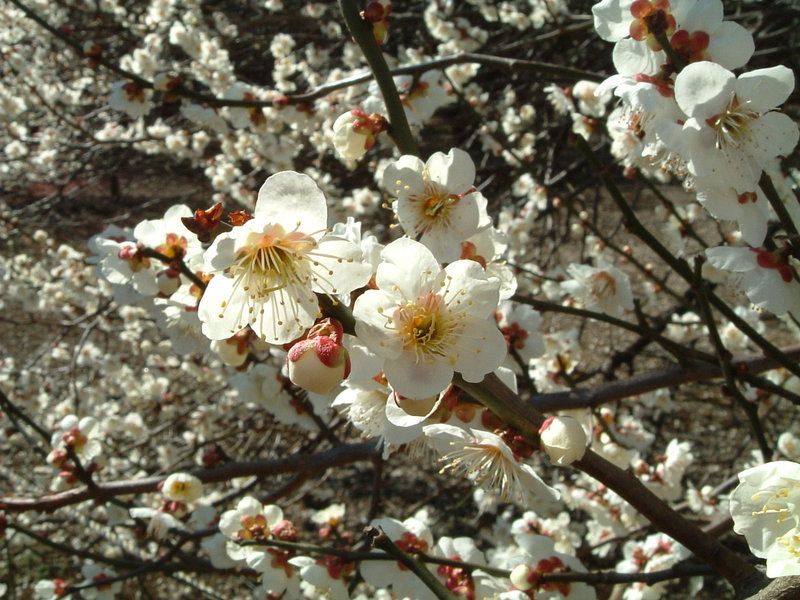
The new background has a traditional Korean wall-hanging and flowers... flowers that look to me like, er, um, cherry blossoms
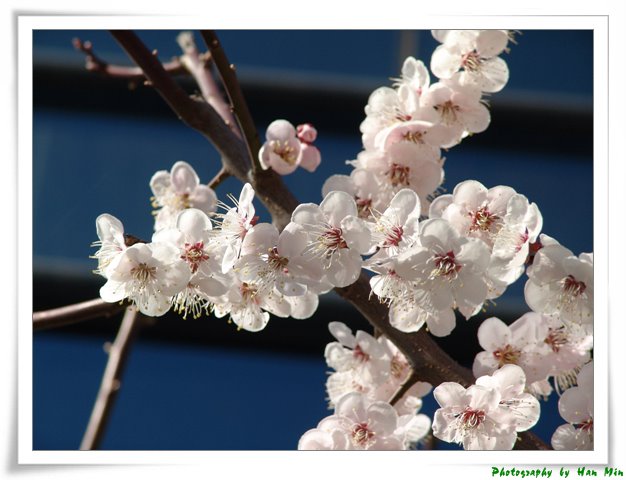
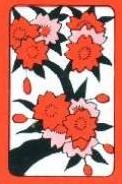
[first photo below]. I'm not kidding, I did a double-take on that. Maybe it's supposed to be a mugunghwa (Rose of Sharon, a common garden hibiscus), Korea's national flower [second photo below]. Both of them are represented as five-pointed flowers, I think, but the flowers on leaf-less branches depicted on the 1000-won bill seems more sakura/pŏkkot-like than mugunghwa-like. Also, the flowers in the drawing remind me of hwatu (go-stop) cards.


It's entirely possible that the drawing is supposed to be of a non-specific flower in general or of some third variety I haven't thought of, but if it really is a cherry blossom, then kudos to whomever made this decision for not fearing the uber-jingoists who decry the millions (?) of Koreans who flock to parks each April to view the cherry blossoms (벚꽃) during their ephemeral bloom and who occasionally chop down the cherry blossom trees (벚나무) to make their crazed point.

The reverse of the note follows after a Choson-era painting depicting the Tosan Lecture Hall in Andong, made famous by Yi Hwang's teachings. The more compact note will also be fifteen millimeters narrower and eight millimeters shorter in length, while using color-changing ink, latent images and silver lines to counter forgery attempts. Gone are the two Korean syllables in the serial number, replaced by Roman characters. Gone also is the dominant pinkness that characterized the previous bill (the 1000-won, 5000-won, and 10,000-won were mainly pink, orange, and green, respectively). The new blue/aqua color reminds me of a cool day at the beach.

Finally, with Dr. Hwang Woo-suk now disgraced, the Bank of Korea says it is planning to remove the word "specimen" on each bill, which had been inserted as a subtle nod to the celebrity veterinarian's biological research.

ADDENDUM TO POST:
Jing
said the flowers in question might be pear/plum blossoms, known in Korean as maehwa. Upon further inspection, I think that's what they were. The card below on the left is a maehwa (pear blossom), representing February in the hwat'u cards (hanafuda in Japanese). This is the one I thought resembled the flowers on the 1000-won bill. The card on the right is the pŏkkot (cherry blossom), representing March. I always get these two flowers confused in the hwat'u system, so I may be wrong that the new money is possibly featuring a cherry blossom.


Below is a picture of actual maehwa. You be the judge.

The five chugigi

The highlight of a recent conversation with a friend who lives in Nonhyŏn-dong: the five chugigi (노무현의 5가지 죽이기), or, the five things President Roh Moohyun wants to destroy. None of this is new (apparently Roh has mentioned this many times to many people), but it is interesting how this has become often-mentioned talking points among Korea's conservatives. Anyway, look at who Roh sees as his enemies in this class/cultural warfare:

1) 三星 죽이기 (Samsung Group conglomerate)

2) 江南 죽이기 (the Kangnam area with its filthy rich)

3) 서울大 죽이기 (Seoul National University, with its intellectual elites and graduates who dominate Korea's political and economic spheres)

4) 東亞日報 죽이기 (the Dong-a Ilbo, though it's probably the Korean edition he hates)

5) 基督敎 죽이기 (kidokkyo, or Christianity, especially Protestants)

Saturday, January 14, 2006

Elvis has left the villa

It started a few days ago when the South Korean media reported on speculations that the "Dear Leader" Kim Jong-il had left his haven in the North for China. Was he going to Beijing? Who would he meet? What was the purpose of the trip?

The Chinese were tight-lipped. After all, a lot of people would like to see the Dear Leader become the Dead Leader, so his itinerary would naturally be kept on the QT by the PRC. Kim Jong-il reportedly fears flying, so he takes a special armored train wherever he goes, especially on trips into China.

It was on a return to China in 2004 that an explosion occurred in North Korea's Ryongchon area, along the train tracks from Beijing to Pyongyang, just hours after the Dear Leader had passed that way. Some think it may have been an assassination attempt; more than 160 people were killed and $350 million in damage occurred.

If the right people were to find out Kim Jong-il's travel plans, he could become a tempting (and somewhat easy) target. Just taking out the bridge over the Amnok/Yalu River between Dandong and Shinuiju while the Dear Leader is still in China might be enough to cause his government to be thrown into turmoil.

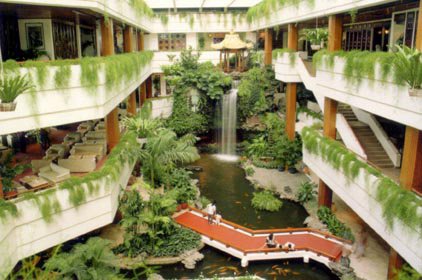
There was speculation that he was not in Beijing, but way down south, about as far away from North Korea you can get and still be in a major Chinese city. Japan's Nippon TV reported that a figure was seen getting out of and later into a limo at Guangzhou's prestigious White Swan Hotel, near the historic British and French quarters of the city. More speculation for inquiring minds.

[photo: When all guests were suddenly forced on Thursday to vacate Guangzhou's White Swan Hotel, insiders knew it could only mean either a massive outbreak of food poisoning or a visit by North Korean strongman Kim Jong-il.]

I have visited that part of Guangzhou a couple times and have even dined at a restaurant inside the White Swan, looking out at the waterfront of the Pearl River. I ordered something from the menu I couldn't read, and they brought me a wonderful chicken dish in a sauce I can still taste. Aye, this hotel is indeed fit for someone with the fine gastronomical tastes of Kim Jong-il.

(By the way, this part of Guangzhou, once a British and French concession, is actually a very interesting place if you ever get a chance to visit. A beautiful mixture of Chinese-European architecture from the 19th century that will make you think the Opium Wars were all worth it. There are romantic overnight ferries lazily plying the Pearl River between Hong Kong and Guangzhou or Macau and Guangzhou—that's right, it's a literal slow boat to China—plus faster boats if you want to spend the extra money. The boats let you off not far from Shamian Island, where the hotel and the historic quarters are located. The live animal market, ground zero for past and future pandemics, is also a must-see.)

[photo: Much of the White Swan Hotel's appeal to North Korea's ruler is that its interior's foliage provides plenty of cover for for despots wearing green Mao suits, just in case someone tries to get him.]

Anyway, the whole world was playing a high-stakes geopolitical game of "Where's Waldo?" The
New York Times reports:
Rarely, though, do the authorities go to the extent of clearing out an entire five-star hotel without explanation ahead of time. So when the authorities in the southern Chinese city of Guangzhou ordered all guests to leave the luxury White Swan Hotel on Thursday and threw up a tight security cordon around the building, it was clear that no ordinary dignitary was coming for the weekend.
But even if they could demonstrate KJI really was there, the question still remained why he might be visiting Guangzhou and nearby Shenzhen, on the border with Hong Kong. Sure, these are all close to Macau, which is where North Korea's counterfeit superbills and drug profits are laundered, but could that be the reason? Many speculated that Kim Jong-il was down in the Hong Kong-influenced southern province of Guangdong to get an eyeful and earful of the progress China has made with economic reforms.

To be honest, I'm not so sure Guangzhou is the place to bring someone whom you're trying to convince to begin major reforms. Frankly, the septuagenarians who replaced the octogenarians who used to rule China have mostly lost control of the place. Someone like Kim Jong-il and his cronies are not going to look at free-wheeling Guangzhou and go, "Yeah, let's try that."

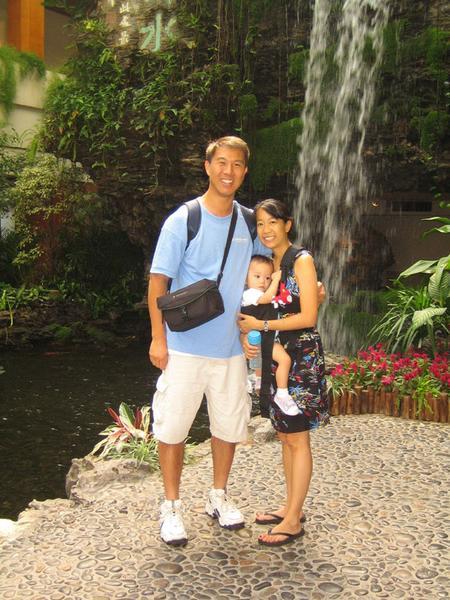
[photo: Tourists like Goff, Stace, and baby Sarah of Daly City, California, were forced to leave the White Swan Hotel at a moment's notice to make room for Dear Leader Kim Jong-il.]

So while the world wondered where the wandering Wunderkind Waldo-esque Leader had gone, Kushibo's sources in the former canton of Canton tell me the Coifed One is actually in China's Wild, Wild South to record a record album. That's right: the son of the Great Leader has long been a big fan of Canto-pop. He's spent the last eight years amassing a major collection of LPs, CDs, videos, and abducted C-pop stars whom he goads into having sex by promising their freedom.

He's been practicing his tones and nasal sounds for many hours in his spare time, enough that he thinks he can pull off a convincing rendition of sappy lovelorn lyrics that Hong Kongers and Vietnamese can dance to.

And that was the purpose of clearing out the White Swan Hotel, to allow the Great Leader full access to their state-of-the-art karaoke bar so that Mr. Kim could belt out a few tunes without being embarrassed. Why the White Swan? Reportedly, Grand Field Marshal Kim feels very "Canto-inspired" when he is there in the heart of Guangdong. Also, the venue carries sentimental value for him, since this is where he shot dead eight very distant relatives of high-level defector Hang Jang-yop, who had been lured there with promises of an affordable lobster buffet (their bodies were dumped into the Pearl River and devoured by Cantonese mud sharks, mutated offspring of freshwater catfish and carp that went through rapid evolution thanks to the copious amounts of chromium Chinese factories pump into that country's rivers and streams. UPDATE from 9/2008: chromium and melamine).

My sources, at no small risk to their safety, have managed to snag from a Guangzhou studio the tentative cover for the album [at left]. Kim Jong-il [at center] is joined by General Kang "the Swallow" Kyonu and Colonel Cho "Nine Fingers" Pilsu, two experts on torture and interrogation who also play a mean saxophone and keyboard, respectively. The album cover will not bear Kim's name, since US Commerce Department restrictions would mean that a direct tie to Pyongyang would prevent sales in Chinatowns across the United States. The Dear Leader assumes his fans will simply know who he is. Marshal Kim is toying with the idea of using the name of one of his on-stage personas, Fat-n-Shady.

For now, the album is to be titled "Reuters." Apparently Reuters writes a lot of articles about Kim, and he wants to show some respect. Word.

Of course, it may turn out that this bit of information, like so much scuttlebutt on this enigmatic leader, is a load of horse-pucky. All I can say is, whatever he is doing in Guangzhou, may he catch bird flu and die, taking as many of his handlers out with him.