Friday, August 19, 2011

Chinese officials force reporters covering Biden speech out the door

You'd think that if you found a group of people who actually want to hear a Joe Biden speech, you should let them sit through to the end.

But if you're Chinese officials and you're afraid that the Vice President of the United States might say something frank, candid, and a little bit biting about your country, maybe you don't want people in the room who buy the proverbial ink by the proverbial barrel.

Or maybe they were afraid Joltin' Joe was about to call his Chinese counterpart "articulate and bright and clean and a nice-looking guy."

From the Los Angeles Times:
Xi spoke first, calling Biden's visit a "major event" in the U.S.-China relationship and expressing his desire to work with America "to promote development of relations between our great nations."

Then Biden spoke, starting with a reference to his first visit to China in 1979, when he saw "the great wonders" of the nation. He spoke of his admiration for the Chinese people and the "great sweep of history." And to Xi, he spoke of the importance of developing a close personal relationship, one of "openness and candor," and stated his belief that foreign policy "is more than just formal visits, it's establishing relationships and trust."

"It is my fond hope that our personal relationship will continue to grow," Biden said to Xi, who is widely expected to be the next Chinese president.

It was right about this time that a near-brawl was breaking out about a hundred feet away from the diplomatic exchanges in the Eastern Hall of the Great Hall of the People.

Only minutes into Biden's remarks, Chinese officials had begun to direct reporters toward the exits. Most reporters and the vice president's staff objected, saying it was important to cover the entirety of Biden's opening statement, as had been the agreement between officials beforehand.

A Chinese press aide said Biden was going on far too long for their liking. But in fact, including the consecutive translation of his comments from English to Chinese, Biden spoke only two or three minutes longer than Xi had.

Soon the stern shooing turned into forceful shoving. As reporters tried to stand their ground, Chinese officials locked arms and pushed forward in a show of overwhelming force. Soon enough Biden did finish, but reporters had difficulty hearing the entire thing because of the fisticuffs.
This is one of the things that makes me so uneasy about China: it is a big and powerful country that tries so very, very hard to remove uncomfortable facts and discourse from the public sphere, often replacing it with its own pre-approved distraction or diversion.

From SARS to the treatment of Uighurs to Joe Biden potentially making a speech where he would call for more press freedom or human rights in North Korea, China's ally, Beijing has great fear over the public knowing what's really being said or done. As we've seen with SARS itself, it is an unsustainable situation that threatens to collapse in on itself. Sadly, though, my thoughts and opinions probably reach very few Chinese, as Blogger (this blog's platform) is still blocked in China, I believe.

Meanwhile, Biden is getting no love on the other side of the Pacific Ocean, either. At Real Clear Politics, Richard Benedetto makes the case that for jettisoning Joe in favor of Secretary of State Hillary Clinton:
In contrast, Biden flopped on the one high-profile task Obama gave him this year -- negotiate a budget-deficit deal with Democrats and Republicans in Congress. The Biden-led talks came to an abrupt end in June when Republicans walked out.

All this is not lost on the public. The Gallup Poll puts Clinton’s favorability with the American people at 66 percent. The last Gallup measure for Biden put him at 42 percent.

Moreover, with the growing possibility that a woman -- Rep. Michele Bachmann -- could be on the Republican ticket either in the first or second slot (more likely the latter), Clinton would provide a formidable counter that an all-male ticket would not. Democrats would love to pit Clinton’s political and experiential skills against those of Bachmann. It’s a matchup they believe they would win going away.

On top of all that, Clinton has a large, spirited and loyal following among Democrats and many independents. Biden does not. The vice president only brings Delaware and its three electoral votes to the fold. And Delaware is a heavily Democratic state that would probably vote for Obama whether Biden is on the ticket or not.

Clinton, however, could shore up flagging Obama support in critical swing states such as Pennsylvania, New Jersey, Ohio, Florida, Minnesota, Wisconsin and Iowa, states the president must carry to win a second term. Without them he’s a goner, and he knows it.
And I would like to see Clinton go up against Bachmann in a VP debate. We can see once and for all who pulls off the Crazy Eyes look better.

My, that was terrible. No national print media would ever do that to Hillary, would they?

Oh, my. That's just horrible. It sure puts the latest engineered outrage over the Bachmann Newsweek "Queen of Rage" cover into perspective a bit. Of course, Bachmann's outraged supporters somehow missed this and many other depictions of Hillary Clinton as having crazy eyes herself, as they largely happened before the Republicans insist the world began, on January 20, 2009.

By the way, I'm not so sure how the above photo of Ms Bachmann is so dramatically different from this one at left, which I snagged directly from the Congresswoman's own Bachmann-for-President website.

(This post was brought to you by Stream of Consciousness™.)

Monday, August 15, 2011

Yasukuni enshrinement mix-up

I imagine most of my readers are familiar with the controversial Yasukuni Shrine. Originally meant to enshrine those who died fighting for the Japanese Emperor, turning them into kami gods, it became a source of contention and bad relations with Tokyo's neighbors when the shrine keepers chose to enshrine the fourteen Class-A war criminals who had been the architects of Imperial Japanese expansionism and brutality before and during World War II.

Adding fuel to the fire, the relatives of some of the Koreans and Taiwanese who were enshrined there after dying during service in the Imperial Japanese military have sought to have their loved ones removed (ditto with some Japanese family members).

The Yasukuni shrine keepers shrug their shoulders and say once a dead soldier has been made into a kami, there ain't nothing they can do about it. It's a bit of an angels-dancing-on-the-head-of-a-pin argument.

Well, speaking of pinheads, one Mr Kim is particularly ticked off about enshrinement at Yasukuni: He was never an Imperial soldier and, just as importantly, he's not dead.

From the Los Angeles Times:
For most of his life, Kim Hui-jong has kept what he considers a shameful secret. In 1944, as a teenager, he was abducted from his village in northern Korea by Japanese soldiers and forced to dig tunnels at a World War II military camp on the island of Saipan.

It would take him a decade of marriage to tell his wife about his past. Kim, 86, still often dreams of the battlefield shelling that severely damaged his hearing and the taunts of his captors: "You Koreans are like canned meat; we can take you anywhere and use you as we see fit."

He always considered his Japanese enslavement, and the two years he later spent as a U.S. prisoner of war, as a lifelong humiliation. Then, in 2005, Kim received a new insult he insists he still cannot bear: For decades, the former conscript learned, he has been counted among Japan's war dead and, because of an administrative error, his name is listed at Tokyo's controversial Yasukuni shrine. He could no longer remain silent.

Many view Yasukuni as a symbol of Japanese militarist values that led millions to their deaths. Worse, Kim and other critics say, Shinto priests who control the shrine list Japanese leaders executed as war criminals in its ranks of the dead.
Just so we're clear, it's not Mr Kim to whom I referred as a pinhead.

Anyway, expect the Yasukuni shrine keepers to do drag their feet on this, if they do anything at all. The modus operandi in dealing with embarrassingly bad things from World War II is to ignore it, especially if it sets a slippery-slope precedent. This is why, for example, Tokyo continues to insist Tokto is Japan's, not South Korea's, because to do anything else would seem to weaken Japan's claim to islands disputed with Russia, China, Taiwan, etc.

Saturday, August 13, 2011

UPDATED: Korea-obsessed British university student gets surgery to become Merong Girl (메롱걸)

ORIGINAL POST:
One of those popular urban legends about South Korea is that kids in English-obsessed South Korea are getting their tongues snipped (a procedure called lingual frenectomy) in order to pronounce English more accurately. I call it an urban legend because, while there certainly are people who have gotten the surgery done, it has reached the point where there are more stories about this supposedly popular Korean procedure in English-language media than there are people who have actually done it. I think.

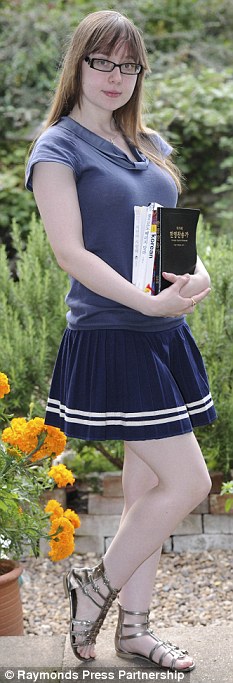
Now the British media has brought us a twist on this story. It seems one university student in England is obsessed with Korean culture and learning Korean (see all those Korea books she's carrying), and (wait for it...) she has had a similar tongue-lengthening surgery in order to speak Korean better.

From the UK's Daily Mail:
Student Rhiannon Brooksbank-Jones dreams of living and working in South Korea once she finishes university, even though she has never visited the country.

But while taking language lessons, the 19-year-old found that she couldn't pronounce certain crucial sounds in the Korean alphabet.

Her dentist suggested it may be because she was born with a slightly shorter than average tongue, caused by having an unusually thick lingual frenulum - the flap of skin that joins the underside of the tongue to the floor of the mouth.

After discussing the matter with her parents and language tutor, Rhiannon decided to undergo an operation to correct the condition, despite the fact it has never caused her any problems in speaking English.

She underwent a lingual frenectomy, which involves making an incision in the flap of skin. As a result, Rhiannon's tongue is now about 1cm longer, and she can say words that were impossible before.

Rhiannon, of Beeston, Nottingham, said: 'I'd been learning Korean for about two years, and my speaking level is now high, but I was really struggling with particular sounds.

'It became apparent after a little while that I was having trouble with the Korean letter 'L', which is very frequent and comes from a slightly higher place in the mouth than the English 'L', and that my tongue was too short.

'My pronunciation was very 'foreign', but now I can speak with a native Korean accent. The surgical procedure was my only option. It's not like you can stretch your tongue otherwise. I just decided enough was enough.
Poor lingual frenulum, you're hated on two continents.

Anyway, while in Korea I imagine a lot of anglophones would scratch their head and say, "What the...?!" for the same reasons we might do the same about six-year-olds with English-obsessed Korean mothers having the surgery (if you have a tiger mom, expect to get mauled a bit), back in the United Kingdom people are hemming and hawing about this surgical procedure having been covered by the national health insurance scheme. Apparently this Nottingham native is some sort of modern-day medical Robin Hood: stealing from the rich National Health Service and giving it to her poor, unable-to-pronounce ㄹ self.

Okay. But me? I smell a carefully crafted ploy by a young, smart, and reasonably attractive young lady to launch a career in Korea's public sphere: she's cute (never hurts with any job), speaks Korean pretty well (a plus for doing anything other than English teaching), has considerable interest in Korean culture (an ego massager for a large portion of the Korean masses), and has the kind of figure many Korean men like in Caucasian women (that's a euphemistic way of saying she has a good-sized chest while falling within the range of thin to nothing larger that chubby-cute). And I like her glasses.

So in conclusion: Get in touch with me, Rhiannon Brooksbank-Jones, and I'll make you a star.

Seriously. And I've already christened you 메롱걸* (the only alternative is 혀녀). That's what we call 서비스.

* To understand what is 메롱 (merong), see the picture below:

above: South Korea's most famous English teacher

UPDATE:
This story has also become a post at The Marmot's Hole. Human rights lawyer Ben Wagner, who is highly skilled at finding bigotry where no one else does, has revealed that Merong Girl is promoting racist viewpoints:
All the best in to Rhiannon in her Korean language studies, but I wish she hadn’t chosen to perpetuate to the myth that race is somehow tied one’s ability to speak a language with native fluency. Ironically it’s an allegedly short “Korean tongue” which supposedly makes it difficult to produce the English L/R sounds, the Brit’s “short” tongue should have made her a natural if any of these nonsensical theories had any scientific basis.
Thank goodness for Mr Wagner, or else I wouldn't have realized Ms Brooksbank-Jones was perpetuating race-based myths. Here I thought that the reason for the surgery was that her tongue (i.e., not the tongue of most White people in England) was "shorter than average" and that she (i.e., not most White people in England) had "an unusually thick lingual frenulum." Now I realize she's some sort of White Inferiorist. I may have to rethink launching her career.

Wednesday, August 10, 2011

You had me at hello.

Take the above cartoon. Replace Roy with two Indian residents of South Korea. Replace the alien heads shaped like hands with a South Korean child's kochu. Replace the annihilation of Earth with the aforementioned Indian residents of South Korea going to prison. Then you have the first story of this Marmot's Hole post.

This Apple-vs-Samsung lawsuit is getting serious

A court in Germany has agreed with Apple and has granted a preliminary injunction that would stop the sales and marketing of Samsung's Galaxy Tab 10.1 tablet computer across most of Europe. The Netherlands is an exception, since Koreans are the Dutch of Asia.

Samsung is planning to appeal, even though earlier this month it already voluntarily agreed to halt sales and marketing in Australia.

Monday, August 8, 2011

Despite downgrade, South Korea believes in US debt

On Friday, California time, I spent much of the day driving up and down the 405, listening to CNN, MSNBC, and Fox News on the XM radio in my mom's Santa Fe. I was trying to get a feel for what the reaction was to Standard and Poor's downgrading of US debt from AAA to AA+ (the latter of which sounds good, but is not so great).

Fox News, surprisingly, was not talking about it at all, every time I tuned in to them. Maybe because actually discussing it would force them to recognize that holding a gun to the economy's head by threatening not to raise the debt ceiling so they could squeeze concessions out, all the while refusing to consider reversing the tax cuts on the rich that plunged us back into serious debt in the first place, was the catalyst for the downgrade*. Quoting S&P:
The downgrade reflects our view that the effectiveness, stability, and predictability of American policymaking and political institutions have weakened at a time of ongoing fiscal and economic challenges.
That's what pulling a political stunt that causes everyone to question whether we'll pay our bills will do. Thank you, Tea Party, you got what you wanted and still managed to damage the American Economic Ship.

Over at MSNBC, which I rarely watch or listen to, we had Rachael Maddow talking about how Standard & Poor's standard performance was pretty poor (see how I did that?). This was a loud echo of the White House and Treasury's criticism of S&P, which had made a $2.1 trillion accounting error in arriving at the downgrade but went ahead with it anyway. Over at CNN (I think), Democratic Congressman Barney Frank noted that this is the same "amateur hour" S&P who was telling us everything was hunky-dory right before the economic collapse of 2007-2008 (Ezra Klein quote of the week: "Standard Poor’s didn’t just miss the bubble; they helped cause it.").

I like what Gene Sperling of the White House Council of Economic Advisors had to say:
The magnitude of their error combined with their willingness to simply change on the spot their lead rationale in their press release once the error was pointed out was breathtaking. It smacked of an institution starting with a conclusion and shaping any arguments to fit it.
Reminds me of the Chinese a bit, I'd say.

Anyway, the original point of this post was to pass on the news that South Korea is responding to the S&P downgrade by saying it has faith in the US government's ability and willingness to cover its debt:
South Korea said it reaffirms faith in U.S. Treasuries even after Standard & Poor's last week cut the sovereign credit rating of the world's biggest economy.

"Our faith in the U.S. Treasuries has not changed, although we cannot say whether to sell or buy them," Vice Finance Minister Yim Jong Yong told reporters after an emergency meeting with officials from the central bank and financial regulators in Gwacheon, south of Seoul, today. "In principle, no other assets can replace the U.S. Treasury as safe asset."
Thank you. If anyone knows the danger of seeing faith in the economy go way out of proportion to the problems that exist, it's South Korea. And I'm happy to see that they don't want the US to fall victim in the same way. Unlike Beijing, I suppose Seoul realizes that eroding faith in the US economy by sniping at the US debt rating is a good way to make a self-fulfilling prophecy that comes back to bite Beijing (or Seoul) in the butt.

Caveat to everything: I'm not an economist, but my confidence in the South Korean economy to recover and for Seoul to pay off its debts was realized, and I have the same cautious optimism about the US in the long run.

* Talking down the economy to the point of stymieing the recovery is a Republican strategy for 2012. By lying about the stuff that has worked, (e.g., TARP, etc.), pretending that the economic crisis (and the unpopular ways of dealing with it) essentially began with the Obama administration, and regularly making statements that erode faith in the recovery so that it will cause consumers and investors to hold off on buying, they hope to (a) make the economy actually stay bad or even get worse, while (b) making it look like it's all Obama's fault. Note that this is similar to the strategy that Republican talking heads (e.g., Rush Limbaugh) claimed that the Democrats had in 2004 and 2008, vis-à-vis the economy and the Iraq War. 

Gloria Steinem wants to save Cheju-do

Kushibo's note: I'm not so sure if the graffiti goes hand in hand
with the idea of environmental preservation.

Gloria Steinem actually has visited subtropical Cheju-do, the southernmost province of South Korea and the only island province (insert "Korea's Hawaii" remarks here), and she is bent of preserving it by making the world aware of local residents' efforts to block construction of a ROK Navy base there:
Residents of Gangjeong [Kangjŏng], the village that is to be home to this base, have been living in tents along the endangered coastline, trying to stave off the dredging and bulldozing. In a vote several years ago at a village meeting, residents overwhelming opposed the base.

They’ve tried to block construction with lawsuits and pleas for a proper environmental impact study. They’ve been fined, beaten, arrested and imprisoned. They’ve gone on hunger strikes, chained themselves to anything available, invited tourists in to see what’s at stake, established Web sites and won support from global peace organizations. Members of the “no base” campaign, including children, camp out along the shore behind high walls erected around the site to conceal the protests. Police officers patrol outside. This has been going on for more than four years.
Okay, while she may have a legitimate argument about the environment and human rights involved, it was her laughable geopolitical reasoning that compelled me to write. She states simply — no, over-simplistically — that "China and South Korea have positive relations at the moment." Yup, as if peace for the moment means we can completely let down our guard.

China and South Korea have positive relations for now, but that doesn't mean that China is not slowly putting out its feelers for weak points where it can grab land, territorial waters, etc., etc., including on the Korean Peninsula. South Korea needs to be able to protect itself, with or without its strong US ally. It also needs, sometimes, to project itself, perhaps by sending out ROK Navy boats to protect South Korean ships and the ships of its allies (and sometimes its enemies, as its done against pirates off the coast of Africa).

In short, South Korea needs its naval base. Now, whether or not it should go right there is another question, and certainly one would hope for as little environmental impact as possible. But "things are hunky-dory with China" right now should not be part of the argument.

The rest of the article, by the way, is worth a read if you're not familiar with Cheju-do's horrible history in the years between liberation from Japan and the start of the Korean War. There's a reason why leftist former President Roh Moohyun was compelled to go to Cheju-do and apologize for past acts of the ROK government and declare Korea's Oahu (that's my description) an Island of Peace.

Sunday, August 7, 2011

Marking the 66th anniversary of the atomic bombing of Hiroshima

August 6 was actually yesterday, Japan time, so I missed it. As ROK Drop notes, this year's ceremonies remembering the victims takes on a different tone — even urgency — in light of the still on-going nuclear disaster at Fukushima.

I've written plenty on Hiroshima, which I've visited twice, but my thoughts are best summed up in this post, which I encourage you to go read on this day. (It includes a discussion of Korean victims of the blasts at Hiroshima and Nagasaki, called hibakusha in Japanese or p'ipokcha in Korean.)

On last year's anniversary, The Western Confucian put up a post on Hiroshima that turned into a lengthy discussion of the morality of dropping the bomb on a civilian population — twice — in order to win the war.

Saturday, August 6, 2011

Kim Jong-un's "Tora! Tora! Tora!" moment?*

The Chosun Ilbo would have us believe that Kim Jong-un, the young general who supposedly is poised to take over for Dad when he kicks the bucket, is the one who ordered the attacks on South Korea over the past year:
A North Korean document supports the conclusion that North Korea attacked the Navy corvette Cheonan and Yeonpyeong Island last year to whip up domestic support for the succession of leader Kim Jong-il’s son, Jong-un.

The document, which the Chosun Ilbo obtained from a source in China on Tuesday, claims that Kim junior was deeply involved in both attacks. Titled “Lecture Materials,” the document was apparently drawn up for military propaganda officers early this year.


According to its wording, Kim Jong-un told military leaders that the inter-Korean situation “will become very tense in February and March.” He made the comments around the end of January last year, two months before the attack on the Cheonan. The document claims South Korea and the U.S. “concocted a plot about the sinking of the Cheonan, but it failed.”

The source, who claims to do frequent business with trading companies under the North Korean Workers Party, said that propaganda officers have been indoctrinating North Korean soldiers to show absolute loyalty to Kim Jong-un based on those materials. “They even have to take a test after their indoctrination classes,” he said.
As I noted at ROK Drop, I'm a bit curious about the date. The “2010년 1월” stands out as odd when one sees that in North Korean news sources the “Western” date is typically hand in hand with the 주체 date (주체 99년 or some such). I wonder if anybody who has familiarity with actual North Korean documents could provide insight about whether the above is a reason to find this document suspect.

Of course, dear reader, you may already be aware that I am deeply suspicious of the mountain of evidence, eagerly printed up in the Chosun Ilbo and repeated uncritically in the Japanese and Western press, that comes from what could be described as an Evidence Mill™ run by people who make money and/or enhance their stature from supplying this stuff. While I think most defectors/refugees are genuine people who can give us valuable insight into current attitudes in the regime, it seems to me that a handful of folks might be looking for personal gain à la that Iraqi guy who supplied all of the information used back in 2002 and 2003 to justify going to war against Saddam Hussein.

Of course, from Kim Jong-il not being at death's door, to Ling and Lee having willingly entered North Korea, to Kim Jong-un's coronation not being imminent, my views on North Korea have others viewing me at first as crankily contrarian and out of touch and then later as eerily prescient.

But that doesn't mean I could be wrong on this. Always my caveat.

* And yeah, I know that "Tora! Tora! Tora!" is Japanese. My theory is that a Korean pilot in the Imperial Japanese Navy on that fateful day in December 1941 had a bit of prescience himself and had gotten on the radio to warn everybody to turn around. 

Thursday, August 4, 2011

IE-IQ connection a hoax

By now you might have read this post at The Marmot's Hole. No, not the part about Jessica Gomes's boobs, the other part about a study showing that Internet Explorer users were found to have lower IQs than users of other browsers.

No, seriously, not the part about Jessica Gomes. Try to keep up.

Anyway, after some used this new study to impugn the intelligence of over ninety percent of the South Korean population, it turns out it's all a hoax:
In a statement on its website, Aptiquant said it "was set up in late July 2011 by comparison shopping website AtCheap.com in order to launch a fake ‘study’.... The main purpose behind this hoax was to create awareness about the incompatibilities of IE6, and not to insult or hurt anyone.”
Well, I do agree with their anti-IE6 proclivities, but I'm not happy that they furthered the idea that social scientists are out purveying junk science in the process.

Anyway, I know you want it, so here it is:

Kudos to Ms Gomes for going on a magazine cover san raiment and sans le Photoshop.

China tosses the US down the A-hole

Now that the debt ceiling "crisis" is over, we all thought the US dodged a bullet with its credit rating being downgraded. Welp, we thought wrong:
Although the United States narrowly avoided an unprecedented default following congressional approval of a last-minute compromise plan to raise the debt ceiling, China's leading credit rating agency Wednesday downgraded U.S. sovereign debt after putting it on negative watch last month.

The Dagong Global Credit Rating Company, which lowered the United States to A+ last November after the U.S. Federal Reserve decided to continue loosening its monetary policy, announced a further downgrade to A, indicating heightened doubts over Washington's long-term ability to repay its debts.

It said the gloomy assessment -- much lower than the AAA ratings given by the so-called "big three" Western agencies Moody's, Fitch, and Standard and Poor's -- was inevitable given the level of market concern generated by the stalemate between Democrats and Republicans over the debt ceiling.

"The squabbling between the two political parties on raising the U.S. debt ceiling reflected an irreversible trend on the United States' declining ability to repay its debts," Dagong Chairman Guan Jianzhong told CNN.

"The two parties acted in a very irresponsible way and their actions greatly exposed the negative impact of the U.S. political system on its economic fundamentals," he said.
Ironically, Dagong's move could hurt not just the United States but also China, the largest foreign owner of U.S. debt with holdings worth almost $1.2 trillion.
I've long been saying that the debt ceiling “crisis” is a completely manufactured one. Yes, there is a serious problem with the national debt and the current deficit (not the same thing, by the way), but the August 2 deadline itself was a completely manufactured crisis under the complete control of the people holding the gun to the head of the American people and the economy (i.e., the GOP leadership).

In short, there was never any real chance that that default was going to occur, and China knows that. This is nothing but a political move, designed to poke the US in the eye for various things (e.g., allowing the Dalai Lama to visit, criticism about China's abysmal human rights, etc.) and domestic consumption (i.e., see how bad things get when you have a full-blown democratically elected republic?).

The US should seriously consider revisiting demands that China properly value its currency (i.e., let it appreciate to its natural value) and consider retaliation if it doesn't. If anyone's going to let the US economy go down in flames, it's going to be Americans, dammit! (And yeah, I do partly blame the Republicans for this one, as they've acted as if their dangerous gambit would have no consequences.)

Tuesday, August 2, 2011

Japan Times on the three right-wing Japanese lawmakers trying to make their way to Tokto

No animals were harmed in the making of this protest.

Tokto (aka Dokdo) is a big deal in South Korea, and Japanophiles and Korea critics are constantly telling us that no one in Japan really cares about the islets. Yet here we have opposition legislators trying to spark a Seoul-Tokyo row by entering the Republic of Korea and consequently being barred from entry before they even left, not to mention the Japan Times printing it as the top story of the day:
South Korean officials told the three that their visit could "trigger actions that would threaten public safety" and sought their swift return to Japan.

The lawmakers remained unconvinced and called on the officials to provide detailed explanations for denying their entry.

The trio were planning to inspect Ullŭngdo (Ulleungdo), the administrative and military base for the South Korean-controlled islets called Dokdo by South Korea and Takeshima by Japan, on Tuesday and Wednesday.

The lawmakers said they do not intend to renew Japan's territorial claims to the disputed islets, but the South Korean government said the refusal was based on the immigration control law.

"Takeshima is Japanese territory," Shindo told South Korean media at the airport. "Our positions are different and we need to talk to each other on the issue." He also warned that Seoul's decision to deny them entry would evolve into a "big diplomatic problem."

Chief Cabinet Secretary Yukio Edano had expressed Japan's "deep regret" over the unusual step taken by South Korea and said Tokyo was making a last-ditch effort to urge Seoul to let the lawmakers in.

"The lawmakers intended to inspect the island legally and in light of our friendly relations, we very much regret that South Korea took such a measure," Edano said at a press conference.
I was on the fence about blocking these political agitators from entering, but when even the JT acknowledges they were essentially on some sort of reconnaissance mission (and not even of the territory they're claiming!), I say they're lucky they were just turned around at the airport.

Monday, August 1, 2011

China to provide aid to North Korea for flooding that hit both Koreas hard

I'm still doing light posting, but I thought this was a bit newsworthy, even if it is expected. The devastating rains that have pounded Korea and caused massive flooding and mudslides in Seoul have also wreaked havoc on North Korea, apparently, although we don't know the extent.

As usual, Beijing the Benefactor will bail out Pyongyang:
North Korea says China and its Red Cross have decided to give Pyongyang relief aid to help recover from recent flooding.

The North’s official Korean Central News Agency said Sunday that Chinese President Hu Jintao also expressed “deep sympathy and sincere consolation” in a letter to North Korean leader Kim Jong Il.

KCNA didn’t reveal the amount of aid. North Korean media said last week that the country was seriously suffering from flooding that had inundated rice fields and destroyed roads, houses and public buildings.

Human casualties haven’t been mentioned. Torrential rain in more developed South Korea has killed dozens over the past week. Forecasts say more rain is expected this week.
Thank you, Beijing. Now the West (i.e., the US, the EU, Japan, and South Korea) can avoid a discussion about whether disaster aid to Pyongyang would be propping up the regime.

Meanwhile, the damage we actually know about in South Korea is mind boggling. By now, my readers have probably also seen this video:


This video freaks me out in part because this major road (the Nambu Beltway) is one I traveled every day to and from work. Frankly, I never imagined that small mountain (or big hill?) could ever have caught enough water to cause this kind of damage, but when half a meter falls in a few days, I guess it's possible.

Above is a view of the mountain after the damage, courtesy of the Chosun Ilbo (whose link includes more video). Below is one of the apartment blocks that were hit.

As one ROK Drop commenter noted, a lot of people assume you're safe on the second floor or higher, but the second floor of this building looks like it was hit as bad as the first, and third floor was probably inundated as well.

My apartment is on the seventh floor of our building, which itself is midway up the slope to Namsan. That would mean we're highly unlikely to be flooded, but susceptible (although probably not by much) to a mudslide from Namsan.

This was indeed something I thought about when I chose homes for lease or purchase. Having gone through a serious up-to-your-chest flood in Kaebong-dong back in the 1990s (which looked as bad as the intersection at Taech'i Subway Station today (see below), when I was an adult on my own later on I chose homes on higher ground.

The Mt Umyŏnsan video toward the top of this post reminds me of the mudslide that buried the California coastal community of La Conchita in January 2005 (more photos here). Both were unexpected, hitting relatively affluent communities that were not built onto the hillsides themselves.

In Southern California, we have a cycle of late summer and early fall brush fires wiping out foliage that holds soil in place, leading to the earth giving way when the rainy season comes in the winter. The rain in turn brings more grass in the spring, which dries up and turns into tinder for the next round of brush fires and then mudslides. If you live in the hillsides, this is a real hazard (along with coyote attacks and occasional mountain lion mailings and killings or even bear visits). Some comedians would joke that wild animal attacks, mudslides, and brush fires were God's way of telling you, "Don't build here," but with most homes on the (relatively) safe coastal plain, Orange County and much of Southern California are low on the death map.

But I'm digressing. I'm concerned that Korea is still in for some more very wet weather. It may or may not be the worst since they started keeping official records in 1907 (that claim seems to be bandied about every time there's severe weather, which means it's either being used as inaccurate hyperbole or the disasters are indeed getting progressively worse), but it's pretty bad. Godspeed and God bless. My prayers go out to everyone affected by this tragedy.